

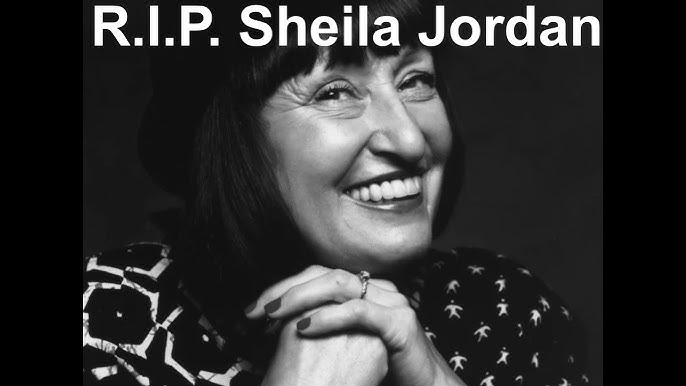
’24/7 Valencia’ were fortunate to see Sheila Jordan sing at ‘Jimmy Glass’ in Valencia at a very memorable jazz concert in the historic centre back in 2022. She was backed by just bass and piano and regaled us with a set of standards from her impressive back catalogue. Then aged 94, she was one for the few jazz singers still active on the touring circuit who had jammed with Charlie Parker and Mingus and Max Roach back in the 1940s and early 1950s. After the show, we were able to talk long into the night about her amazing life. Sheila Jordan passed away, this August, at the age of 96. “She was just listening to bebop and closed her eyes”, said a witness and close friend.
24/7 Valencia: You’ve had one of the most remarkable journeys in jazz. Can you tell us about your early life?
Sheila Jordan: I was born in Detroit but my father left my mother. She turned to the bottle and couldn’t cope bringing me up and so she sent me to live with my impoverished grandparents. Growing up in Summerhill, Pennsylvania I was a very unhappy little kid because of the harsh surroundings and everybody drank in the family. The poverty and the coalmines and the miners and the mine explosions. And then … my grandfather … he had the disease of alcoholism too. His generation were of native American descent. So, we were called “half-breeds”.There was a lot of prejudice back then. We were dirt-poor. I used to sing to keep myself happy, or connected I should say too. If the light bill wasn’t paid we didn’t get electricity… we didn’t have water inside… we didn’t have a toilet inside. We heated by a coal stove and wood stove. Years later, at age fourteen, I moved back to Detroit to live with my mother again. By then, she was still an alcoholic but coping a bit better with life.
Tell us about your love of jazz: I’ve had people who don’t know jazz say “oh, yes, but you really have to be intellectual.” I say: “Intellectual? Do you know where this music started? It started from slavery, from slaves brought over from Africa working in cotton fields for long hours in unhealthy conditions. And what did they do? They sang the blues, because of the pain.” I always identify with that because as a little kid there was so much pain in my life I sang all the time too. I tell that to people who call jazz intellectual. That’s where it started. It started with the blues. I grew up poor and looked down upon. I found that the Afro-American community in Detroit and New York welcomed me with open arms. I never felt excluded by them. There was a lot of prejudice back then. I was stopped many times by the cops just for being in the company of black musician friends in a car or on the street. It was a dangerous time to be in mixed company and there was lot of intolerance. Now, I walk down the streets of New York City and there are so many beautiful inter-racial couples with these beautiful little children and it’s so fantastic. It makes me feel so good to see that. People should be free to be with whoever they want.
What are your resounding memories of the legendary Charlie Parker? I remember standing at the jukebox as a teenager and put my nickel in and up came Bird and his Re-Boppers playing ‘Now’s The Time.’ I’ll never forget it. It changed my whole life. Bird came on and it was 4 or 5 notes in and Oh my god! My skin was crawling. I said “that’s the music I’ll dedicate my life to.” I would go and see Parker when I was a kid in Detroit. He’d bring me up on stage. Bird was always very supportive… he treated me like I was his little sister. When I sought him out after I had moved to New York, I asked if he remembered me from Detroit. “Sure,” Parker said, “you’re the kid with the million-dollar ears.” When I was living in New York as an adult, Bird would come up to my loft—I lived on 26th Street. I had a parakeet that I taught to say ‘Hello Bird.’ So Bird came up… and the bird jumped right on him and said, “Hello Bird”… Bird said, ‘What are you, a damn ventriloquist?!”
One time he came up to my loft with two LPs under his arm… Stravinsky’s ‘Rite of Spring’ and Bartók. He said, “You need to hear these.” He was educating me, musically…and not only with jazz. That said, Charlie and I would also listen to great jazz albums together many times in my loft. I remember one time Charlie Parker came up to my flat and he played a solo for one hour! He just took his horn out. Nobody was there to accompany him. He said “Can I play?” and I said “Yeah!” I’ll never forget that and I think to myself why didn’t I have a tape recorder at the time? Looking back, why didn’t I have a camera at the time? All these beautiful moments with Charlie Parker. He’s the reason I sing. He was my spiritual God you know!
As a young singer, I sat in with Charlie Parker and his band plenty of times. When I sang with Charlie Parker, we would do mostly ballads. It was the thrill of my life to sing songs like ‘Body and Soul’ whilst Charlie Parker took a solo with s saxophone on the bridge of the song! His pianist, Duke Jordan, was my husband. Bird was impressed that I was able to imitate his horn lines with my vocals! He was always very supportive and positive regarding my music. There was nothing romantic going on between us, I just loved him (Bird) and loved his music.
However, Bird’s addiction got the better of him as time went on. I was with Bird the night they wouldn’t let him into the Birdland! They wouldn’t let him in because of the way he was dressed. He was wearing a dirty T-shirt. He was hurt. He turned to me and said, “Can you believe they won’t let me into the club that’s named after me?” We went to an arcade after being turned away. Very sadly, Bird was on a downward spiral; he died just a few months later. He was only 34 years old. I still miss him.
Could you take us about your recording career: I recorded with George Russell on The Outer View, singing “You Are My Sunshine,” before releasing my debut album ‘Portrait of Sheila’ on Blue Note Records. Up until that time, Blue Note had a policy to hardly ever record jazz vocalists. So, I guess, Blue Note Records must have recognised my potential as a singer.
Your marriage with pianist Duke Jordan—Charlie Parker’s bandmate—was both intimate and challenging. Could you tell me about that period? I had become friends with Duke when he toured in Detroit and we kept in touch. After I moved to New York, the relationship became romantic and I started living with Duke Jordan in Brooklyn and we then got married. Bird used to play these “cocktail sips,” which were formal Sunday afternoon parties that the black community threw. Bird would play with Duke on piano. We were in love—or I thought we were. The problem for us was that Duke was addicted to heroin, which wasn’t good for a marriage or anything else. Even Charlie Parker was angry at him for getting so high. At our home, Bird once berated Duke: “Man, didn’t you learn anything from me?” it was the only time I ever saw Charlie Parker angry. Duke would leave me and come back when he pleased. After my daughter Tracey was born, he didn’t come back at all, which was terrible. I didn’t feel as though it was my responsibility to police his habit. To be honest, I really detached. I had seen my share of addiction growing up and wanted to pull away. I was naturally allergic to it. Our daughter, Tracey, became the emotional centre: I knew she “could truly love me” and “I was sure would love me back.” But once Duke left after Tracey’s birth, I had to carry on alone.
And what about Duke—why didn’t you work together musically? A lot of times when Duke was playing with Bird, Charlie Parker would ask me to sit in. … I didn’t get paid. It wasn’t a job… Bird would just say, ‘Come on, sing a couple of tunes. Sheila and Duke play.
Still, were there parts of Duke’s artistry you admired? Oh yeah, Duke Jordan was a very underrated piano player. Miles Davis didn’t take to him but Bird loved his piano playing. Nobody ever talks about Duke, or the incredible songs that he wrote and his incredible solos. His intros for Charlie Parker’s tunes are masterpieces as far as I’m concerned. … I’m grateful to him for two things. He gave me a beautiful daughter, and I love my last name… I kept my married name, Jordan, because I like it. I’m going to keep the Jordan name alive…
It sounds like you held down a day job for many years. I worked in an office as a secretary until I was 58 years old because I had a daughter to support. And all that time, I always found a place to sing. You support the music until it can support you. You find a way because the music is very important. Once or twice a week, I’d get a babysitter. I’d go and sing in this club, and then I’d get up the next morning and go do my day gig.
How did you become a full-time musician again? At my day job, my department was finally merged and I got laid off and was given a year’s pay. I was so upset. However, in the back of my mind there was a voice saying “This is what you have always wanted… the chance to be a full-time musician again! A little voice in my head also told me: “You’ve been complaining about not being able to sing full-time … now go sing and shut up”. So, I grabbed the bull by the horns and never looked back. There is a saying: “Be careful what you pray for. You might get it!”
Alongside performing, teaching has played an important role in your life. How did that journey begin? When City College of New York invited me to teach in 1978—even though I lacked formal credentials—the college that chose me told me: “You have a degree in life! Teach what you do.” And I was terrified the first day I went in to teach. But I was just very honest with the kids. I heard them sing, I gave them some constructive criticism. And it’s been a beautiful experience for me… I love to see young people out there keeping this music alive.
It just thrills me. I taught jazz vocal workshops at City College of New York from 1978 to 2005, seeing many generations of jazz singers grow. It was most satisfying. I often reminded my students how fortunate they were to have formal jazz education—something I lacked. My family didn’t have the resources to give me an education and studying jazz formally didn’t exist in my day either. The one wonderful thing about singers today is they have the advantage that I did not have growing up. You don’t know how lucky you kids are. You’ve got all of this out there for you. Take advantage of it! I taught from my heart.
The legendary Lennie Tristano coached you for 3 years…He was my mentor. Solos by Lester Young and Charlie Parker was a thing he taught us. Another thing he taught me was don’t try to sound like anybody else! You have your own story to tell. So, you tell your story and let it be that. Don’t try to imitate anybody else. For God’s sake I knew I couldn’t sing like Sarah Vaughan, she had the most glorious voice and I knew that I couldn’t scat like Ella Fitzgerald, the greatest scat singer in the world for me, and I knew I couldn’t sing like Billie Holiday, Billie’s depth and her story, so I realized that very early and I only sang me. I sang my story. Lennie Tristano is so underrated. Lennie was the first free player I ever heard. He was a great teacher, he was very encouraging. He didn’t yell at you, he did not break your spirit. He was a very special teacher. He just taught me, like Bird always said to me, to trust in who I am. Take constructive criticism but not to give up. That was Lennie. He was the best.
Sheila, your musical approach—including the voice-and-bass duets—has been truly distinctive. Can you tell us how you developed that style? I love the bass. It’s my favourite instrument. I am the creator of the bass-and-voice; I started doing it in the late ’40s, early ’50s. Everybody thought I was crazy, but I kept doing it because I loved it… and now there are several singers doing bass-and-voice, but I was doing it since back then.
You are in great voice and your recent albums are really cool too. What advice do you have for young singers in jazz? Emotions come first… have your own sound… dedication and believing in yourself is the key. Just be yourself and be humble. Another piece of advice would be… no smoking ! I quit smoking at fifty. I should have quit earlier. I don’t think smoking is good for singing. It’s not good for anything really. But an addiction is an addiction. I also gave up smoking because I wanted to preserve my voice! People tell me, I may not always have the higher range I once had, it depends, but I’ve obtained a lower range. These exercises (a voice coach taught me) I’m doing have helped me a tremendous amount. The other thing I do is I steam my nose twice a day and that helps too. I was also addicted to cocaine for some time until 1987 and alcohol for a period until 1978. I had a spiritual awakening. I hadn’t slept because I was snorting cocaine and getting high during a period of being a ‘dry drunk’. This voice came to me and said “I gave you a gift and if you don’t take care of it I’m going to take it away and give it to somebody else”. Joining Alcoholics Anonymous and doing rehab really helped me a lot.
Music saved me too. My influence comes from instrumentalists, mostly Charlie Parker… I learned to phrase from listening to his recordings. Once a musician asked me what the song was about… I told him – “Can’t you hear what I’m singing?” It’s important to have an understanding of the lyrics and their meaning in a song. It is my belief that lyrics are important.
Thank you for your time, Sheila.
Interview by ‘24/7 Valencia’ team
Article copyright ‘24/7 Valencia’
Sheila Jordan (Rest in Peace)
| Born | November 18, 1928 Detroit, Michigan, U.S. |
|---|---|
| Died | August 11, 2025 (aged 96) New York City, U.S. |
Related Post















Leave a comment