

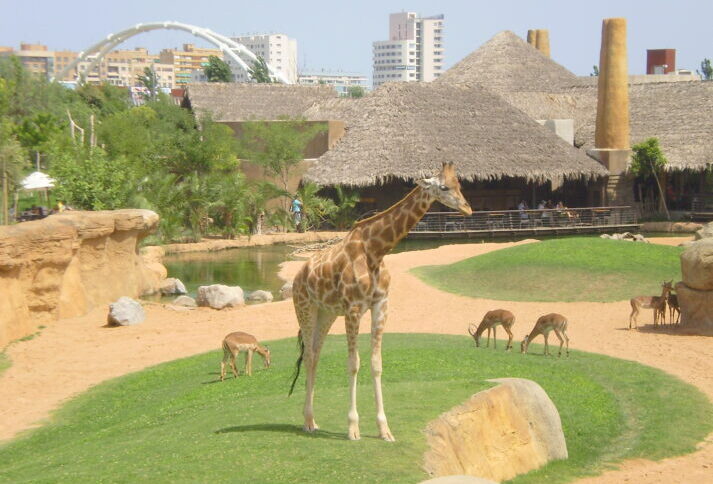

Bioparc Valencia opened in 2008 within the old Turia riverbed, replacing the outdated Viveros Zoo, and was designed and is managed by Rainforest Valencia in partnership with the City Council. Spanning over 10 hectares (100,000 m²), the park adopts a “zoo-immersion” philosophy, where visitors feel like they are part of the animals’ habitats due to seamless landscapes and hidden barriers created by rivers, ditches, rock formations, and vegetation. From the outset, Bioparc aimed for high credentials: receiving the Europa Nostra design award in 2009 and hosting the EAZA conference in 2019, during which it earned the title of Best Nature Park in Spain.
Ecosystems & Animal Exhibits
Bioparc is organized into four biomes replicating African habitats:
- African Savannah (Dry & Wet)
- Dry Savannah hosts rhinos, zebras, ostriches, hyenas.
- Wet Savannah incorporates giraffes, antelopes, gazelles, meerkats, plus lions against a backdrop of watering holes and streams.
- Equatorial Jungle
- Dense canopies house gorillas, chimpanzees, leopards, otters and large pythons, with multiple viewing depths and sensory experiences.
- Wetlands & Kitum Cave
- A recreated underground cave (modeled on Kenya’s Mount Elgon) showcases Spain’s only underwater hippo view, along with crocodiles and birdlife.
- Madagascar Island
- Lemurs roam freely and sometimes climb down to greet visitors; alongside ring-tailed lemurs, red-bellied mongoose and vari species; with enclosures for fossa, and displays on island biodiversity The resort also boasts one of Spain’s largest elephant groups, set amongst giant baobabs and waterfalls in the Baobab Forest. Significantly, Makena—the first elephant born in the Valencian Community—was born here in November 2022, thanks to European conservation breeding efforts. She was recently joined by a sibling, Malik, illustrating ongoing success in its ex situ programmes.
Conservation & Research
Bioparc’s primary mission is conservation, embracing both in situ and ex situ strategies through the BIOPARC Foundation. Highlights:
- European Endangered Species Programs (EEP/ESB): breeding gorillas, elephants, lemurs, bongos, musarañas (elephant shrews), dingoes, and more .
- Makena’s birth and the chimpanzee calf Cala, along with successful rhinoceros pairings, indicate robust captive breeding.
- International partnerships include a conservation MoU with Thailand, reinforcing best practices Ecological restoration efforts span vulture protection, bald ibis reintroduction through guided migration, native bat and gallipato amphibian projects, and roadside nesting boxes for bats Bioparc significantly reduced single-use plastics ahead of EU mandates and installed solar panels and water-recycling systems, enhancing sustainability
Education & Immersive Experience
Education is woven into the fabric of Bioparc’s design:
- The park is a “big open classroom” with outdoor interpretation zones, three interpretive centres, and two teaching rooms for guided school tours (from around €11 per student)
- Visitor experience is also enhanced through amphitheatre shows (1,000 seats), scheduled feedings, daily keeper talks, and interpretive signage.
This immersive environment evokes genuine emotions: one visitor blog described the adrenaline of feeling hyenas might leap across a barely visible stream—“I’ve never felt that in a zoo anywhere in the world.”
Visitor Logistics & Experience
- Opening hours: 10 AM–6 PM year‑round; extended to 8–9 PM Apr–Sept
- Admission: General admission – € 28,90-31,90
-
Reduced – € 22,60-25,00 ( Free for children under 4 years old)Facilities: Restaurants like Ndoki (weekends & holidays), snack bars, ice-cream stands, gift shops, a small cinema, terraces overlooking the savannah, plus clean restrooms and shaded seating
- Visitor flow: The suggested stay is 3–4 hours, though nature enthusiasts often plan a half-to-full day venturing—including picnic breaks and shows .
Upcoming Expansion: Silk Road Theme Park
In May 2025, Bioparc announced a €64 million expansion themed around the Silk Road.
- Phase 1 (2027 opening): recreates the African maritime route from Mombasa to Alexandria, adding new African species, large aviaries, and an aquarium.
- Phase 2: restoration of Valencian alquerías to host a silk worm breeding museum, themed zones inspired by Zanzibar, Ethiopia, Egypt (€20 m).
- Phase 3: Chinese Imperial Garden and VR/AR cultural experiences (€44 m), once permits are secured.
Projected to add 500,000 annual visitors, this expansion underscores Valencia’s global storytelling ambitions linking Africa, Asia, and the Mediterranean.
Socio‑Economic & Environmental Impact
- Visitor numbers: draws ~1.5 million annually, boosting local tourism.
- Economic multiplier: enhancing regional jobs, supporting restaurants, transport, lodging and education.
- Environmental outreach: drives public engagement through immersive, emotionally-driven politics—“leisure with a cause”.
Final Thoughts
Bioparc Valencia stands out as more than just a zoo: it’s a living, breathing stage of African biodiversity, where education, emotional connection, and rigorous conservation coalesce. From the birth of Makena and the rewilding of European species, to its pioneering immersive design and visionary expansion plans—Bioparc continues to redefine what modern, ethical wildlife sanctuaries can achieve.
Whether you’re a local, a traveller, or an environmental advocate, Bioparc offers an unforgettable journey: step into the wild, feel the rhythms of nature, and be inspired to act. A great day out for all the family.
Report by ‘24/7 Valencia’
Article copyright ‘24/7 Valencia’
More info in English: https://bioparcvalencia.es/en/




Leave a comment