


The Valencia Museum of Illusions (MoI) is a place where perspectives shift, eyes are tricked, and brains become dumbfounded by all there is to see. As I entered the MoI, my attention was drawn to the bright blue walls with contrasts of white everywhere, merely a hint at all the contrasts and colour theory experiments I was about to see. I was welcomed at the front desk and introduced to the concept of the museum, in summary: your brain is lazy, let’s try to trick it.
Immediately after I passed the front desk, I was confronted by “Fallera”, the face of a Falla woman whose eyes were cut out and pasted on the wall a couple of inches behind the façade. As I moved closer, to the right, or to the left, the eyes followed me, staring at me from wherever I stood. The staff member I was with explained that it was a trick with perspective and spatial reasoning, and that it was designed to make it seem as though Fallera was always watching.
Turning around, I saw what is called an Ambigram, which is where letters appear to change shape and conform to new letters depending on what angle you see them from. From the right side of the display, the letters read “illusion”, and from the left, they say “magic”. Switching positions is like watching the words assemble, disassemble, and reassemble right before your eyes.
Throughout the whole museum, between more notable exhibits, are smaller tricks of the eyes. They usually seem to be pictures of patterns, but when looked at closer, they seem to move in a wave, or to change colour depending on where you focus your eyes. At one point, the staff member asked me to count the number of black dots on a picture, but I couldn’t because every time I looked at what appeared to be a black dot, I realized it was white, and that my brain had tricked me into thinking it was black.
Next, I went into the Dark Room. This room was painted black and had very dim light, specifically for one exhibit. It looked like a pentagonal die, but much larger, and when you looked in, it appeared to go on forever. I didn’t see my reflection, so I had to ask the staff member how in the world this exhibit worked. She explained that this was a hexagon made of unidirectional perspective glass, which has one side that you can look into, and one side that is a mirror. As I looked in, all I could see was the reflections of the other glass. I looked as far as the image and my eyes could go, and the reflections began to take on a greenish look. The staff member explained that the green tint was due to the colour of the crystal that was used to create the mirrors. Duly impressed, I moved on to the reverse room.
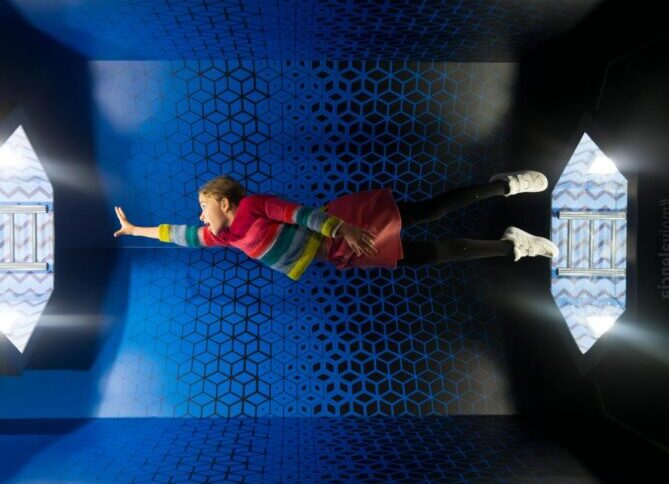
The reverse room is a space with furniture, wallpaper, and a table, but all of it is upside down. The idea is to take a picture as you hang from the top of a chair, which is attached to the ceiling, and when you turn the picture upside down, you look like you’re doing a handstand on the chair. I learned that this, and several other exhibits, show techniques used on film sets to create the illusion of being upside down, or smaller than someone who’s the same height as you, or like you are in a tunnel that’s rotating while you stand still. Each optical illusion is both fun and fascinating, as each has a purpose but also delights the senses.
In the next exhibit, I saw a straight metal bar next to a piece of hard plastic with a curve cut out of it. Of course, my mind said that you would have to bend the straight metal rod in order to fit it through the cut out section, but as I turned the plate that the rod was on, the angle it was on made it fit perfectly through.
Another visual distortion piece was an exhibit with three circles, each with a different pattern. As you turned them, they would trick your brain into thinking that certain parts had become 3D, or, if you looked down at your hand when you finished watching one of them, it made your hand seem to be shrinking. The staff member said that everything was dependent on contrast and context, which could trick your eyes and brain into thinking that something that appeared one way, was actually another thing entirely.
At the end of the exhibits was a room full of brain games. There were puzzles and pentominoes and a big wooden table with moving pieces on it. Depending on which game you were playing, the staff member said it could take hours to figure out the answer.
As I finished up my visit, I spoke with one of the managers about the MoI. He explained that Valencia’s MoI is one of about 55 Museums of Illusion around the world in all different countries. They offer “edutainment”: part education and part entertainment. Whether it’s a field trip or a corporate event, the MoI is happy to host and show visitors that everything is not always as it seems, and there’s a lot of fun in that.
To plan your trip to the MoI, go to their website here
Report by Fiona Pacious
Article copyright ‘24/7 Valencia’
MUSEUM OF ILLUSIONS VALENCIA
C/ de Guillem de Castro, 13,
Extramurs
46007
Monday to Thursday, 10:00 AM to 9:00 PM
· Friday and Saturday, from 10:00 a.m. to 10:00 p.m.
· Sunday, from 10:00 a.m. to 9:00 p.m.
Book your tickets on the website: https://moivalencia.es/contacto

















Leave a comment