

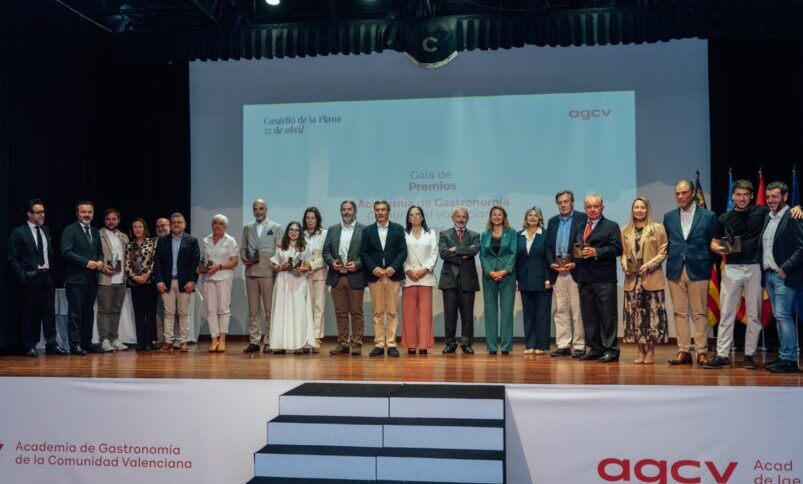
The institution presented up to ten awards, including three new categories, distributed throughout the Comunitat and in very different areas. Manu Yarza receives the Chef of the Year award, Jorge Lengua stands out as Young Talent, Francesca Baccon excels in the Dining Room and Yelko Suárez, in wine. Products such as truffles and cheeses from Castellón shine, in an edition that also values the Gastronomic Research of the Gastroterra Project. Institutional representatives and renowned chefs —Ricard Camarena, Quique Dacosta or Miguel Barrera— were included among the more than 400 guests gathered at the Gran Casino del Grau de Castelló.
Castelló, April 27, 2026. More than 400 people have gathered to celebrate the Gala of the Awards of the Academy of Gastronomy of the Valencian Community which, once again, highlights projects that contribute to the evolution of the sector. The awards ceremony has brought together authorities, producers, renowned chefs, dining room staff, academics, businessmen and agents of Valencian society in its diversity. In the last year, the academics have worked intensely to find and reason about projects related, especially, to local producers, young talent and gastronomic research, cornerstones of the new stage that the institution is going through.
Renowned chefs such as Quique Dacosta, Ricard Camarena, Lluís Valls, Begoña Rodrigo, Vicente Rioja, Pablo Montoro, José Vicente Pérez, Susi Díaz, Vicky Sevilla, Carito Lourenço or Carolina Álvarez, among many others, attended the gala. Also noteworthy was the presence of Cuchilla Lluch, member of the Royal Academy of Gastronomy, accompanied by her husband, the actor Juan Echanove.
The celebration of the gala has served to communicate, during the awards ceremony, a renewed roadmap. This can be seen not only in the format of the gala itself, focused on putting the spotlight on collective projects in diverse fields, but also in the categories of the awards. The institution, chaired by Sergio Terol, has decided to incorporate three new awards: Best Agri-Food Product, Best Elaborated Product and Gastronomic Research. In addition, the Emerging Talent award is renamed Young Talent. “The priority is to give space to the new generations and to those young projects that revitalize the sector,” explains Sergio Terol, who faces his first awards ceremony as president of the organization.
Thus, the list of winners includes the following:
Best Agri-Food Product Award (*NEW) – Truffle from Castellón
For having become one of the most unique products of the interior of the CV, boosting the rural economy and positioning the territory in haute cuisine.
Best Elaborated Product Award (*NEW) – Cheese from Castellón. Because they represent an exemplary recovery of livestock knowledge and traditional techniques, adapted to contemporary quality standards.
Gastronomic Research Award (*NEW) – Gastroterra Project. An initiative that articulates scientific knowledge, territory and gastronomy, researching and providing new technologies for sustainable development.
Chef of the Year Award – Manu Yarza (Yarza, Valencia) The chef develops a cuisine of product, rooted in tradition and refined with contemporary sensibility. His proposal reinforces the value of the local recipe book, from a personal and coherent perspective.
Best Dining Room Manager Award – Francesca Baccon (Quique Dacosta, Dénia). At only 26 years old, she leads the dining room of the Three Michelin Star Quique Dacosta. Without ever losing her welcoming smile, she turns the service into a precise and emotional choreography. Her example instills pride and respect in the profession of waiter.
Young Talent Award – Jorge Lengua (Llavor and La Suculenta, Castellón) The chef embodies a new generation that reinterprets the Valencian recipe book from a contemporary sensibility. He has been demonstrating this since his beginnings at La Suculenta and now, with the recently awarded Michelin star at Llavor.
Lifetime Achievement Award – Maipi (Valencia) Founded by a couple who made local and proximity cuisine their hallmark, this restaurant elevates the essence of the bar to excellence. Loyal clientele and a hospitable model ensure that its trajectory endures with Germán and Carito.
Wine World Award – Yelko Suárez (Arrels, Sagunto) His explanations and recommendations, didactic and accurate, connect the territory with the experience. From Arrels he promotes a wise oenological proposal, coherent with the Mediterranean wine landscape, as well as international.
Gastronomic Communication Award – Ediciones Plaza The publishing group, one of the leaders in economic and cultural information, has consolidated a line that dignifies and makes visible the gastronomic ecosystem.
Special Recognition – Alicante Gastronomic City. First city in the Valencian Community to have been recognized as the Gastronomic Capital of Spain. The Academy values its sustained strategy of gastronomic promotion, through the axes of product, hospitality and tourism.
As can be seen in the reasoning behind the awards, the territory, the local pantry and research are key in the new project of the Academy of Gastronomy, which wants to promote training, collaborating with young talents and helping them from the ground up. Following this new direction, the academics work daily, with the aim of turning the institution into a tool for action in the restaurant sector, but also in the agri-food sector, of the autonomous community. In this sense, Sergio Terol starts from a fundamental idea: “To understand gastronomy as a cultural fact. This implies going beyond the restaurant to also work in the primary sector and markets, with direct action in areas such as training, research and outreach.”
A Choral Act Focused on Castellón’s Pantry
The guests gathered at the Gran Casino del Grau in Castelló were able to appreciate the elegance and care of an event that highlighted the qualities of the gastronomy of the Comunitat, with a special focus on the province of Castellón. After the customary welcome, the president of the AGCV, Sergio Terol, gave his speech, emphasizing the “defense and appreciation of our local product, the determined impulse to training and the transmission of knowledge. We work to ensure that gastronomy continues to be a reason to get together, a source of shared happiness. That is what the Academia works on: studying, teaching and promoting.”
Next, the Mayor of the city, Begoña Carrasco, acknowledged that it is “a great source of pride to see so many familiar faces, Repsol Suns or Michelin Stars, part of the best gastronomy in the world. Gastronomy is synonymous with future and well-being. We want to promote gastronomic tourism in Castellón, and hosting this great gala here helps us to do so.” Afterwards, the aforementioned awards were presented, with the academics explaining the reasons for their choice, and the academics were also present. At the end of the awards ceremony, the Academia presented its new corporate image, which was led by the vice president of the institution, Carlos Pujadas. After the last special recognition, aimed at Alicante Gastronomic City, the President of Les Corts Valencianes, María de los Llanos Massó, delivered the closing speech, in which she stressed that the Comunitat has “enormous gastronomic potential. We have to take care of and protect the agri-food product, as well as support the hands that devise and prepare each dish. And, of course, protect this heritage.”
The celebration of the gala in Castellón had as its main argument to project the city as a gastronomic territory in the Comunitat Valenciana as a whole. This reinforces the role of its producers, chefs and entities, which are ambassadors of a diverse, sustainable landscape, deeply linked to its food culture. After the awards ceremony, the attendees enjoyed a grand gastronomic cocktail, conceived as a tour of the province, through its products, elaborations and landscapes.
Among the participants, representative projects from different areas of the Castellón pantry such as Bodega Flors (Les Useres), Vermut Padre, Jamones Alfredo de Todolella, Quesos de Almedíjar together with the Association of Artisans of the Comunitat Valenciana, the new Association of AOVEs of Castellón —which groups nine producers from all over the province—, Trufas Martínez de Valencia, Mar Negre handmade chocolates from Albocàsser or honey from natural landscapes of Castelló, Mos de Bresca. The gastronomic section also included the involvement of training centers, such as the COSDA school, which prepared rice dishes; GASMA, with R&D proposals; and the Benicarló School, which worked with the DO Benicarló artichoke.
They were joined by restaurants such as La Suculenta or Reviscolem El Ring (Cinctorres), with a contemporary reinterpretation of olleta in panipuri format; also the Vila-real Gastronomic Association, with the traditional olleta de la Plana in a clay pot; or the Arre restaurant, which together with the Fishermen’s Association set out to bring the sea of Castellón closer to the event. In addition, the Hunting Federation of the Comunitat Valenciana participated for the first time in a meeting of these characteristics, highlighting the relevance of game cuisine, in collaboration with chef Ángela Milián, from Vinatea.
New Identity, New Challenges
The new identity of the academics, presented during the gala, starts from an idea of evolution: modernity, contemporary language and an expanded vision of gastronomy. That is why it uses the acronym ‘agcv’ and the color orange as a visual axis, as it is closely linked to the Valencian imaginary and the oranges of the orchard. The institution has also announced its new website, more informative and educational, within this change. However, the transformation is not just in the image, but goes down to the foundations.
In order to also grow in economic structure and sustain more ambitious long-term projects, the Academia has obtained the registration of the process that will allow it to advance in its recognition as a public law corporation, with good acceptance by the Administration. In short, the celebration of these awards is the starting point of the aforementioned new lines of work that the academics have ahead of them, acting as a tool for action in the gastronomic field, and emerging as a speaker for young projects and defenders of the local pantry.
“Gastronomy is a tool to preserve the idiosyncrasy that characterizes us, as well as a way to protect the landscape and the relationships that sustain it,” concluded Sergio Terol, as spokesman for the Academia de Gastronomía de la Comunidad Valenciana. Because, as they reiterate from the institution, “eating is not just nourishing ourselves. It is sharing, transmitting knowledge and building identity. And in that sense, the Academia wants to be a space that connects tradition and contemporaneity from culture.”
Report by ’24/7 Valencia’ team
Article copyright ’24/7 Valencia’
ABOUT THE ACADEMIA DE GASTRONOMÍA DE LA COMUNIDAD VALENCIANA
The AGCV is an independent institution dedicated to the promotion and dissemination of the gastronomic culture of the territory. Integrated into the national network of academies, its work focuses on recognizing the work of professionals in the sector, as well as highlighting the product, the landscape, and the traditions that make up the culinary identity of the Valencian Community.
MORE ABOUT THE AGCV:
Web: www.agcv.es
Facebook: www.facebook.com/academiadegastronomiadelacomunidadvalenciana
Instagram: www.instagram.com/agcv_academiadegastronomiacv
















Leave a comment