

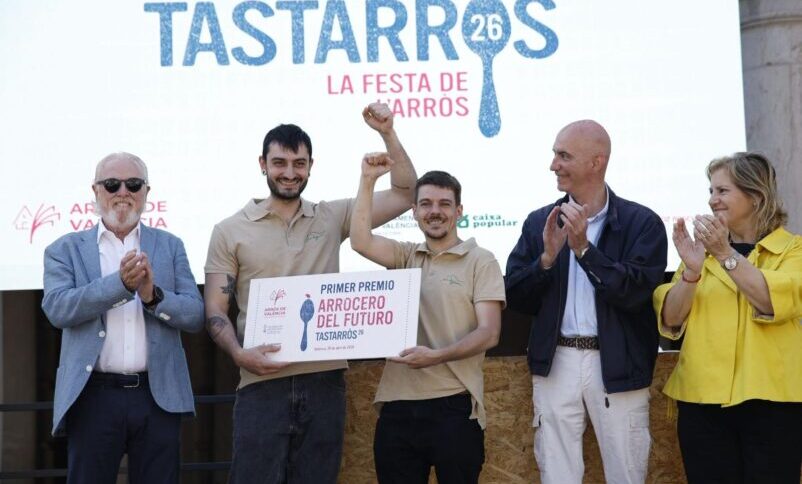
In its 9th edition, Tastarròs once again filled the Valencia City Hall square (Plaza Ayuntamiento) with its popular rice festival; the more than 50 participating restaurants from Valencia and the surrounding regions offered servings of traditional and avant-garde rice dishes to the more than 42,000 people who came to this space, which was visited by great personalities of gastronomy such as Quique Dacosta, Begoña Rodrigo, and Bernd Knofler. Néstor López and Carlos Monge, from the Fisgón restaurant in Madrid, won the title of ‘Rice Grower of the Future’ thanks to their paella recipe with nods to Extremadura that has been with them in their restaurant since its opening; this competition recognizes the chef under 40 years of age who cooks the best rice recipe made with one of the three varieties of rice protected by the D.O. (Protected Designation of Origin): senia, bomba, or albufera.
TastArròs concludes its ninth edition with record numbers, demonstrating its overwhelming success. A multitude of people came to the Valencia City Hall square throughout the weekend to enjoy this popular festival and learn about the age-old rice-growing tradition. In figures, the more than 50 participating restaurants have offered rice dishes throughout the weekend for the more than 42,000 visitors. From 12:00 noon to approximately 5:00 p.m., they prepared traditional and contemporary recipes live, made with varieties protected by the D.O. Arròs de València, which could be tasted for five euros. Organized by the D.O. Arròs de València, with the collaboration of the European programme EU Rice, the Conselleria de Agricultura, Ganadería y Pesca (Regional Ministry of Agriculture, Livestock and Fisheries), and the Valencia City Council, TastArròs demonstrates once again what this product means for all the locals at a social, cultural, and gastronomic level.
With an extensive programme designed for all audiences, the event once again surprised and delighted those who came to the central square this weekend. Although the rice tasting has been the great attraction of the event, the most anticipated moment arrived with the celebration of the ‘Rice Grower of the Future 2026’ competition, which took place this Sunday. In this edition, the winners were Néstor López and Carlos Monge, from the Fisgón restaurant in Madrid, with their daring proposal of rice with Extremaduran hints with pestorejo (the pig’s face, which is made up of the snout, cheek, and ear) and which is one of their best-selling dishes in the restaurant. In addition to winning the title, they received a cash prize of 1,000 euros.
In their deliberation, the judges valued the creativity of the recipes that the contestants cooked live in the square amid great displays of support. The jury was headed by Cuchita Lluch, with the presence of the Michelin-starred Begoña Rodrigo and Bernd Knofler, as well as Vicente Patiño (from the classic Saiti) and composed of some of the best professionals in gastronomic journalism, joined by the innovative businessman Rafael Muñoz from Muñoz Bosch. This year there were ten finalists in the competition, selected from many applicants from all over the country, who sent their recipes to the TastArròs organization. The Rice Grower of the Future podium was completed by Miguel Calaforra from Socarrat (Lanzarote) and José Cifre from Noble (Valencia). The following chefs aspired to the prize:
Rafael Cuellar from AmordeMadrid (Madrid)
Marta Martíenz from La Vega (Ossa de Montiel de Albacete)
Andrés Rengel from Nostre (Valencia)
Héctor Alvarez from L’ Albufera (Madrid)
Nico Ionita from El Nour Chaparral (Serra)
Cristóbal Bouchet from Forja (Valencia)
Vicente Carbonell from Tu Arrocero (Valencia)
GASTRONOMY AND TRADITION
TastArròs is the largest showcase of rice culture. People who have set foot in this space this Saturday and Sunday have been able to enjoy different versions of the most popular dish in Valencian gastronomy. A Roig Viu, (Albaida, Valencia), from chef Arturo Roig; Portolito Centro (Valencia), from Carlos Tubis; Llisa Negra (Valencia), from Ana Llop; Flores Raras (Quique Dacosta’s two-star restaurant in Valencia), from chef Carolina Álvarez; Restaurante Rioja (Benisanó), from Vicente Rioja; Manu Yarza from Yarza; Amarre 29 (Port de Sagunt), from chef Víctor Aliaga; La Tavernaire (Valencia), from Silvia Ruano; Tu Arrocero (Valencia), from the Portolés Brothers, or Setaygues Gambrinus (Valencia), from Voro and Teresa are some of the restaurants that have participated with a stand in the 2026 edition.
Beyond the rice tasting and the ‘Rice Grower of the Future’ competition, various activities also took place this Sunday. On the Tastarròs T’ensenya stage, several chefs with an avant-garde spirit shared their research and new ways of understanding rice. Visitors were also able to get closer to the traditional world of fishing with the exhibition ‘Peixca a l’Albufera’, and there was a new call for the ‘Llaurador més ràpid de l’Albufera’ (Fastest Farmer of l’Albufera), a fun competition that invites people to experience what it is like to become a farmer for a moment, following the advice of local experts. Likewise, the family workshop was held at the Rice Museum stand, and there was a parade of giants and big-heads. There was also space for international awareness of rice culture, thanks to Eu Rice, a program promoted by the Asociación Empresarial Agrícola de Salónica (Agricultural Business Association of Thessaloniki) and the D.O. Arroz de Valencia, with the support of the European Union; its objective is to promote sustainable, safe, and traceable rice cultivation that complies with strict quality and environmental standards. At their stand, visitors were able to learn more in depth about the biodiversity and natural wealth of the Albufera. Xavi de Bétera’s concert set the pace for the end of the day. A festive farewell to a weekend in which rice becomes, once again, a symbol of identity, tradition, and shared creativity.
ABOUT D.O. ARRÒS DE VALÈNCIA
The Regulatory Council of the Designation of Origin Arroz de Valencia was founded in 1998 as an entity composed of professionals from the sector that protects the guarantee framework of Valencia rice. It is an ancestral crop linked to the territory that ensures strict compliance in each of the stages of production and processing of the cereal. The Designation of Origin Arroz de Valencia protects three varieties of rice: senia, bomba, and albufera, which are the best adapted to the cultivation area of La Albufera and to the traditional rice recipe book, typical of the Levante area. Its ability to conduct flavour is highly appreciated among restaurant professionals and the end consumer. The D.O. Arròs de València highlights not only the economic and cultural importance of rice, but also its critical relevance in the viability of the wetlands in which the rice fields are located. These crops are ecosystems of great importance, since they guarantee the water flow that makes life possible in the wetlands and extends the presence of the water sheet during the months in which it is scarce. The cultivation of rice in the Valencian Community is the oldest in Spain — dating back to the first years of Muslim occupation in the region — and uses varieties that result from improvement work that began in the first decade of the 20th century. These varieties have managed to adapt their characteristics to the cycle and the climate and result in a raw material of exceptional gastronomic quality. The D.O. covers rice fields located in Alicante, Valencia, and Castellón, although in a very high percentage (more than 90%) its cultivation is concentrated in the Albufera Natural Park, a wetland of international importance. The fact that this natural space with unique characteristics is in good condition for its fauna and flora depends directly on the maintenance of the rice fields and on the promotion of techniques and practices aligned with environmental sustainability.
Report by ’24/7 Valencia’ team
Article copyright ’24/7 Valencia’
Related Post














Leave a comment