

When people think of markets in Valencia, they often picture the city’s larger, more iconic spaces filled with history and architectural detail. But some of the most meaningful places are not the most famous ones. In the quieter streets of the Extramurs district, ‘Mercado Rojas Clemente’ offers something more understated: a market defined not by spectacle, but by repetition, familiarity, and everyday rhythm.
Open Monday to Saturday from 7:30 AM to 3:00 PM, it operates within a narrow morning window that shapes its entire character. People don’t just come here to shop; they move through a routine. The same faces appear, the same greetings are exchanged, and over time those small repetitions turn the market into something that feels embedded in the neighbourhood rather than separate from it.
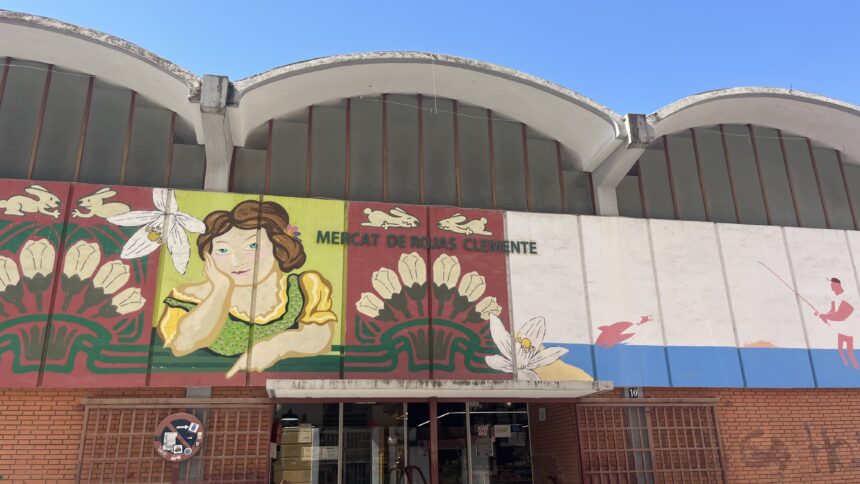
Visually, it breaks from expectation. Instead of the traditional facades associated with Spanish markets, its exterior is covered in bold street art and graffiti. The building feels less like a formal structure and more like an extension of the neighborhood’s creative identity, reflecting a Valencia where tradition and contemporary expression exist side by side.
Inside, the pace shifts immediately. The atmosphere is quieter, more personal, and shaped less by movement than by recognition. One stall owner, Roberto from RADIX, describes it as something that exists beyond commerce: “It is still a market that is deeply connected to the everyday life of the neighborhood… a close relationship between shopkeepers and neighbours, people who have known each other for years, and a way of buying based on conversation, trust, and human interaction”. That sense of familiarity is what holds the space together. Even as the city around it continues to change, the market operates through relationships that build slowly over time rather than transactions that begin and end at the counter.
Roberto is also clear that its value doesn’t come from scale or appearance: “It is not a particularly large market, nor is it especially spectacular from an architectural point of view. Its value lies in the people who bring it to life every day”. What matters here is not form, but continuity. The fact that it keeps functioning through everyday presence and routine. That continuity becomes most evident in how interactions unfold. What begins as a simple exchange often shifts over time. At first, people arrive with a clear intent, moving quickly through their grocery list. But as visits repeat, the rhythm changes. Conversations begin to appear naturally, and space gradually becomes more social than transactional.
From that point, the market expands beyond food. People begin sharing fragments of their lives, whether family traditions, travel or memories connected to cooking and eating. These exchanges are unplanned, but they reshape the atmosphere, turning everyday buying into something more layered and human. What makes this dynamic distinctive is that it doesn’t come from change, but from repetition. The same encounters, repeated over time, create familiarity. And familiarity slowly opens space for openness to new products, recommendations, and ways of engaging with food. This is where the market’s identity becomes clear. It is not simply a place of consumption, but a place where recognition builds gradually. People are not passing through; they are returning, remembering, and becoming part of a shared rhythm that accumulates quietly over time.
That rhythm also points to what would be lost if spaces like this disappeared. In a city increasingly shaped by speed and convenience, markets like this represent a different structure, one built on presence rather than efficiency. As Roberto puts it, “I believe a neighbourhood would lose much more than just a place to shop. It would lose part of its identity”. Markets, in his view, are not just retail spaces but social ones, places where generations overlap, people recognize one another, and conversation still exists as part of everyday life. Unlike supermarkets, where interaction is minimal and movement is purely functional, here there is still space to pause, to ask, and to connect. That difference is what gives the market its meaning. It is not about resisting modern life, but about preserving a slower rhythm within it.
Ultimately, Mercado Rojas Clemente stands out not because it tries to define itself, but because it doesn’t need to. It continues through ordinary repetition through return, routine, and recognition. And in that quiet consistency, it reflects a version of the city that often goes unnoticed: one built not on landmarks, but on everyday life.
Report by Lilly Salvador
Article copyright ‘24/7 Valencia’
Photos copyright Lilly Salvador/ ’24/7 Valencia’
MERCADO ROJAS CLEMENTE
Pl. de Rojas Clemente
Extramurs
46008
Valencia
https://www.instagram.com/mercado_rojasclemente/
https://www.facebook.com/mercadorojasclemente/?locale=es_ES
Hours:
| Thursday | 7:30 am–3 pm |
| Friday | 7:30 am–3 pm |
| Saturday | 7:30 am–3 pm |
| Sunday | Closed |
| Monday | 7:30 am–2:30 pm |
| Tuesday | 7:30 am–2:30 pm |
| Wednesday | 7:30 am–2:30 pm |














Leave a comment