

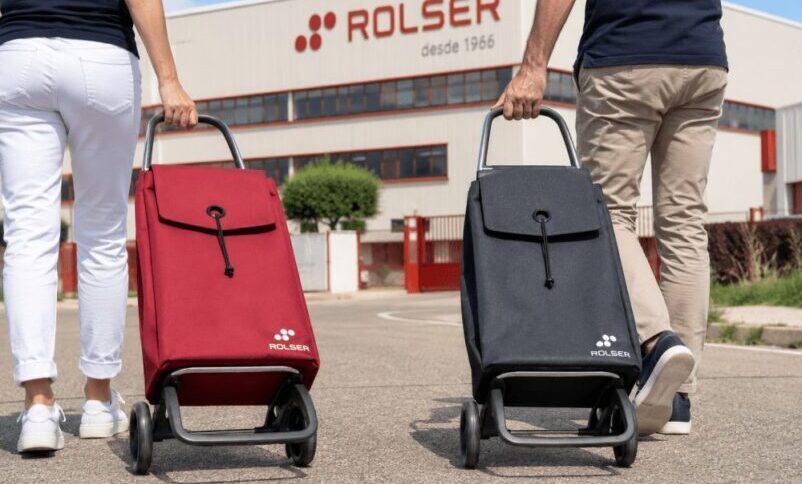
Think of the humble shopping trolley and you might picture a supermarket in Britain, a little old lady negotiating the streets of Valencia, or perhaps your own grandmother pulling one home from the market. But what if one of the companies that helped transform this everyday object into the stylish, practical trolley we know today was born right here in the Valencian Community?
Welcome to Rolser, a remarkable family business from Pedreguer in Alicante, whose story began not with shopping trolleys, but with palm baskets, handbags and hats.
And, as is so often the case with great inventions, it was a simple idea that changed everything.
FROM RAISINS TO SHOPPING TROLLEYS
The story begins in 1966, when Vicente Server Ferrer and his wife, Isabel Pérez Costa, started a small family business in Pedreguer making handbags, baskets and other products using traditional materials.
It was hardly the obvious starting point for an international company.
The couple had originally been involved in the area’s traditional raisin industry, but the decline of that business forced them to look for another way of making a living. Pedreguer already had a strong tradition of working with palm and other natural materials, so the family turned to manufacturing baskets, bags and hats.
Then came the 1970s – and a revolution in the way people shopped.
THE SUPERMARKET CHANGED EVERYTHING
Until the arrival of modern self-service supermarkets, shopping was a very different experience.
You went into a shop, told the shopkeeper what you wanted, and the shopkeeper fetched it.
Then came self-service.
Suddenly, shoppers were expected to walk around a supermarket, select their own products and somehow carry everything to the checkout.
According to accounts of Rolser’s history, the Austrian supermarket chain SPAR, which was expanding in Spain around 1971, approached the Pedreguer company looking for something that would make this new style of shopping easier.
The solution was wonderfully simple.
Take a bag. Put it on a frame. Add wheels.
And in 1972, Rolser’s first shopping trolley was born.
It was an idea that would eventually become extraordinarily familiar.
SO, DID ROLSER REALLY INVENT THE SHOPPING TROLLEY?
Well… yes and no.
This is where the story becomes particularly interesting.
Rolser did not invent the supermarket’s large metal shopping cart – the kind you push around inside a hypermarket. That is generally credited to American inventor Sylvan Goldman, who developed the modern supermarket shopping cart in the 1930s.
Rolser’s achievement was different.
The Pedreguer company took the traditional shopping bag and transformed it into a portable, wheeled personal shopping trolley – essentially the ancestor of the familiar Spanish carrito de la compra.
And rather than claiming to have invented every wheeled shopping device, Rolser’s own history describes its achievement more specifically: in 1972 it attached a chassis and wheels to its fabric bags and created its first shopping trolley.
That distinction actually makes the story more interesting.
Rolser didn’t invent the wheel.
It found a brilliant new use for one.
FROM THREE MODELS TO AN INTERNATIONAL BRAND
The Server family realised that they had stumbled across something potentially much bigger than a one-off order.
In 1972, Rolser produced its first catalogue, featuring models with wonderfully human names such as Isabel, Mari, Fany and Líder. Major companies including SPAR and the Spanish department-store giant Galerías Preciados soon began placing orders.
The family subsequently concentrated increasingly on the trolley business.
And the name?
ROL + SER.
The first three letters come from the English verb to roll, while Ser comes from the Server family surname.
It is a small detail, but a wonderfully appropriate name for a company whose entire future was about making things roll.
THE TROLLEY THAT BECAME A HANDBAG
Rolser wasn’t content simply to put wheels on a bag.
The company became obsessed with making the idea better.
In 1975, it launched the Plegamatic, an ingenious design that could transform from a spacious shopping trolley into a handbag.
This was decades before words such as multifunctional, space-saving design and urban mobility became marketing buzzwords.
Rolser was already doing it.
The company developed numerous innovations involving folding mechanisms, materials and transport systems, eventually building a reputation not simply for making shopping trolleys, but for reinventing them.
AND THEN VALENCIA STARTED TO ROLL
There is something particularly appropriate about Rolser’s success in the Valencian Community.
Walk through a traditional Valencian neighbourhood and you will quickly discover that the shopping trolley is not merely a piece of equipment.
It is part of daily life.
You see them heading towards the mercado, crossing pavements, waiting at pedestrian crossings and being pulled home with the day’s fruit, vegetables, bread and other essentials.
In fact, the shopping trolley has become almost a piece of street furniture – and an unofficial symbol of traditional Mediterranean shopping.
Rather than loading everything into a car, many people still walk to their local market or supermarket and bring the groceries home on wheels.
And remarkably, many of those wheels can be traced back to a factory in Pedreguer.
A FAMILY BUSINESS THAT REFUSED TO LEAVE HOME
Perhaps the most impressive part of the Rolser story is what happened next.
The company began exporting in 1980, initially opening markets in countries including France, the United Kingdom, Portugal and Belgium.
Today, Rolser remains headquartered and manufacturing in Pedreguer.
Its principal factory covers more than 21,000 square metres, and the company continues to manufacture shopping trolleys alongside bags, ironing boards and ladders.
The family connection has also continued through successive generations.
Mireia Server is now CEO, representing the third generation of the family business.
That makes Rolser a rather unusual Valencian success story: an internationally recognised manufacturer that never abandoned the town where it began.
FROM ‘GRANNY TROLLEY’ TO DESIGN OBJECT
For years, the shopping trolley had something of an image problem.
It was associated with grandmothers, pensioners and the weekly trip to the market.
But Rolser has spent years attempting to change that perception.
Modern models come in different shapes, colours and materials, with folding systems, insulated compartments, multiple wheels and designs intended to make them easier to manoeuvre.
The company has increasingly positioned its products around design, mobility, sustainability and everyday convenience.
And it isn’t stopping there.
In 2024, Rolser unveiled its T-Shop, a trolley that can transform into a backpack and is designed to meet cabin-luggage dimensions for air travel.
In 2026, the company also attracted attention for a radically different idea: a shopping trolley that can double as a walking aid, based on a design developed by Dani Redondo, a product-design student at Valencia’s EASD. Rolser acquired the idea and was studying its potential manufacture.
So, the little trolley that started as a solution to carrying groceries is still evolving.
MORE THAN A SHOPPING TROLLEY
There is another fascinating side to Rolser.
The company has become deeply connected to the social and cultural life of Pedreguer.
Its own foundation, the Rolser Server i Pérez Foundation, has supported cultural and social projects, while the company sponsors local sporting organisations and Valencian pilota initiatives.
It has also invested in sustainability, with the company stating that it recycles and reuses surplus materials from production. Pedreguer’s town hall has highlighted Rolser’s use of ecological and sustainable materials and its reuse of manufacturing waste.
This is a long way from the family’s beginnings making palm baskets.
THE NEXT TIME YOU SEE ONE…
So the next time you see somebody pulling a shopping trolley along a Valencia pavement, don’t dismiss it as old-fashioned.
You are looking at a surprisingly sophisticated piece of design history.
And if it happens to be a Rolser, there is an even better story behind it.
More than half a century ago, in a small town in the Marina Alta, a family that had already been forced to reinvent itself looked at a humble bag and asked a wonderfully simple question:
What if we put wheels on it?
That little idea, born in Pedreguer in the early 1970s, helped create an object that has become part of everyday life across Spain and far beyond.
From palm baskets to international exports.
From the traditional market to the modern supermarket.
From grandma’s trolley to designer urban mobility.
Rolser has been rolling with the times for more than 50 years – and the remarkable thing is that it is still rolling.
DID YOU KNOW?
- Rolser began in Pedreguer in 1966.
- The first Rolser shopping trolley appeared in 1972.
- SPAR was among the companies involved in the early development of the trolley.
- Galerías Preciados was one of the early major customers.
- The name ROL-SER combines “roll” with the Server family name.
- Rolser launched the innovative Plegamatic in 1975.
- The company began international expansion in 1980.
- Its main manufacturing plant remains in Pedreguer, Alicante.
- Today the company sells products internationally and continues to develop new forms of personal shopping and transport.
So, perhaps Valencia really does have a claim to being the place where shopping learned to roll.
Report by ‘24/7 Valencia’ team
Article copyright 24/7 Valencia
Photo copyright ’24/7 Valencia’









Leave a comment