

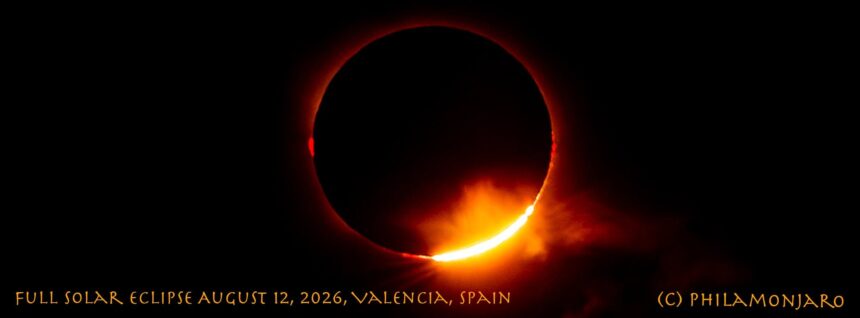

Valencia witnessed one of the most extraordinary evenings in recent Spanish history on Wednesday 12 August, as the Moon passed directly in front of the Sun and briefly transformed the city and surrounding region into an enormous open-air observatory. For months, anticipation had been building. By Wednesday evening, the excitement was tangible, with residents, tourists, families, amateur astronomers and professional photographers all looking for the perfect place from which to experience an event that had not been visible from the Iberian Peninsula in more than a century.
And Valencia had an important advantage: a wide, open horizon.
The countdown began
In the city of Valencia, the eclipse began at approximately 7:38pm, with the Moon gradually moving across the Sun. The most dramatic moment arrived at around 8:33pm, when the eclipse reached maximum and totality lasted for approximately one minute. The entire event continued until shortly after 9pm.
The timing, however, presented a particular challenge. The Sun was extremely low in the western sky, meaning that anyone hoping to experience totality needed an unobstructed view towards the horizon. Buildings, trees and even relatively modest rises in the landscape could potentially spoil the moment.
This was why the beaches, open agricultural areas and elevated viewpoints became particularly attractive.
Malvarrosa becomes an astronomical theatre
One of the most popular locations was Malvarrosa Beach, where thousands gathered to watch the sky.
People arrived carrying folding chairs, towels, picnic bags, cameras and, most importantly, certified eclipse glasses. What might normally have been an ordinary August evening beside the Mediterranean became something rather different: a huge communal astronomical event.
One visitor on Reddit, who watched from Malvarrosa, described the experience simply as making the eclipse “extra special”, while another reported that around thousands of people had gathered on the beach.
There was something particularly Valencian about the scene. Families and groups of friends gathered together, tourists mixed with locals and people who had perhaps never previously shown much interest in astronomy suddenly found themselves discussing orbital mechanics, cloud cover and the position of the Sun.
For a few minutes, the beach was no longer simply a place for swimming and sunset drinks – it was an observatory.
The strange light
As the Moon increasingly covered the Sun, the character of the evening began to change.
The temperature and brightness altered, shadows became unusual and the familiar golden light of a Valencian summer evening gradually took on an eerie quality.
Then came the moment everyone had been waiting for.
At totality, the Sun disappeared behind the Moon and the daylight suddenly collapsed into darkness. The normally bright summer sky became dramatically darker, while the Moon’s silhouette was surrounded by the delicate solar corona.
For those who managed to obtain a clear view, the experience lasted only around a minute – but it was enough.
Across Spain, reports described crowds applauding, cheering and even crying as totality arrived.
Valencia’s scientific contribution
The eclipse was not merely a spectacular public event. Valencia also played an important scientific and educational role.
The Universitat de València organised a live broadcast from the dome of the Rectorate building, using two cameras – one connected to a telescope to provide a close-up view of the Sun and another showing Valencia itself as the light gradually disappeared. The broadcast began at 7:30pm and continued through the eclipse and towards sunset.
The University had also spent considerable time preparing the public for the event, including activities explaining the science of eclipses and the importance of observing the Sun safely.
There was even an opportunity to experience the eclipse from the Mediterranean itself, with astronomers from the University involved in activities at sea. The open sea offered something the city could not: an almost completely unobstructed horizon.
The wider Comunitat Valenciana joins in
Valencia city was only one part of a much bigger regional celebration.
The Generalitat Valenciana established nine official observation points across the Comunitat Valenciana, including locations in Macastre, Utiel, València, Puçol, Aras de los Olmos, Castelló de la Plana, Onda, Benassal and Peníscola.
Further north, Castelló de la Plana experienced particularly impressive conditions, with thousands of residents and visitors gathering along the beaches. When totality arrived, the sudden darkness produced cheers and applause, with the total phase lasting approximately 94 seconds in the provincial capital.
Other Valencian locations also attracted visitors who wanted to escape the urban environment and find a completely unobstructed horizon.
An evening Valencia will remember
Perhaps the most interesting thing about the eclipse was not simply the astronomical event itself, but the way it temporarily changed the behaviour of an entire population.
On a normal August evening, Valencia’s beaches, parks, terraces and streets are filled with people enjoying the Mediterranean summer. On 12 August, thousands of those people were looking in exactly the same direction.
Phones were held aloft. Cameras were prepared. Eclipse glasses were passed around. Children asked questions. Adults became amateur astronomers. Strangers chatted about whether the clouds would stay away.
And then, for approximately one extraordinary minute, the Sun disappeared.
For a city accustomed to spectacular sunsets, intense summer light and a Mediterranean sky, it was an unusually dramatic reminder that nature can still put on a show that makes even the biggest human celebrations look rather small.
Valencia did not simply watch the eclipse. For one evening, the city became part of it.
And for anyone who missed it, there is some consolation: Spain will experience another total solar eclipse on 2 August 2027, although the areas of Spain enjoying the best view will be further south.
For those who were standing on Malvarrosa Beach, watching the Moon swallow the last sliver of sunlight on 12 August 2026, however, the next eclipse will have a difficult act to follow.
Report by ’24/7 Valencia’ team
Article copyright 24/7 Valencia
Photo copyright Phillip Solomonson / ’24/7 Valencia’
More info: https://linktr.ee/philamonjaro
Related Post















Leave a comment