

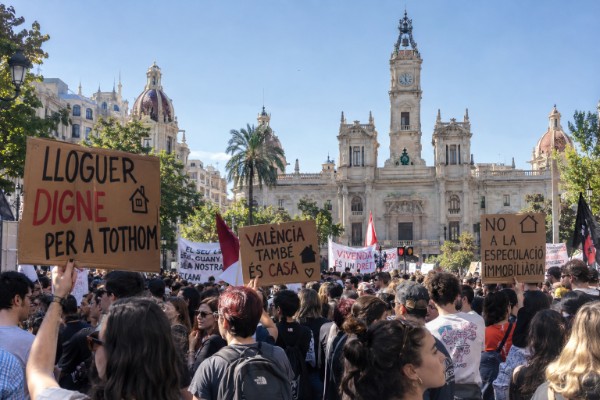
From the eviction of an 87-year-old woman in Madrid to thousands taking to the streets in Valencia, Spain’s housing crisis has become a political emergency. But how did a city once celebrated for its relative affordability become a place where young people increasingly struggle simply to find somewhere to live?
There was something almost symbolic about where Valencia’s latest housing protest ended.
On Saturday, 3 October, thousands of people marched through the city demanding affordable housing, action against evictions and an end to what campaigners describe as property speculation.
Their destination was the Palau de les Arts in the City of Arts and Sciences.
Inside was the Valencia Real Estate Summit 2026, a gathering of property professionals, investors and business leaders.
Outside, protesters surrounded the building, shaking their keys and shouting “Vergonya!” — shame.
For a city whose property market has become increasingly attractive to investors, the juxtaposition could hardly have been more powerful.
And eventually the confrontation became physical. Some protesters broke through the security cordon around Les Arts. Police responded with charges, tear gas and rubber bullets. At least five people were detained and nine police officers were reportedly injured.
Later, however, the atmosphere became peaceful again, with protesters sitting down, raising their hands and continuing their chants.
The message was unmistakable: Valencia has a housing problem — and people are becoming increasingly angry about it.
VALENCIA IS NO LONGER THE CHEAP ALTERNATIVE
For many years, Valencia had an enviable reputation.
Compared with Madrid and Barcelona, it was cheaper. It was big enough to offer jobs, culture, universities and nightlife, but still relatively affordable. For foreigners arriving in Spain, it was often presented as the perfect compromise between a major European city and a Mediterranean lifestyle.
That calculation is becoming increasingly difficult.
According to Idealista’s September 2026 figures, the average advertised rent in Valencia city reached €16.30 per square metre, around 3.1% higher than a year earlier. The provincial average was €14.20 per square metre.
Those figures only tell part of the story.
A person looking for a relatively modest 60-square-metre apartment at €16.30 per square metre is already looking at approximately €978 a month before bills.
For a young Valencian worker earning a modest salary, that is not an abstract economic statistic.
It is the difference between living independently and remaining in the family home.
Or sharing a flat.
Or moving further out.
Or leaving Valencia altogether.
And Valencia is not alone. A recent analysis of rental prices across Spain found that rents have risen by more than 30% since 2015 in 97% of census areas, while in two-thirds of areas the increase exceeds 50%. The Valencian Community is among the regions where advertised rents have risen particularly sharply.
THE TOURIST CITY VERSUS THE RESIDENTIAL CITY
The housing debate in Valencia inevitably touches another transformation: tourism.
The city has become an international destination.
The airport is busier. Cruise ships arrive. New hotels appear. Short-term tourist accommodation has expanded. Foreign buyers have discovered Valencia. Areas that were once largely residential have become increasingly attractive to visitors and investors.
For the tourism industry, this is economic success.
For somebody searching for a long-term rental, it can look rather different.
Housing campaigners argue that homes should primarily be places for people to live rather than financial assets or tourist accommodation.
Opponents of tighter regulation respond that Spain cannot solve its housing shortage simply by restricting landlords and investors. They argue that the fundamental problem is lack of supply.
The conservative Partido Popular has made precisely that argument.
Following the defeat of the government’s emergency housing measures in Congress, PP spokesman Juan Bravo argued that housing would not become affordable through decrees but through building more homes.
It is a simple argument — and one that appeals to many property owners and developers.
But it also raises another question:
How long does it take to build a home, and what happens to people who cannot afford today’s rents while they wait?
THE MARI CARMEN ABASCAL EFFECT
The national protest movement has been given a human face.
Her name is Maricarmen Abascal.
The 87-year-old Madrid woman became the symbol of Spain’s housing crisis after being evicted from the apartment in which she had lived for approximately seven decades.
She was unable to meet a dramatically increased rent demanded after the property changed hands and was acquired by an investment fund.
Whatever one’s political position, the image of an elderly woman in a wheelchair being removed from the home where she had spent most of her life has proved extraordinarily powerful.
Her case transformed an economic argument into an emotional one.
Housing stopped being simply about supply and demand.
It became about security, dignity and the meaning of home.
The anger surrounding Abascal’s eviction helped fuel demonstrations in Madrid and elsewhere, and was followed by emergency measures proposed by Pedro Sánchez’s government.
But on Friday those measures were defeated in Congress.
The PP, Vox and Junts voted against the government’s two housing decrees.
The result was politically explosive.
WHAT WAS THE GOVERNMENT TRYING TO DO?
The measures proposed by Sánchez’s PSOE-Sumar government included stronger protection for vulnerable tenants facing eviction, extensions to rental contracts, restrictions relating to temporary and room rentals and other measures intended to prevent people from being priced out of their homes.
The government presented the package as an emergency response to an increasingly serious social problem.
Critics saw it differently.
The PP argued that the government was failing to address the fundamental shortage of housing.
Vox accused Sánchez of worsening the situation for vulnerable people and argued that restrictions on landlords could reduce the supply of rental properties.
Junts also voted against the decrees, although the Catalan party has indicated that it is prepared to negotiate alternative proposals.
The political argument therefore remains remarkably familiar:
The left says regulation and tenant protection are essential.
The right says regulation can make the shortage worse and that Spain needs to build.
Meanwhile, the person looking for an apartment has to pay this month’s rent.
AND THEN THERE IS VALENCIA
This is where the national debate becomes particularly interesting for our city.
Valencia is governed locally by the Partido Popular, while the Generalitat Valenciana is also under PP leadership, with the regional political landscape shaped by its relationship with Vox.
At the same time, housing is emerging as one of the major issues ahead of the 2027 municipal and regional elections.
Compromís is already making housing a central part of its political message. Mónica Oltra, who is preparing a bid for Valencia’s mayoralty, has called for greater public housing and stronger action against speculation.
The political danger for all parties is obvious.
If housing becomes the issue that determines how people vote, traditional arguments about ideology may become less important than a much simpler question:
“Can I afford to live here?”
That question crosses political boundaries.
It concerns the 25-year-old sharing a bedroom.
The 35-year-old couple who cannot save enough for a deposit.
The family facing a rent increase.
The pensioner frightened about losing their home.
And increasingly, people who have lived in Valencia for decades but are discovering that their own city is becoming financially inaccessible.
THE GENERATIONAL DIVIDE
Perhaps the most politically significant aspect of the crisis is generational.
Older generations who bought property decades ago can look at today’s prices and see a successful housing market.
Younger people can look at exactly the same market and see an impossible barrier.
A generation that has grown up hearing that education, hard work and employment lead to independence is discovering that none of those things necessarily guarantee somewhere to live.
This is why the protests have such potential.
Housing is not an issue that can easily be dismissed as belonging to the traditional political left.
It affects people who vote PSOE.
People who vote PP.
People who vote Vox.
People who vote Compromís.
And people who have stopped voting altogether.
COULD HOUSING CHANGE SPAIN’S NEXT ELECTION?
That may ultimately be the most important question.
Prime Minister Pedro Sánchez is now under renewed pressure after the defeat of his housing decrees. PP leader Alberto Núñez Feijóo has openly called for elections, arguing that Sánchez has lost the support of both Parliament and the streets.
There is speculation that Sánchez could call a snap general election as early as November.
If he does, housing could become one of the defining issues of the campaign.
For Sánchez, the protests offer both a problem and an opportunity.
The problem is obvious: his government has been unable to get its proposed measures through Congress.
The opportunity is that the protests allow the PSOE and its allies to portray the opposition parties as blocking measures intended to protect ordinary tenants.
The PP has an equally straightforward counterargument: Sánchez has been in government for years and housing has become more expensive under his watch.
And Vox is likely to attempt to connect the housing crisis with immigration, tourism and pressure on public services.
The electoral battle could therefore become extremely fierce.
FROM MADRID TO VALENCIA
There is something particularly revealing about what happened in Valencia on Saturday.
The protest did not finish outside Parliament.
It finished outside a meeting devoted to property investment.
That tells us something about where the argument is heading.
This is no longer simply a dispute between political parties.
It is becoming a confrontation between different visions of what a city is for.
Is Valencia primarily a place to live?
A place to invest?
A place to visit?
A place to buy a second home?
A place to operate a tourist apartment?
Or can it successfully be all of these things at once?
After Saturday’s demonstration, dozens of young people began camping in Plaza del Ayuntamiento, turning the protest from a single march into something potentially more permanent. Organisers are also talking about further mobilisation and a possible general strike.
That is significant.
Spain has seen protest movements before.
The housing movement now has the ingredients of something larger: a clear economic grievance, highly emotional individual cases, an increasingly unaffordable property market, an identifiable political target and a generation that feels its future is being squeezed.
FAST FACTS — VALENCIA’S HOUSING CRISIS
🏠 €16.30/m² — average advertised rent in Valencia city in September 2026.
📈 +3.1% — annual increase in advertised rents in Valencia city.
🇪🇸 97% — proportion of Spanish census areas where rents have risen by more than 30% since 2015, according to a recent analysis.
👵 87 — Maricarmen Abascal’s age when she became the national symbol of the housing crisis.
🏛️ 3 October 2026 — thousands marched through Valencia in the latest national housing mobilisation.
🏢 Les Arts — the protest’s final destination, where the Valencia Real Estate Summit was taking place.
⛺ Plaza del Ayuntamiento — where young protesters subsequently began camping.
🇪🇸 50 cities — approximately the number of Spanish cities where demonstrations took place on Saturday.
A CITY AT A CROSSROADS
Valencia has spent the last two decades becoming more international, more prosperous and more attractive.
That success has consequences.
The same city that attracts visitors, investors, digital workers, students and new residents must also find a way of allowing the people who already live here — particularly its younger generations — to remain.
The housing crisis therefore poses a much bigger question than whether rents are too high.
It asks who Valencia is ultimately for.
And with municipal, regional and potentially national elections approaching, politicians may discover that this is a question voters are increasingly prepared to answer for themselves.
For now, the sound of thousands of keys being shaken outside Les Arts may be the clearest warning yet.
People are not simply asking for cheaper houses. They are asking whether they still have a future in the city they call home.
Report by Will McCarthy
Article copyright ‘24/7 Valencia’















Leave a comment