

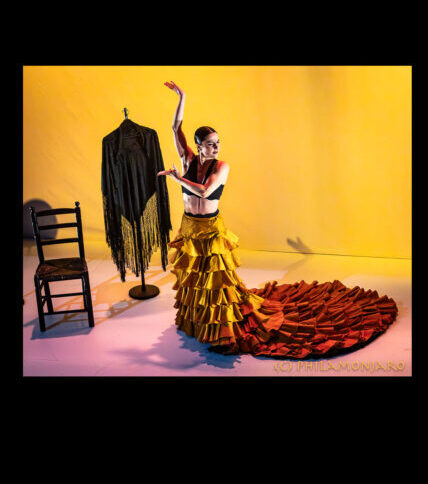
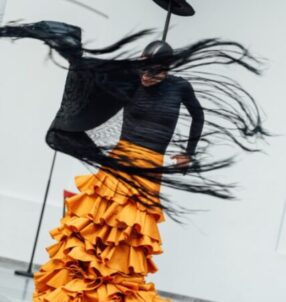
At Valencia’s Teatre Rialto, Valencian dancer and choreographer Irene de la Rosa explored flamenco through vibration, memory and visual expression in a performance that challenged conventional ideas about how dance is heard, felt and understood. On 9 October, I attended a special free performance of Antoñita: cuerpo y memoria at Valencia’s Teatre Rialto, presented by the Institut Valencià de Cultura as part of the celebrations marking the Valencian Community’s national day. Created by Valencian dancer and choreographer Irene de la Rosa, the production offered a different perspective on flamenco, exploring the relationship between the body, memory, silence and perception. It was an artistic investigation into how dance could communicate beyond sound, using movement and visual expression to reach audiences in different ways.
Flamenco beyond sound
The starting point for the production was the life and artistic legacy of Antonia Singla, better known as La Singla, the celebrated flamenco dancer who was deaf from childhood. Her remarkable ability to communicate through dance provided the inspiration for a work that explored how the body could become a powerful channel for expression and emotion.
Through a solo performance, de la Rosa took audiences on a journey through three interconnected worlds: the vibration that travelled through the body, memories that gradually faded, and a return to childhood, where play, curiosity and imagination offered new possibilities.
Flamenco became more than a musical tradition. It became a language in which rhythm could be felt, movement could communicate emotions, and silence could carry its own meaning.
The body remembers
Memory played a central role in Antoñita: cuerpo y memoria. The production explored how experiences remained within us, even as individual recollections became blurred or changed over time.
The return to childhood introduced a sense of play and rediscovery, inviting audiences to consider how we perceive the world before we learn to take its familiar sounds, gestures and sensations for granted.
By placing the physical experience of dance at the centre of the performance, Irene de la Rosa investigated the expressive possibilities of flamenco through a contemporary artistic perspective.
Making flamenco more accessible
One of the project’s most important aspects was its commitment to making dance more accessible to deaf audiences.
The production incorporated resources including vibrational sound, rhythmic lighting and visual elements designed to reinforce the perception of movement and musicality without relying exclusively on hearing.
This approach formed part of a wider programme of artistic research and mediation developed in collaboration with the deaf community, with support from the Federación de Personas Sordas de la Comunitat Valenciana (FESORD).
Rather than treating accessibility as an afterthought, the project integrated it into the creative process, exploring how different sensory experiences could become part of the artistic language itself.
The result was a production that encouraged audiences to think differently about the relationship between sound, movement and communication.
Irene de la Rosa: tradition and contemporary dance
Irene de la Rosa has established herself in the fields of Spanish dance, flamenco and contemporary performance. Her artistic career has included collaborations with the Ballet de la Generalitat and the Compañía Flamenca Óscar de Manuel, alongside work with Mediterranean Guitar, Marea Danza, the duo MUNAY and Taiat Dansa.
She also directs her own company, with previous productions including Miscelánea, Minimal, La duda and Entonces, ¿quién entiende de esto?, which received the Focus Days 2024 award.
With Antoñita: cuerpo y memoria, de la Rosa continued her exploration of dance as a means of expression, communication and transformation, bringing flamenco into dialogue with questions of memory, sensory perception and inclusion.
A special performance for 9 d’Octubre
The performance I attended took place on 9 October, when the Institut Valencià de Cultura offered free admission to celebrate the Valencian Community’s national day. Invitations were available through the Teatre Rialto box office and the IVC’s online ticketing platform, subject to capacity.
The occasion provided an opportunity to experience a production that combined flamenco with an investigation into accessibility and the different ways in which people experience the performing arts.
Antoñita: cuerpo y memoria ultimately offered a reminder that communication does not depend on sound alone. Through movement, vibration, light and gesture, the body can tell stories, evoke memories and convey emotions that words cannot always express.
At the Teatre Rialto, flamenco became a meeting point between tradition and contemporary creation, inviting audiences to look beyond what they hear and discover what they can feel.
Report by ’24/7 Valencia’ team
Article copright ’24/7 Valencia’
Photos copyright Phillip Solomonson / ’24/7 Valencia’















Leave a comment