

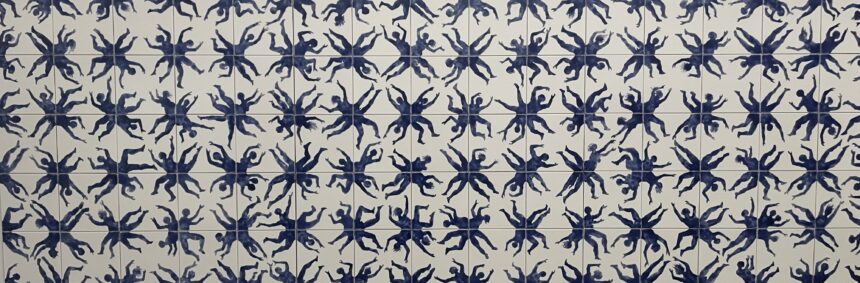
From sculptures and paintings to performance art, IVAM’s exhibits are sure to leave guests pondering meaning and questioning the roles we play in society. Since 1989, this creative hub has hosted many creations, with over 11,000 works in its permanent collection.
IVAM has showcased several hundred individual artists exhibiting their works. Showcasing a large selection of artwork across varying genres and a diverse pool of creators, the contemporary building and its dynamic spiral layout and modular spaces, it has been Valencia’s first major institution dedicated to modern and contemporary art!
Beginning on the bottom floor (G1 – Gallery 1), “Esena II. Latencies” – Scene II. Latencies, links work created almost one hundred years ago, with contemporary productions and administrative materials, alongside video documentation of performances from the previous phase of the Collection “Making Landscape’ situated next to physically presented materials. The chosen objects “transcend the boundaries of formal autonomy, incorporating the biographical, the poetic and the political”.
Together, these elements construct a layered, non-linear narrative that invites viewers to navigate between memory and matter, archive and imagination. Scene II. Latencies do not seek definitive readings but rather gestures toward multiplicity, encouraging reflection on how artworks resonate across time. This evolving constellation of practices, voices, and materials underscores the Collection’s ongoing transformation—foregrounding artistic processes rooted in fragility, resistance, and care, and reaffirming the museum’s role as a site for critical engagement and collective memory.
Towards the back left, you can discover the “Ser Artista”- Being an Artist by Julio González (G2), curated by Juan José Lahuerta, casts a new light on this great artist’s work, debunking certain myths about his life and works alike that have persisted since the mid-20th century.
“You just need to take a look at the books and manuals that have been used to write the history of modern art since the 1930s – largely through the exhibitions that the MoMA systematically assigned to the vanguards, designed to build a history organised in clearly established categories and strict genealogies -, and the consequences of this process in 1950s ‘triumphant’ New York. This meant the decontextualization of the European vanguards of the 1920s and 30s, subjected to an exclusively formalist judgement which has a single redemptive purpose: abstraction to which, necessarily, modern art tends towards in its culmination”, contextualises the curator.
Heading up the spiral staircase onto the second floor, an interactive play space for children and their accompanying adults, “IVAM’s Juguetoria”, can be discovered (G3). It Incorporates play and art through the amalgamation of colour and tactility.
Wooden structures paired with colourful objects and light enable children to get involved with IVAM’s art displays in a natural interpretation of artistic display – “For it to work, you have to enter, observe, share and imagine”, reads the explanatory sign at the entrance of this area.
Further up the centre’s spiral feature, 3 more enlightening exhibitions can be discovered. The multifaceted artistic expressions of “Senga Nengudi” and “Maren Hassinger” (G4) showcase the first time in a Spanish museum where the close friendship and collaboration between both artists has been worked on, which started with the experiences of Studio Z in Los Angeles and continued for more than 5 decades since the 70s. Their tertiary performance art and sculptures, linking the natural and the unnatural, continue to inspire and are a reminder that art can bring people and communities together.
The exhibition centres on their shared practice, shaped by mutual care, improvisation, and a spirit of resistance. Beginning with two foundational texts —Manifesto (Hassinger, 2006) and Maren and I (Nengudi, 2009)— the exhibition reflects on how both artists developed a vocabulary rooted in ritual, collaboration, and affirmation of identity.
Often working outside institutional recognition, they created their networks of support and visibility, using performance, sculpture, and installation to address issues of race, gender, and belonging. Together and individually, they have challenged the dominant systems of cultural production, offering instead a model based on dialogue and self-determination, an approach that continues to resonate today.
Located on the same floor (in G5) is the exhibit “Soledad Sevilla. Rhythms, Grids and Variables”, in which the painter Soledad Sevilla (Valencia 1944) presents a rigorous language based on the purity of line and colour, and on the construction of forms derived from geometric modules.
Curated by Isabel Tejeda, it provides a chronological overview of the artist’s career through more than 100 works. Her captivating brush strokes, coupled with the elegant choice of shade, infer the boundary between the seen experience and the unseen experience, glueing feelings evoked by sound and texture into a visible medium to be enjoyed by exhibit goers.
Finally (located in G6), “Això no és còmic!” – This is not a comic! Fanzines: The Innovation and Transformation of Comics explores how fanzines and self-publishing have driven the evolution of the comics medium through bold formal experimentation. Over the past century, comics have continually absorbed diverse sociocultural and artistic influences, reinforcing their expressive versatility.
Fanzines and self-publishing have become key spaces for creative freedom, offering open, accessible platforms unbound by commercial expectations. This has accelerated the search for new forms and storytelling methods, particularly through the emergence of collectives and festivals in the early 21st century that support ongoing experimentation.
The exhibition brings together works by over forty authors, providing an overview of the expressive potential cultivated in fanzine culture. Designed as more than a static display, it combines exhibition, creation, and audience participation, offering a dynamic, evolving space that reflects the ongoing redefinition of comics through self-publishing and collective experimentation.
The IVAM stands not only as a vibrant centre for modern and contemporary art but also as a welcoming space for the community. It’s café-restaurant, operated by Mascaraque, offers a modern and inviting environment where visitors can enjoy meals and refreshments throughout the museum’s opening hours: Tuesday to Thursday and Saturday from 9:30h to 19:00h; Friday until 20:00h; and Sundays and holidays from 10:00h to 17:00h. During July and August, the café is open on Saturdays from noon to 19:00h.
Complementing this is the museum’s thoughtfully curated gift shop, featuring unique art-inspired items perfect for souvenirs or gifts. Importantly, IVAM also offers free entry every Wednesday between 16:00h and 19:00h and free entry all day Sunday, encouraging engagement with art and culture. Together, these features make IVAM a vital cultural landmark in Valencia, fostering creativity, accessibility, and connection for visitors of all ages!
Report by Elliot Fryatt
Article copyright ‘24/7 Valencia’
IVAM photos copyright Elliot Fryatt / ’24/7 Valencia’
IVAM
C/ de Guillem de Castro, 118
Ciutat Vella
46003
València
Spain
IVAM Official Website: https://ivam.es/en/visit/
Related Post














Leave a comment