

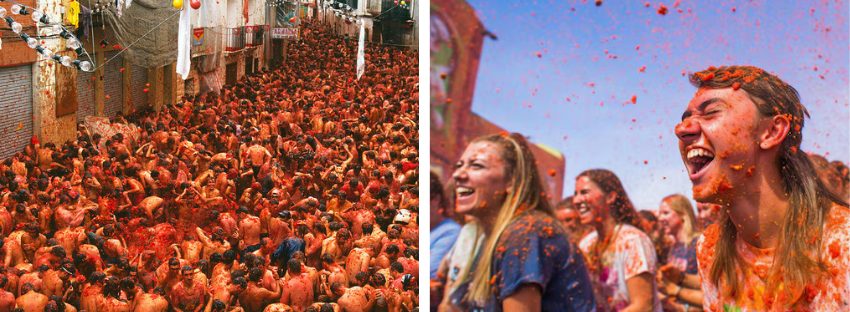

When the BBC contacted me to offer me a seat in their commentary booth for La Tomatina 2025, I was honoured to have been chosen. As editor of ‘24/7 Valencia’ for 25 years, I’ve covered many Valencian festivals, but being asked by a world-class broadcaster to narrate 90 minutes of live streaming for perhaps the world’s best-known food fight? That was a scoop. And on 27 August 2025, from the streets of Buñol, it became an experience I will never forget.
Why the BBC wanted La Tomatina
In the BBC’s view, La Tomatina is more than a quirky spectacle. It’s a vivid, visceral slice of Spanish—and specifically Valencian—popular culture. The splashes of red, the chaos of thousands hurling tomatoes, the built-in drama as the clock ticks, the communal joy: all of these make for a memorable live television spectacle. The BBC’s aim was to bring that to a global audience, and they wanted someone local, with regional insight, language, and passion. As editor of a publication rooted in Valencia, I was perfectly placed to translate what might otherwise be dismissed as “tomato throwing” into a story of ritual, identity, and joy.
What is La Tomatina (for those unfamiliar)
For our readers at 24/7 Valencia who enjoy a closer look behind the spectacle, here’s the essential background:
- La Tomatina is an annual festival held in Buñol, a small town in the province of Valencia.
- It takes place on the last Wednesday of August (for 2025, that’s 27 August).
- The core event is a free-for-all tomato fight: participants throw tomatoes at each other, turning the town square and surrounding streets into a sea of red. It is often called the world’s largest food fight.
But there is structure behind the chaos.
A brief history
Understanding La Tomatina’s evolution gives us a sense of how a festive prank became a global phenomenon:
- The origins date to 1945, when during a parade in Buñol, some young people engaged spontaneously in a food fight in the town square.
- In the late 1940s, the fight was repeated in a more organized way as young people brought tomatoes from home.
- For periods in the 1950s, under the Franco regime, the festival was banned because it lacked religious significance.
- In 1957, as a symbolic protest, locals held a “tomato funeral” — carrying a coffin with a large tomato inside, accompanied by a procession — to push for reinstatement. That protest succeeded, and the festival was officially permitted again
- In modern times, La Tomatina gradually became better known beyond Valencia, aided by media coverage (notably the Spanish television program Informe Semanal).
- In 2002, it was officially declared a Fiesta of International Tourist Interest.
- Until 2013 there was no formal limit on participants, but after that the organizers instituted a cap of 20,000 ticketed participants to ensure safety and manageability.
So by 2025, we have a well-oiled festival, with institutional backstops, rules, and expectations.
Pre-festival rituals and build-up
The tomato battle doesn’t exist in isolation — it is the climax of a day (or days) of pageantry, games, and local ritual. In my BBC commentary I tried to capture some of these elements for our global viewers:
- On the morning of the festival, a traditional event called Palo Jabón (greased pole) is held. A tall pole is greased, and a piece of ham is placed at its top. Participants attempt (often by climbing on each other) to reach the ham. Meanwhile, all around, people dance, sing, and are doused with water hoses to cool the air and raise the excitement.
- Bands, parades, and communal paella contests take place in the days leading up.
- Fireworks and musical performances also help set the festive tone.
By the time the bell rings (signaling the start of the tomato fight), the crowd is primed, the tension palpable, and the cameras ready.
Rules and safety — yes, there are rules
One might assume a tomato fight is pure chaos, but in fact the organizers enforce a short but essential set of rules to maintain safety and avoid excess:
- Only throw tomatoes — no other objects, no bottles, no foreign items.
- Squash the tomato before throwing — this reduces impact and risk of injury.
- Do not tear clothes — avoid intentional aggression or damaging someone’s clothing.
- Keep a safe distance from trucks (the trucks carry the tomatoes) so participants are not run over or crushed.
- Stop throwing tomatoes after the second signal (starter pistol shot) — that marks the end of the battle.
- Only throw at targets you can see — to avoid blind hits or injury.
- Do not throw tomatoes at buildings — the aim is people, not property.
- Follow instructions from security staff — staff help manage flow and safety.
- Have fun — perhaps the only non-regulatory rule, but the spirit matters.
After exactly one hour the fight ends. The square is blanketed in tomato pulp. Fire trucks come in to hose down streets, while participants themselves use hoses or nearby water sources to rinse off. Some even head to a local pool (Los Peñones) to clean themselves.
Interestingly, the citric acid in tomatoes means that rinsed surfaces sometimes end up cleaner than they were before!
My night in the booth: how it went
As a commentator, your role is part educator, part entertainer, part “colour supplier” to the main presenter and the viewers. Over those 90 live minutes, here is how I approached it (and what I saw):
- Pre-show briefings: Before we went live, I walked the BBC team through the history, local customs, key vocabulary (e.g. palo jabón, peñón, camiones de tomate), and safety protocols. I also flagged the moments when I expected emotional or visual peaks (the ham falling, the first tomato flurry, the slow winding down).
- Opening narration: As cameras panned over the streets of Buñol and the gathering crowd, I began weaving background: this wasn’t just a messy gimmick but a ritual rooted in decades of local tradition and communal identity.
- Live play-by-play: When the first shotgun-like shot rang and the tomato battle began, the pace quickened. I described clusters of participants launching soft red missiles, the red haze rising over heads, the squeals, the laughter, the dodge-and-throw choreography. I tried to balance exuberant commentary (“Look at that wave of tomatoes!”) with context (“This is exactly why the rule to squash the tomato first matters — see how much gentler the splat is”).
- Interludes and depth: When the pace slowed, I returned to history: how the Tomatina grew from a spontaneous food fight among locals to an internationally signposted event. I noted the shift in 2013 to ticketed limits (20,000 participants) to preserve order. I also flagged that in 2024, more than 23,000 people from 51 countries participated.
- Behind the scenes: I shared glimpses of how trucks loaded with tomatoes drove in, how staff distributed water hoses, how local security staff marshalled participants, how some advanced participants carried goggles and gloves, how the crowd ebbed and flowed at edges.
- Wind-down and aftermath: As the second signal shot echoed, I called out the end, and described the shift from fighting to cleanup: the spray of fire engines, the streams of water washing red off walls and pavement, the mingling crowd, the sight of red-stained clothes and shoes, the laughter and fatigue mingling in the air.
Throughout, I felt the weight of responsibility: with the BBC’s global viewership relying on me for context, I had to remain grounded, precise, and evocative. I also had to support the main presenter (who was based remotely) by feeding timely descriptions, background anecdotes, and translation context when non-English phrases appeared.
What it meant for 24/7 Valencia
From a media and marketing perspective, this was a golden moment:
- Being selected by the BBC as commentator elevated our brand’s prestige. We can now once again say that ‘24/7 Valencia’ is not just a local magazine, but one whose voice is trusted by top-tier international media.
Reflections & closing thoughts
Commentating on La Tomatina was exhilarating, exhausting, and unforgettable. I was immersed in red pulp, human energy, and centuries of tradition. Through the BBC lens, I hope I brought the world a sharper, more human view—not just tomatoes flying, but a living festival with meaning, identity, and joy. We thank the BBC for choosing the editor of ‘24/7 Valencia’ to commentate on the intense ‘La Tomatina’ for an intrigued public.
Report by Will McCarthy
Article copyright ‘24/7 Valencia’

















Leave a comment