

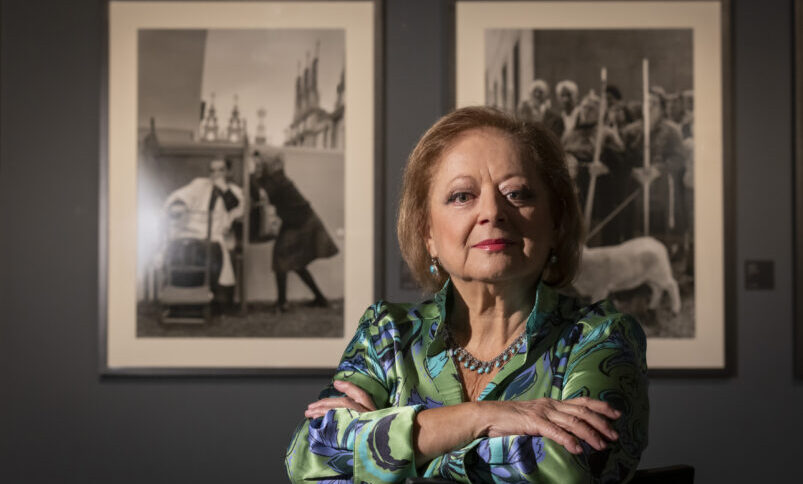
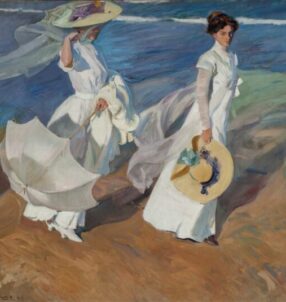
The Valencian Institute of Modern Art (IVAM) has presented the exhibition ‘Cristina García Rodero. Hidden Spain,’ which brings together 157 images from this historic series that made the photographer from Puertollano (Ciudad Real) a leading figure in Spanish photography.
“In 1973, the Juan March Foundation awarded Cristina García Rodero an artistic creation grant, which allowed her to acquire her first camera, a 35mm Pentax. She then took a bus to the town of Almonacid del Marquesado in Cuenca province,” explained Blanca de la Torre, director of the IVAM, regarding the project with which the photographer traveled through the towns of Spain “to document and preserve the memory of their festivals, ceremonies, rituals, traditions, and the way of life of their people.”
“I was a completely inexperienced young woman who, above all, wanted adventure,” Cristina García Rodero recalled about her beginnings. “With what I earned as a teacher, I would take trains and buses at night on weekends to go to the villages.” For fifteen years, she photographed processions, pilgrimages, women in mourning with headscarves, and men in their Sunday best kneeling as the saint passed by.
In 2023, fifty years had passed since the project began, and the Círculo de Bellas Artes in Madrid, the Centro Cultural La Malagueta of the Málaga Provincial Council, the Juan March Foundation, and the IVAM (Valencian Institute of Modern Art) decided to celebrate this work by organizing an exhibition that, after touring several venues, has arrived at the Valencian museum where it will be on display until February 8.
The exhibition, curated by the artist herself, includes the photographs that make up the book ‘España Oculta’ (Hidden Spain), published in 1989, which has been reissued. “A major publishing event,” in the words of Blanca de la Torre, since this volume is “a fundamental milestone in the history of photography in Spain.”
“I republished the book myself because I decided I was going to do whatever I wanted,” Cristina García Rodero pointed out regarding the publication, of which 13 editions were initially released and sold in secondhand bookstores around the world at very high prices. “The book ‘Hidden Spain’ is my calling card; people know me because of that book, even though I’ve been working for 53 years.”
The director of the IVAM recalled that the artist herself, in her grant application, stated that she intended to create an anthology of Spanish customs, both in their openness and progress, and in their concealment and tradition. “I would call town halls, talk to people, priests, drummers, musicians, fairground workers, bombarding them with questions to find out which festivals were the most important,” Cristina declared.
However, her work cannot be reduced to mere documentation. These are images that move and stir emotions because what matters to the artist is “engaging in conversations with people who often end up becoming your friends, who are happy when you return, and to whom you will always be indebted.” For the director of the IVAM, “from an ethnographic and anthropological point of view, the collection has undeniable interest.”
The National Photography Prize winner pointed out that she cannot leave a project unfinished. “I hate people who skim over things or photographers who tell me, ‘I’ve got the shot, let’s go.’ I don’t leave. Even if I’ve taken the photo of my life, you have to push yourself to the end, and even more the following year, and even more the year after that,” she asserted during the presentation.
“Many people asked me: ‘Why are you traveling 600 km here to see a devil?’ ‘Madam,’ I said, ‘but this is a unique, special devil,’” the artist recounted, describing the challenges of venturing into that hidden Spain, of seeing without being seen, with the diagonal lines that structure so many of her photographs. It was a project she had to undertake without any references. “Julio Caro Baroja’s book, ‘El carnaval’ (The Carnival), was very important to me,” she explained, referring to the scarcity of documentation on popular culture from that era.
“While other photographers were capturing the modernity of La Movida, Cristina opted for a style of photography that wasn’t in the mainstream, but she pursued it with determination, passion, and talent,” Blanca de la Torre summarized, describing a body of work that transcends documentary photography to offer us an emotionally charged testimony of that “mysterious and hidden” Spain, a fundamental work for understanding “its light and its shadows.”
Report by ’24/7 Valencia’ team
Article copyright 24/7 Valencia
Tel: +34 963 176 600
Hours: Tuesday to Sunday: 10:00h – 19:00h
Friday: 10:00h – 21:00h
Monday: Closed
Free entry Sundays
Related Post













Leave a comment