

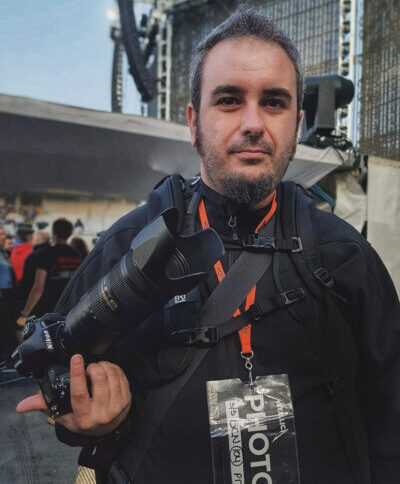
24/7 Valencia: Can you tell us a little about your training as a photographer?
PEDRO HERNÁNDEZ: Hello, first of all, thank you for your interest. It’s a pleasure talking with you.
My training as a photographer is partly self-taught, partly from photography studies I completed while in college. The truth is, at that time, more than 25 years ago, I didn’t take it very seriously because it was all geared toward becoming a wedding or family portrait photographer, disciplines that don’t interest me at all. So those studies served to teach me the basics of photography, that is, how to expose correctly and frame correctly, and little else.
Over time, I learned that basic rules are very important, just as it’s important to know how to break them. The rest has been trial and error, which is how you truly learn.
Now, with digital photography, it seems much simpler: there are mirrorless cameras where you see the finished photo in the viewfinder. But it’s a double-edged sword …because of this…many people don’t want to learn the basics and take thousands of photos without really knowing what they’re doing, and some of them turn out well by chance. For me, that’s a far cry from my concept of a photographer, although in 2025 the word “photographer” is used very freely.
Growing up and learning your craft, did any photographers influence you?
Of course, we all have role models in our profession. I could mention many. When I was young, I spent hours looking at music magazines, and, directly or indirectly, all those images end up influencing you. To summarize the topic a bit (which is a lot to say), I’d say the two photographers I admire most are Annie Leibovitz and Ross Halfin. And I admire them both for very different reasons: what one has, the other doesn’t, and vice versa.
Annie is the queen of light and portraiture, with an incredible technique and many years of experience. The famous photo of John Lennon cuddling with Yoko Ono in bed elevated her to the Olympus of photographers, but since then, she has reinvented herself a thousand times to reach where she is now as the official photographer of the British Royal Family. Her portraits of Queen Elizabeth II are the modern equivalent of Velázquez’s paintings. They are masterpieces.
On the other hand, there’s Ross Halfin, whom I’ve been able to meet and chat with on occasion. Ross is the complete opposite. He always says he knows nothing about photography (it’s not true), but Ross has a gift. He has the confidence of musicians and has managed to “get into the kitchen” of major artists’ lives. His photos of Ozzy Osbourne, Metallica, AC/DC, Iron Maiden, and Jimmy Page are already music history in their own right. A photograph of Ozzy sitting on the toilet? That’s Ross. A photograph of Ozzy in a stadium full of people where he looks like a God? That’s Ross too. He humanizes the artist to the extreme in a dressing room or in a hotel, just as he makes you feel insignificant compared to the artist’s greatness on stage. If photography is about “capturing a moment,” Ross is the boss in the rock world.
Do you have specific cameras that you prefer, depending on the subject and location?
I’ve always used Nikon, and have for over 35 years. I’ve had the opportunity to try cameras from all brands, but for me, there’s nothing like Nikon. The quality of its lenses is unmatched, and its cameras have the controls where they should be; everything is within easy reach. Besides, Nikon only makes cameras and lenses. If you only make one thing and have been in business for years, you know how to do it very well. There are other good brands that make cameras, but they also make photocopiers or game consoles. If they don’t make a good camera, they can always make money from other products. Nikon has to do it right no matter what; they don’t make coffee makers or refrigerators, hah- hah!
Indeed, to answer your question, depending on the job, I choose one camera model or another, as well as the lenses. Photographing a band in a dimly-lit room where you’re half a metre away from them isn’t the same as photographing Robert Plant at Les Arts in Valencia or Metallica at the Metropolitano, where you have to shoot from 50 metres away with a huge telephoto lens. Currently, my two main cameras are a Nikon Z6 and a Z8, and I’m really happy with both. Regarding lenses, there’s a bit of everything. For venues, I usually use a wide-angle and a medium zoom. For stadiums and festivals, you have to go further with zooms of 200mm or more. The important thing is that they always use lenses that capture a lot of light, because at concerts, light is scarce and the action is very fast. You need good equipment because everything works against you.
What have you learned most from traveling around Spain through your work?
Good question… I’d say planning is perhaps the most important thing. In the end, when you photograph musicians, there’s always a significant amount of improvisation, because many are unpredictable, but you have to do your homework beforehand so that improvisation is as minimal as possible.
You also learn how to navigate concert halls and theatres. Once you’ve explored most of Spain’s concert halls, you know the strengths and weaknesses of each one and are prepared for everything from where to park to where to stand, etc. It’s also important to meet people and, above all, behave appropriately. After all, the musicians and venues are opening the doors to “their home” to you, and you should try to make a good impression. The idea is to be allowed to come back…
Any favourite concerts or artists that stand out and why?
It’s hard to answer this one. I had favorite artists when I was younger. Over time, you demystify them a bit. Maybe my first big concert is etched in my memory: it was Metallica in Barcelona in ’99. I was a kid and a Metallica fan. I was pretty nervous. Of course, it was film, so you didn’t know what you’d done until a few days after the photos were developed. It was a very long wait.
More recently, I had a great time shooting Glenn Hughes for the amplifier company Orange Amps. He’s a lovely gentleman.
Among national artists, the one I enjoy most is Alberto Marín (Def Con Dos, Ankhara, Mónica Naranjo). Besides being an excellent guitarist, he’s a great person with whom I’ve been friends for years, and I always enjoy photographing him with any of his bands. He’s very easy to photograph because he’s a beast on stage and in a minute he “gives” you more photos than other artists have in their entire careers. Something similar happens with Bunbury: all photographers love photographing Enrique Bunbury; he’s the most rewarding artist to photograph. It probably has something to do with the fact that his partner is a photographer, and Enrique greatly respects photographers.
Is music your main focus? Are you also interested in nature photography?
Music is where I feel most at home, but I also practice other disciplines. I shoot fashion, portraits, product photography, and even sports photography on occasion.
I really like nature photography, but I don’t usually publish anything; I keep those photos to myself, although I really enjoy taking landscapes and, above all, wildlife.
There are two disciplines I can’t handle: macro photography, I don’t have the patience for it, although I find it fascinating, and the other one I can’t stand is weddings, I’ve been offered to do some and I’ve always turned it down.
Describe a typical week as a photographer…
More than a typical week, I can tell you about a typical day, since, in concert photography, there are weeks when nothing happens and other times six things happen in a single week.
On concert day, the first thing I do is check the equipment, make sure everything is in working order, and that the batteries are charged (both the ones you’re going to use and any extra ones). The same goes for memory cards. Clean the lenses and do a little equipment maintenance.
Then it’s time to do your homework, look for information about the band or the tour, try to find videos of the band’s previous concert to see what you’re going to find (what I was saying before about maximizing preparation to minimize improvisation).
The next step is to arrive at the event on time. Never arrive in a hurry, because it’s important to maintain a steady pace and focus. You greet your bandmates, and the band’s road manager or press officer escorts you to the pit (or wherever the photos are being taken; sometimes they send you back to the soundboard, or even worse)… And then it’s time for the rock and roll. It’s short but intense. Two or three songs where you have to give your all in a small space shared with other bandmates. Normally, after those two or three songs, they’ll kick you out of the venue. Sometimes you can stay, but not always.
You get home and have to overcome sleep and fatigue, select and edit images to send to the artist, magazine, or wherever you’ve been hired. It’s essential to do it right away, because if you do it two or three days later, it won’t be newsworthy.
As you can see, there’s no time to get bored, and there’s a bit of masochism in all this, but that’s what we like…
Can you tell us about your social media sites?
Of course, although if I’m honest, I’m not a big fan of social media. Right now, the one dominating the photography industry is Instagram, but it’s really a big lie: people buy followers, pay to have their photos promoted, and call anything “great” in the comments. It’s common to see pathetic photos full of “likes” or “photographers” whose quality doesn’t match the huge number of followers they have. I’m not a fan of these practices, so I hardly spend any time on social media, beyond being able to show them as part of my portfolio and because it’s almost “mandatory” to be on Instagram. But it’s all a big lie, a circus. You see really good photographers with 800 followers and other pathetic ones with 3 million followers. It all stinks.
However, and answering your question, you can find me on Instagram at https://www.instagram.com/picfromthepit/ . You can also see recent work at www.rockculture.es , a website specialized in music press that is doing things very well. They have just turned 10 years old and what they do is commendable, as they combine great bands like Iron Maiden or Judas Priest with emerging groups that, if it weren’t for media like Rock Culture, would be invisible.
Interview by ‘24/7 Valencia’ team
Article copyright ‘24/7 Valencia’
Photo copyright Pedro Hernández (Pic from the Pit)














Leave a comment