

When most people think of museums, they imagine glass cases, ancient artifacts, and carefully preserved objects from the past. Places where history is arranged behind labels and viewed at a distance. The Valencian Museum of Enlightenment and Modernity, better known as MuVIM, takes a very different path. Located in Valencia, MuVIM shifts attention away from objects and toward something less visible but far more influential: ideas. It is built on the belief that the modern world was shaped not only by what people created, but also by how they thought. Instead of presenting history as something finished, it treats it as something still unfolding, formed by shifts in knowledge, belief, and imagination.
This perspective is rooted in the Enlightenment, the intellectual movement of the seventeenth and eighteenth centuries that redefined how people understood reason, science, and society. It marked a break from inherited authority and placed emphasis on critical thinking, education, and progress. For MuVIM, this moment is not just a historical background but a starting point for everything that follows. It is the point where modern ways of thinking begin to take shape.
Rather than preserving this legacy through traditional collections, the museum translates it into an experience. Its permanent exhibition, València seen by Priest Tosca, presents a detailed cartographic reconstruction of the city based on historical maps. Visitors do not simply learn about old Valencia; they see it unfold before their eyes, tracing streets, walls, and urban structures that no longer exist in the same way. It becomes a shifting comparison between the city as it was imagined and the city as it exists now. This sense of layered history continues underground, where the MuVIM’s Medieval Tower in the Tower’s Gallery reveals the original stone remains preserved beneath the building. The experience is more physical and grounded here, a direct encounter with Valencia’s architectural past. Nearby, the Espai Gutenberg and its Treasures of the MuVIM Library open a quieter space of manuscripts, early printed works, and historical texts that show how knowledge was recorded and shared long before digital systems existed. Together, these permanent elements create a dialogue between physical history and intellectual heritage without relying on conventional museum display formats.
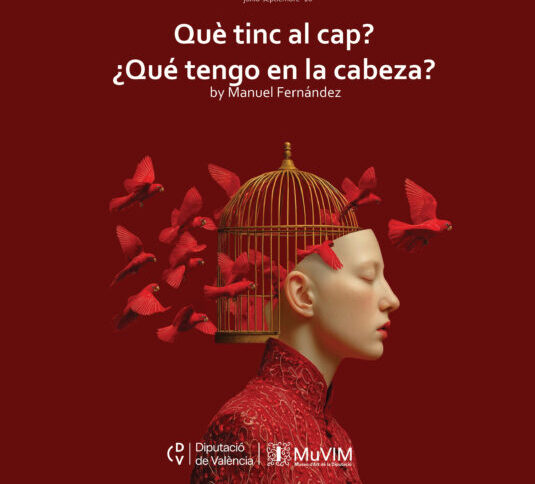
The permanent spaces anchor the museum in time, but the temporary exhibitions give it movement. The galleries shift constantly with new temporary showings. Each exhibition introduces a different visual and conceptual atmosphere. Today, in the Museum Hall, Somni Impossible sets a reflective tone through an immersive, dreamlike composition, where interpretation is left open and meaning is shaped through perception rather than explanation. It is less about understanding a single message and more about navigating an environment designed to slow visitors down and make them think. Across all these spaces, the museum does not behave like a linear narrative. It feels more like a set of shifting environments, each one changing how the next is experienced. Rather than moving through a single story, visitors move through different ways of seeing.
Beyond the galleries, MuVIM extends into public life through a continuous programme of lectures, workshops, screenings, and cultural events that push its ideas beyond the exhibition spaces. These activities turn the museum into something more than a place of observation. It becomes a space where discussion is ongoing, where themes explored in the exhibitions are revisited, questioned, and expanded in real time. A talk might unpack the ideas behind a temporary exhibition, while a workshop might translate those same concepts into creative practice, allowing visitors to engage with them directly rather than passively absorb them. Film screenings and interdisciplinary sessions further broaden this exchange, connecting visual culture, theory, and contemporary social questions in ways that keep the museum in constant dialogue with the present. Access to both exhibitions and public programming remain free, reinforcing a core principle that runs through the entire institution. Cultural participation is treated not as a privilege, but as something open, shared, and continuous.
What defines MuVIM is not a single exhibition or idea, but the way it turns interpretation itself into the subject. Objects, images, and environments are never treated as conclusions. They function instead as starting points that invite questioning rather than simply being understood. Visitors are not led toward fixed answers but into spaces where meaning is built through attention, comparison, and reflection. Rather than offering certainty, the museum works through contrast and openness. Historical reconstruction sits beside digital identity. Urban mapping exists alongside introspective installations. Design, technology, memory, and perception are placed in dialogue rather than separation. Each exhibition subtly reframes the next, creating a shifting network of ideas that resists a single reading and instead encourages continual rethinking.
MuVIM succeeds because it treats ideas as active forces rather than background context. It shows how ways of thinking shape cities, systems, and identities, and how those ways of thinking are never fixed. They evolve, collide, and reappear in new forms across time and culture. In the end, MuVIM is not a museum that asks visitors to look back at history. It is a space that reveals how history is still being formed in the way we think, see, and interpret the world right now.
Report by Lilly Salvador
Article copyright ‘24/7 Valencia’
MuVIM
C/ de Quevedo, 10, Ciutat Vella
46001
València













Leave a comment