

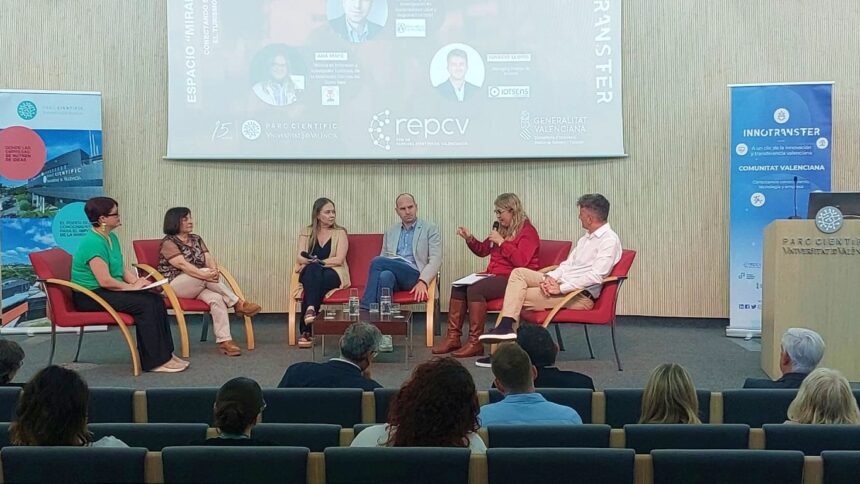
Conscious pilgrimage is positioned as a tool for social, environmental, and economic transformation in destinations affected by climate change. Smart and transformative tourism was the central focus of the conference held this month at the University of Valencia Science Park as part of the Innotransfer programme, which brought together researchers, companies, administrations, and social entities to explore the keys to the regeneration of tourist destinations through open innovation with a common goal: to promote a more sustainable, supportive, and adaptive tourism model.
In this context, the Way of the Holy Grail has been highlighted as a paradigmatic example of a cultural itinerary capable of integrating sustainability, historical memory, citizen participation, and the social economy. Its route, which begins in Naples and culminates at Valencia Cathedral, allows for the coordination of projects with a positive impact on multiple levels: from the restoration of heritage to the activation of volunteer solidarity programmes.
Dr. Ana Mafé García, president of the Cultural Association El Camino del Santo Grial, emphasized that contemporary pilgrimage tourism is no longer conceived as an individual act , but as a conscious and regenerative action that connects travellers with their surroundings, local communities, and charitable causes. In Mafé’s words:
“The 21st-century pilgrim seeks to leave a positive mark wherever he or she goes. The Way of the Holy Grail allows us to transform this desire into real projects that regenerate natural spaces, revitalize municipalities at risk of depopulation, and strengthen the social fabric too.”
The event is part of the open innovation programme promoted by the five science parks of the Valencian Community (rePCV), with the support of the Ministry of Innovation, Industry, Commerce and Tourism of the Generalitat Valenciana, and it discussed solutions for a more sustainable, resilient tourism adapted to new climate and social challenges.
Tourist intelligence and regenerative solidarity
One of the most notable lines of work was the intervention of Inteligencia Turística (IT), a consultancy firm specialising in data-based solutions and artificial intelligence, which presented tools such as Smart Data Cube , Ciclops DTI and the RESITUR observatory, focused on visualising and managing the economic, social and environmental impact of tourism in real time.
IT CEO Celia Romero championed a proactive management approach based on the predictive value of data to prevent destination overcrowding and redistribute tourist flows in a balanced manner. Along these lines, she highlighted that cultural itineraries like the Way of the Holy Grail are key tools for channeling tourists to emerging destinations, providing real benefits to both visitors and the local community.
The event also highlighted international synergies, such as the solidarity tourism model developed in Colombia, which is now seeking to be implemented in the Valencian Community. According to Natalia Castro, coordinator of the Solidarity Travelers Platform programme , this model integrates tourists into local agricultural, environmental, and community regeneration initiatives and finds an ideal framework on routes like the Way of the Holy Grail, especially in areas affected by phenomena like the DANA.
Valencian smart tourism ecosystem
The event brought together the University of Valencia Science Park and a prominent representation of the tourism innovation ecosystem, including academic entities such as the University of Valencia , the Polytechnic University of Valencia and the Jaume I University, along with institutions such as Invattur, ADESTIC and leading technology companies such as DeepSense or IOTSENS .
The event began at 10:00 a.m. with a welcome coffee, which facilitated the first informal meeting between the various stakeholders in the Valencian tourism ecosystem. At 10:30 a.m., the institutional opening ceremony took place, led by Pedro Carrasco , Director of the University of Valencia’s Science Park, and Francisco Javier Sogorb , Deputy Director General for the Advancement of the Digital Society and Digital Enabling Technologies at the Generalitat Valenciana (Generalitat Valenciana). They emphasized the strategic role of innovation in the economic recovery and ecological transition of the tourism sector.
The first roundtable, held between 10:45am and 11:30am, addressed the topic “Tourism with a Purpose: Culture, Impact, and Solidarity .” The panellists were Marisa Vázquez de Ágredos , representative of the Council of Europe’s Cultural Route of Historic Pharmacies and Medicinal Gardens; Rosa Mª Rodríguez Artola , director of the Tourism Institute at the Universitat Jaume I; Natalia Castro , coordinator of the Solidarity Travelers Platform from Colombia program; and Esther Welters , CEO of Kalmas. They all agreed that the tourism of the future must promote a positive impact on the region, as well as values of cooperation and social justice.
The second roundtable discussion, entitled “Technological solutions and data for regenerative tourism,” began at 11:30 a.m. It featured experts in tourism intelligence and big data. Among them were Olivia Estrella , director of the Valencian Institute of Tourism Technologies (Invattur); Fran Vaquer , from DeepSense; Celia Romero , CEO of Tourism Intelligence; Gersón Beltrán , from the ADESTIC association; and Miguel Ángel Catalán , director of the Smart Office at Finestrat City Council. The speakers discussed how to use artificial intelligence and data analytics to manage tourist flows and minimize their environmental impact.
The programme closed with the session titled “Open Vision: Connecting Sectors for the Tourism of the Future,” held from 12:15 to 1:00 p.m. Researchers from various academic fields came together, including María José Viñals, professor at the Polytechnic University of Valencia; Walesska Schlesinger, associate professor at the University of Valencia; and Adrián Ferrandis, director of the LOCSUS group and researcher on the European ECOSN2K project. They were also joined by Ana Mafé García, representative of the Cultural Association El Camino del Santo Grial, and Ignacio Llopis, director of the technology company IOTSENS. This session stood out for showcasing specific collaborative experiences that integrate tourism, technology, culture, and sustainability.
The closing keynote address was Rosa Mª Donat, Vice-Rector for Knowledge Transfer and Innovation at the University of Valencia, who highlighted the fundamental role of the university as a hub for producing excellence and knowledge at the service of society. In her remarks, she emphasized the need to “put soul into scientific projects” so that technological solutions have a truly transformative impact on the region and its people.
This diversity of stakeholders demonstrates that the future of tourism cannot be separated from intersectoral cooperation, digitalization, and an inclusive territorial vision. Within this framework, The Way of the Holy Grail emerges as a natural lever for cultural cohesion, ethical innovation, and the regeneration of the soul of the territories.
Report by ‘24/7 Valencia’ team
Article copyright ‘24/7 Valencia’
Related Post






Leave a comment