

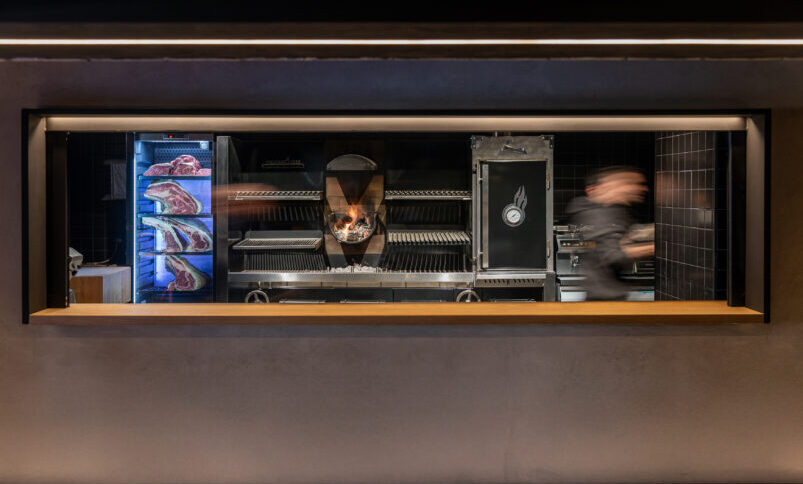
The restaurant is located on C/ Victor Jara, 4, in Mislata (Valencia). Aged meats will continue to be the focus of the menu, although with more Mediterranean influences: wild-caught fish will be featured, grilled to perfection. With seating for 43 diners, the new Beluá is designed to offer customers a relaxed and unhurried experience. The restaurant boasts a grill personally designed by Diego Corrales, master griller and co-owner of this family business, and a wine cellar with more than 80 selections of wines and sparkling wines. Beluá, a renowned restaurant for lovers of high-quality aged meats, is embarking on a new chapter. This family-run establishment, led in the kitchen by Uruguayan grill master Diego Corrales, is relocating to an elegant 240-square-metre space at number C/ Victor Jara, 4, in Mislata, Valencia, just a few metres from its previous location.
The new Beluá will open its doors to the public on February 3rd. This is not simply a change of venue, but a natural evolution of the project, designed to offer a gastronomic and service experience on par with the most exclusive and unique steakhouses in the country. None of this would be possible without the unwavering support of the family that owns and has led the project from its inception.
It is an intimate and very welcoming space—designed by Amanda Ibor Estudio in collaboration with Arancha Alguacil and built by the engineering firm Geditec—where natural materials (wood, handcrafted terracotta, recycled antique beams) are combined with a warm color palette that evokes the essence of Beluá: earth, firewood, and fire. The guiding principle is slow cooking, prepared strictly with fire and embers, which defines the personality of this establishment. The culinary offering will therefore continue to focus on aged meats, highly specialized products to which Diego has dedicated more than two decades of his professional career as a chef. However, in addition to their renowned cured beef with Protected Geographical Indication (PGI) from León, aged and smoked in-house, their long-aged Galician Blonde beef and ox ribeye steaks, and their sirloin steak tartare, the new menu features more nods to the sea, including wild-caught grilled fish like turbot and sea bass cooked on a floating round grill.
“Our foundation is meat, but we’re in the Mediterranean and we had to reflect that,” Corrales points out.
“Vegetables from the Valencian orchards will also play a more prominent role. Beluá is still Beluá, but now it’s a more conscious, more mature project focused on attention to detail.” One of the most significant changes in this new phase involves the service. “We only have twelve tables and we’re not going to double them up,” says Mariela, the head waitress. “Our goal is to enhance the customer experience, allowing them to enjoy our dishes in a relaxed atmosphere where there’s no rush.”
With seating for 43, the dining room is spread over two levels. On the upper level, which can be used as a private room for up to 20 people, an impressive glass-enclosed wine cellar houses more than 80 different wines and sparkling wines. “We start with a very solid base of Valencian wines and complement it with great national appellations,” says Mikaela Corrales, the restaurant’s sommelier. “Internationally, we don’t look for volume, but rather discerning selection. We have very representative wines from France and Italy, as well as wines from Argentina and Uruguay. As a distinguishing feature, we have reserved a section for unique wines and special vintages, with less common selections from countries like Germany, Australia, and the United States, designed for those looking for a more special bottle.”
A Grill with a Custom Design
A perfectionist with a pioneering spirit, Diego Corrales has built his dream kitchen at the new Beluá. Its centrepiece is a spectacular grill, designed by him based on typical Uruguayan structures, but with modifications that improve the results of the barbecues and facilitate agile, clean, and organized workflows during service. This is a crucial point, as this kitchen has no gas connection: all the food is cooked over an open flame, whether it’s razor clams, a ribeye steak, or a stew of aged beef cheek cooked in a clay pot.
Between the fish grill and the meat grill is a dripping grill (also called a colander in some countries), where the embers, firewood, or charcoal are placed. These mix with the fats and juices released by the meat as it slowly roasts, creating unique aromas. “We add our personal touch to the aromas,” says the chef. “Depending on the type of meat and the cut, we look for different scents, blending olive, old oak barrels, or holm oak.”
Dry-aged with Galician cows and oxen selected at the source
The prestige of the meats served at Beluá rests on a process that begins long before the cut reaches the grill. The selection of the cattle is done directly at the source, based on a close and ongoing relationship with the ranchers. Corrales actively participates in the selection of animals according to breed, age, diet, lifestyle, and degree of marbling. He personally reviews images and videos of live animals before authorizing the purchase and works exclusively with trusted slaughterhouses. It’s a world Diego feels very comfortable with, since his grandfather was a cattle dealer in Uruguay, the country that consumes and produces the most meat in the world.
The dry-aging phase with salt blocks takes place a few meters from the restaurant, in the back of the Beluá Gourmet butcher shop, also located in Mislata and run by Victor Renilla and Lorenzo Ortiz. The cuts are placed horizontally—so that the juices are distributed evenly—in state-of-the-art chambers where temperature, humidity, and air circulation are strictly controlled. To guarantee the safety and quality of the process, Beluá periodically subjects the cuts to laboratory tests that certify their suitability for further aging.
This stable environment allows the natural enzymes present in the meat to break down the collagen and muscle fibres, while the gradual loss of water favours the concentration of flavours. In this way, the cuts evolve and develop more tender textures and complexity on the palate, with nuances that can be reminiscent of nuts, butter, or aged dairy products. The goal, emphasizes Diego Corrales, is to enhance the umami characteristic of aging without losing the meat’s primary identity. Furthermore, each animal and each cut requires different aging times. Some meats are aged to preserve cleaner, meatier profiles, while others undergo long maturation periods, designed for those seeking more intense and complex flavours. The process can last several weeks, months, or even over a year, resulting in a product with a very distinctive character: the Beluá brand.
Report by ‘24/7 Valencia’ team
Article copyright ‘24/7 Valencia’
BELUÁ
C/ Victor Jara, 4
Mislata
46920
+34 670 32 76 68















Leave a comment