

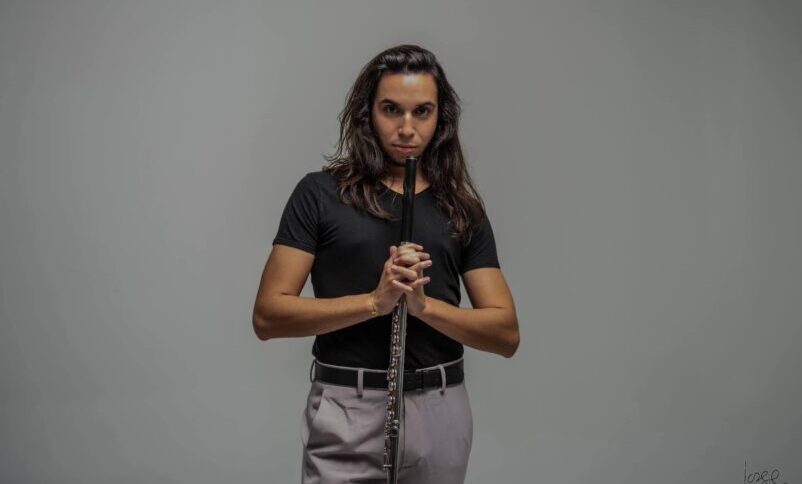
Growing up in Valencia means growing up surrounded by music. Throughout the region, neighbourhood musical societies fill the streets with rehearsals, concerts, and festivals, creating one of Europe’s strongest traditions of community musicianship. It is from this uniquely Valencian culture that flautist Karlos Nao emerged, building a career that blends classical training with flamenco, jazz, Balkan influences, and improvisation. While deeply rooted in tradition, his music continually pushes beyond the ordinary.
Although his performances now take him across Spain, Karlos’ musical journey began much closer to home. “I started when I was 11 and enrolled in the music school in the port, in my neighborhood” he says. That school, the Ateneo Musical del Puerto, was one of Valencia’s many musical societies, where education extends beyond learning an instrument to becoming part of a wider musical community. Encouraged by his father and especially his grandfather, a clarinet player, Karlos developed the discipline and curiosity that would eventually lead him to the conservatory and a professional career.
His path, however, was never supposed to revolve around the flute. When asked which instrument he wanted to study, his answer was immediate: “The electric guitar”. His grandfather quickly ended that conversation with a firm, “Don’t touch that [instrument]”. Although family tradition steered him toward a wind instrument, he still searched for a way to connect it to the kind of music he loved. That changed after discovering the Spanish folk-metal band Mägo de Oz. “I really wanted to play in a rock band… So the only option left was to play the flute because [they are] a rock band that has a flautist”. For the first time, Karlos saw the flute as more than a classical instrument. It became a way to pursue rock music while embracing the instrument that had unexpectedly become his own.
While rock first sparked his imagination, his formal education was firmly rooted in classical performance. After his early training, Karlos continued his studies at Valencia’s Conservatorio Iturbi, where he immersed himself in the classical repertoire before later earning a master’s degree in music research in Zaragoza. Years spent studying composers such as Vivaldi provided the technical precision that still supports his performances today, even as his career has expanded into far more contemporary styles.
His education also reflects something much larger than his own story. In Valencia, music is woven into everyday life through community bands that have shaped generations of musicians. “In Valencia, bands are not rock bands. Bands refer to symphonic bands. Every neighbourhood in Valencia and every town has large marching bands, each with its own music school, youth band, orchestra, and charanga”. Growing up within that tradition meant music was never confined to the classroom, it became part of everyday community life. For Karlos, no comparison captures that identity better than his own: “Flamenco is to Andalusia what marching bands are to Valencia”.
Despite years of classical training, the defining turning point in Karlos’ artistic career arrived unexpectedly during the COVID-19 pandemic. Like many musicians, he suddenly found himself with a lot of time to explore new ideas. After watching flautist Jorge Pardo speak about Camarón de la Isla and Paco de Lucía, his curiosity led him to their music. What began as simple interest quickly became something much deeper. “I said to myself, I’m going to listen to Camarón and Paco Lucía to see who they are. And that was love at first sight. That was the biggest crush of my life on anything. I said, wow, what is this?”. Rather than simply listening, Karlos committed himself to understanding the tradition from its foundations. That meant approaching flamenco as far more than a musical style. Because the flute is not traditionally at the center of flamenco, he immersed himself in every element that gives the genre its identity. “All I had to do was listen to a lot of singing and guitar and then learn about the dance. So, I spent a whole year just studying”. By focusing first on the relationships between voice, guitar, rhythm, and movement, he developed an understanding that extended far beyond technique.
Eventually, there was only one way to continue learning: step onto the stage. “I studied every day for a year until May 2021, when I started meeting people in the flamenco scene in Valencia, to the point where they got me to play at a tablao, and I had no idea what I was doing“. Rather than seeing that uncertainty as a setback, Karlos embraced it as part of the learning process. Each performance deepened his understanding of flamenco in ways that months of independent study never could, forcing him to respond in the moment and develop alongside the dancers, singers, and guitarists around him.
Those experiences also shaped the role he believes the flute should play within flamenco. “As a flautist, I’m not part of the core of flamenco, even when I’m on stage at a tablao. I’m always at the mercy of the dance, the singing, and the guitar”. Instead of competing for the spotlight, he approaches every performance as a collaboration, allowing the music to be guided by the traditions and performers at its center. This perspective has given him the freedom to move between flamenco, jazz, fusion, and theatrical productions while remaining grounded in the same respect for the music.
This same perspective also shapes his interest in Balkan music. As he explains, “They are both folk music genres, and in both, the Romani people have played a very important role… In terms of their origins, the Mediterranean region, and their cultural essence, they are similar”. Recognizing these shared roots allows him to move between traditions naturally, drawing inspiration from both while respecting the history behind each.
Today, that curiosity continues to shape his newest projects. One of the most significant is Por Paco, a collaboration with bassist Nene Maya that pays tribute to Paco de Lucia through performances filmed in Catalonia and Valencia. More than a tribute concert, the project reflects the lasting influence Paco de Lucia’s music has had on Karlos’ own artistic development since first discovering flamenco during the pandemic.
His career, however, is still very much evolving. “In fact, I’m practically living in Barcelona already. I’m going through a period of change and transition right now. An artist also has to find his place”. That search is about more than geography. It reflects an artist who continues to seek new collaborations, new audiences, and new creative challenges while remaining connected to the musical traditions that first shaped him in Valencia.
Report by Faith Callaway & Lilly Salvador
Interview by Will McCarthy
Article copyright ‘24/7 Valencia’
Facebook: https://www.facebook.com/karlos.nao/
YouTube: https://www.youtube.com/c/KarlosNao
Instagram: https://www.instagram.com/karlos.nao/
Related Post










Leave a comment