

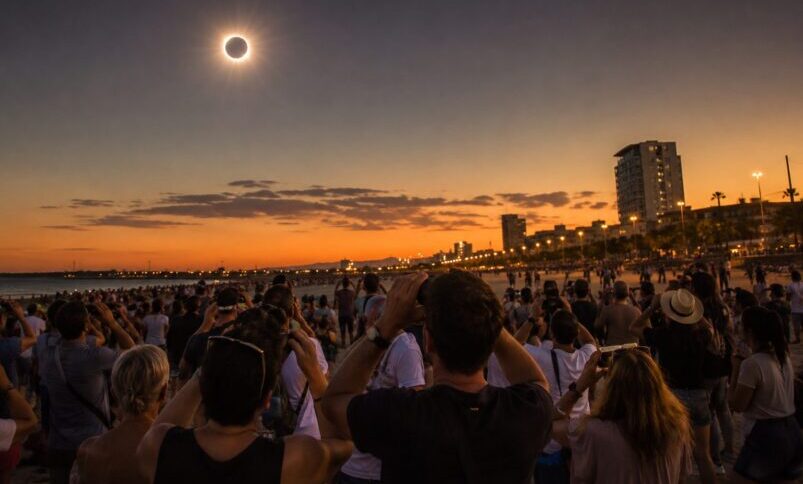

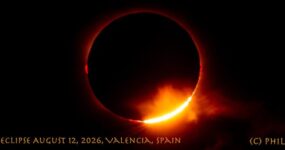
Everything you need to know about watching one of the most spectacular astronomical events in decades – from Valencia, Castellón and beyond. Wednesday, August 12, 2026, is going to be a very special evening in the Comunitat Valenciana. As the sun begins to sink towards the western horizon, the Moon will move directly between the Earth and the Sun, producing a total solar eclipse across much of the region.For many people in Valencia and Castellón, this will be a once-in-a-lifetime experience. The last total solar eclipse visible from mainland Spain was in 1905, making this one of the great astronomical events of the century.And you don’t need to travel to northern Spain to see it. The path of totality passes directly through the Valencian Community, including Valencia city and Castellón. But there is one important catch: the Sun will be extremely low in the sky. This means that choosing the right viewing position – with a completely unobstructed view towards the west – will be crucial.
🌑 WHAT WILL WE SEE FROM VALENCIA?
In Valencia city, the eclipse begins at approximately 19:38, with totality arriving at around 20:32. The Sun will be completely covered for approximately one minute, before the Moon begins to move away again. The Sun will remain partially eclipsed as it approaches the horizon.
That one minute of darkness may sound short, but during totality the experience is dramatically different from an ordinary partial eclipse.
The daylight will fade rapidly, the sky will take on an unusual colour, temperatures may fall slightly and the solar corona – the Sun’s normally invisible outer atmosphere – will become visible around the black disc of the Moon.
The key problem for Valencia is the very low altitude of the Sun. At the moment of totality it will be only around 5 degrees above the horizon, so buildings, trees, hills and even a poorly positioned viewpoint can ruin the experience.
Valencia city: approximately
19:38 – Eclipse begins
20:32 – Totality begins
20:32–20:33 – Approximately one minute of totality
21:00 approximately – Sun sets while still eclipsed
Times vary by a few seconds depending on your exact location.
🌊 WHERE SHOULD YOU WATCH IT IN VALENCIA?
Malvarrosa and Cabanyal beaches
For people who don’t want to leave the city, the Malvarrosa/Cabanyal beach area is an obvious choice because of the open sky and large amount of space.
The Ayuntamiento de València has designated a viewing area along the beach, with a substantial public event planned. Current information indicates that the official viewing area will stretch for approximately 850 metres, with a large public gathering expected.
The beach has the advantage of giving spectators a much wider horizon than the centre of the city. However, don’t simply arrive five minutes before the eclipse: choose your position carefully and make sure buildings do not obstruct your view towards the relevant western horizon.
The Marina and port area
The Marina de València also offers large open spaces and an interesting combination of the eclipse, the Mediterranean and the city’s skyline.
It could be an especially atmospheric place for photographers, although again the low position of the Sun means that you should check the exact line of sight beforehand.
Sagunto and the northern Valencia coast
If you have access to a car, Sagunto and the northern coastal area of the province of Valencia offer another possibility.
At Sagunto, totality will last approximately 1 minute 20 seconds, with the maximum occurring at around 20:32 and the Sun only about four degrees above the horizon.
The important thing here is not simply finding somewhere “high up”. A high location with a mountain blocking the western horizon is useless. What you need is elevation plus a clear western horizon.
⭐ CASTELLÓN: ONE OF THE BEST PLACES IN THE REGION
If you really want to make an evening of the eclipse, Castellón province is arguably the star attraction within the Comunitat Valenciana.
The totality lasts longer here than in Valencia city, and numerous towns fall comfortably inside the path of totality.
In Castelló de la Plana, totality lasts approximately 1 minute 34 seconds, beginning at around 20:31.
Planetari de Castelló
Planetari de Castelló is an obvious place to consider.
Located beside the Mediterranean in the Grau de Castelló, the Planetari has been at the centre of the city’s eclipse activities, with educational workshops and astronomy-related activities planned around the event.
The combination of astronomy, the sea and an open horizon makes the Grau particularly attractive.
Castellón Turismo is also promoting an “Eclipse junto al Mar” experience around the Planetarium and the Mediterranean, with the main event taking place on August 12.
🏰 PEÑÍSCOLA: AN ECLIPSE WITH A CASTLE AS A BACKDROP
Few places in the Valencian Community could provide a more spectacular setting than Peñíscola.
The town sits almost perfectly within the path of totality, with around 1 minute 40 seconds of totality depending on the exact viewing location. The maximum occurs at approximately 20:31.
The catch is the same one affecting the entire Valencian coast: the Sun will be only around four degrees above the horizon.
The castle and old town are spectacular, but don’t assume that the highest tourist viewpoint is automatically the best place to see the eclipse. You need an unobstructed view towards the western/northwestern horizon.
The Ayuntamiento de Peñíscola is organising its own eclipse programme under the title “Vive el gran Eclipse”, making the town an attractive option for anyone wanting to combine the astronomical event with an evening in one of the region’s most beautiful coastal towns.
⛰️ MORELLA AND THE MAESTRAZGO
For something rather different, head inland towards Morella and the northern Castellón mountains.
The higher elevations around Morella offer a very different experience from watching the eclipse from a city or beach. Several municipalities in the area fall directly within the path of totality, including Portell de Morella, Cinctorres, Castellfort, La Mata de Morella and surrounding areas.
Portell de Morella, for example, will experience approximately 1 minute 40 seconds of totality, with the eclipse reaching its maximum at around 20:31.
The advantage of inland locations is the possibility of finding a genuinely open horizon and getting away from urban light pollution.
The disadvantage is accessibility: do not leave your journey until the last minute. Roads in popular viewing areas are likely to become extremely busy.
🔭 WHAT ABOUT THE REST OF THE VALENCIA REGION?
The province of Valencia is largely within or very close to the path of totality. The Asociación Valenciana de Astronomía’s eclipse information lists totality in places including Ademuz, Aras de los Olmos, Llíria, Requena, Sagunto and València, although the duration varies considerably.
This means you don’t necessarily have to travel hundreds of kilometres to experience totality.
For example:
València: about 1 minute
Sagunto: about 1 minute 18 seconds
Aras de los Olmos: about 1 minute 18 seconds
Ademuz: about 1 minute 20 seconds
The further north you go towards Castellón, the longer totality generally becomes.
☀️ AND WHAT ABOUT ALICANTE?
This is an important distinction for readers in southern parts of the Comunitat Valenciana.
Alicante city will NOT experience a total eclipse.
The eclipse will nevertheless be extremely impressive: the Sun will be almost completely covered, with approximately 98.7% of the solar disc obscured in Alicante city. But because a small portion of the Sun remains visible, it will be a partial eclipse, not totality.
That means observers in Alicante must keep their certified eclipse glasses on throughout the entire event.
For those wanting genuine totality, the practical answer is to head north towards the province of Valencia or, preferably, Castellón.
👓 WHICH GLASSES DO YOU NEED?
This is perhaps the most important information in this entire article.
Ordinary sunglasses are NOT safe.
Neither are:
- Polarised sunglasses
- Smoked glass
- CDs or DVDs
- X-rays
- Camera filters
- Homemade filters
- Looking through binoculars or a telescope
- Looking directly through a camera or mobile phone
For the partial phases of the eclipse, you need special solar-eclipse glasses or a solar viewer complying with EN ISO 12312-2 and carrying the appropriate CE marking. Spanish health authorities and ophthalmological experts specifically recommend this standard.
A very important warning
Do not put eclipse glasses over the eyepiece of binoculars or a telescope.
The concentrated sunlight can cause serious eye damage.
If you want to observe the eclipse through binoculars, a telescope or a camera, the equipment needs a proper solar filter fitted at the front of the optical instrument.
Check your eclipse glasses before using them. They should not be scratched, torn, punctured or damaged.
👁️ WHEN CAN YOU TAKE THE GLASSES OFF?
This is the fascinating part.
If you are inside the path of totality, you may remove your eclipse glasses only during the brief period when the Sun is completely covered by the Moon.
The moment totality ends – when the first bright point of sunlight appears – put the glasses straight back on.
The IGN specifically stresses that the glasses should be removed only during totality and replaced immediately afterwards.
For someone watching from Valencia city, that window is only around one minute.
If you are in Alicante, where the eclipse remains partial, you must not remove your protection at any point.
📱 CAN I PHOTOGRAPH THE ECLIPSE WITH MY PHONE?
Yes, but be careful.
A mobile phone camera should not be pointed directly at the Sun for extended periods without appropriate protection, particularly during the partial phases.
If you are using a camera, telescope or binoculars, use a properly designed solar filter attached to the front of the equipment.
And don’t spend the entire eclipse staring at your phone screen.
This is one of those occasions when it is better to put the technology down for a minute and actually look at the sky.
🌅 THE GOLDEN RULE: LOOK WEST
The eclipse occurs very close to sunset.
That makes the Valencia region potentially spectacular – but also technically challenging.
Before August 12, find somewhere where you can see the western to northwestern horizon without buildings, trees or mountains in the way.
A location with an apparently magnificent view may still be unsuitable if a hill or building blocks the Sun at four or five degrees above the horizon.
The official IGN data confirms just how low the Sun will be in the Valencia and Castellón area.
🚗 DON’T LEAVE IT UNTIL 7.30PM
If you are planning to travel from Valencia city to Sagunto, Castellón, Peñíscola or inland Castellón, go early.
Thousands of people are expected to travel towards the path of totality, and August 12 is likely to produce heavy traffic on roads leading towards popular viewing locations.
Our advice is simple:
Choose your location in advance.
Arrive early.
Park legally.
Take water and something to eat.
Bring your eclipse glasses.
Stay put once you’ve found a good viewing position.
Trying to drive somewhere “better” at 20:15 could mean missing the entire event.
🔥 ONE MORE WARNING: DON’T TRESPASS INTO THE COUNTRYSIDE
There is an additional consideration this summer: wildfire risk.
Do not simply decide to drive up a mountain track or walk into a protected natural area because it looks like a good eclipse viewpoint. Restrictions can be introduced during periods of high fire danger, and access to forest tracks and protected areas can be limited or prohibited.
Always check the latest instructions from the Generalitat Valenciana and local authorities before travelling into a natural area.
The Valencian authorities have previously imposed extensive restrictions on access to forest areas during extreme fire-risk conditions, so this is not something to ignore.
🌌 AND THEN… LOOK AT THE SKY
One of the most extraordinary things about totality is that the experience isn’t simply about the Sun.
For roughly a minute, the sky will darken dramatically.
The solar corona will appear around the black Moon. Bright planets and stars may become visible, birds can react to the sudden darkness and the temperature and atmosphere can change noticeably.
And then, almost as quickly as it arrived, the sunlight will return.
For residents of Valencia and Castellón, this is a rare opportunity to experience something that most people normally travel thousands of kilometres to see.
So choose your spot, get your certified glasses, check the weather, face west – and prepare for one extraordinary minute in the Valencian sky.
QUICK GUIDE
DATE: Wednesday, August 12, 2026
ECLIPSE: Total solar eclipse
VALENCIA CITY: Approximately 20:32–20:33 totality
CASTELLÓN CITY: Approximately 20:31–20:33 totality
PEÑÍSCOLA: Approximately 20:31–20:32 totality
ALICANTE CITY: Partial eclipse – approximately 98.7% coverage
BEST DIRECTION: West / northwest
SUN’S ALTITUDE: Only around 4–5° above the horizon in much of the region
EYE PROTECTION: EN ISO 12312-2 eclipse glasses with appropriate CE marking
NORMAL SUNGLASSES: NEVER
TOTALITY: The only phase when people inside the path may safely view the totally eclipsed Sun without glasses
TOP TIP: Arrive early and don’t move once you’ve found a clear horizon.
Report by ‘24/7 Valencia’ team
Article copyright ‘24/7 Valencia’
Related Post













Leave a comment