

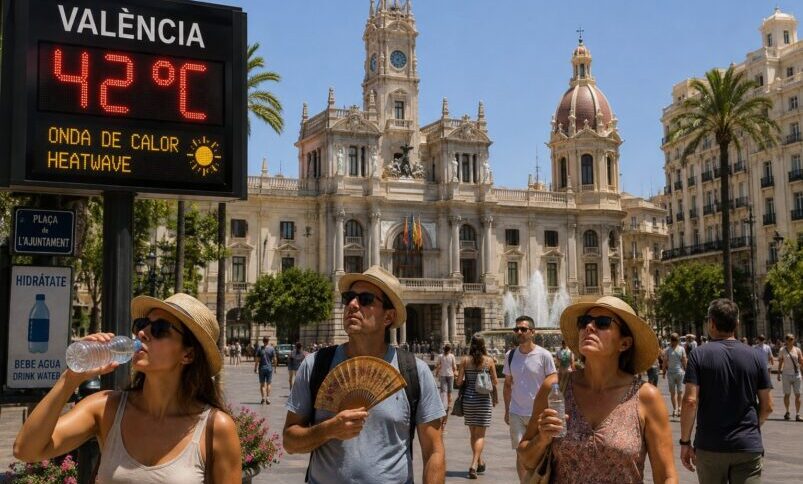
Valencia has always been a hot city. But the summer of 2026 is beginning to feel like something more than simply another Mediterranean summer. From the baking streets of the city centre to the hotter inland towns of the province, repeated episodes of extreme heat have turned the summer into a test of how well Valencia can cope with a rapidly warming climate. And there is an important distinction. Valencia itself, sitting beside the Mediterranean, is often spared the very highest temperatures experienced inland. But the surrounding province has repeatedly been pushed towards — and beyond — 40°C, while the combination of heat and humidity makes conditions on the coast considerably more uncomfortable than a thermometer alone suggests.
A summer that started early
The warning signs were already visible in June.
According to Spain’s State Meteorological Agency, AEMET, June 2026 was exceptionally warm nationally, with temperatures during the period from June 21 to 25 reaching around 9°C above normal in some places. AEMET recorded numerous June temperature records across Spain.
The wider European picture was even more striking. Copernicus reported that June 2026 was the warmest June on record for western Europe, with temperatures across parts of Spain, France, Germany and neighbouring countries several degrees above the 1991–2020 average.
By July, Valencia was repeatedly experiencing heatwave conditions. On July 20, the city was already recording temperatures around 35°C as the region prepared for another heatwave — reportedly the third major heatwave of the Spanish summer at that point.
And inland Valencia could be dramatically hotter.
During one July episode, temperatures in parts of the province approached or exceeded 44°C, while the city and coastal areas remained several degrees cooler because of the moderating influence of the Mediterranean.
Then came August
The latest August episode has provided perhaps the clearest illustration of the difference between coastal and inland Valencia.
On August 18, AEMET recorded 41.4°C at Jalance, 40.9°C at Xàtiva and 40.1°C at Carcaixent. Ontinyent reached 39.9°C.
AEMET subsequently issued warnings for very high temperatures, with the interior of southern Valencia facing temperatures around 40°C and potentially higher.
The reason for the particularly fierce conditions is meteorological as well as climatic.
A persistent area of high pressure — effectively a huge atmospheric lid — encourages clear skies and strong solar heating. In the current episode, this has been combined with a DANA to the southwest of the Iberian Peninsula and a powerful ridge of high pressure over southeastern Spain, helping draw very hot air northwards from North Africa.
Then comes the ponentà: the notorious westerly wind.
When winds blow from the west across the Iberian Peninsula towards Valencia, they descend towards the coast after crossing already-hot land. The air becomes warmer and much drier. The result can be spectacularly high temperatures in Valencia province, particularly inland.
For residents of Valencia city, however, there is another complication.
The Mediterranean: air conditioner or hot-water bottle?
Normally, the sea is Valencia’s great natural temperature regulator.
The Mediterranean absorbs enormous quantities of heat during the summer and prevents the coast from reaching the extraordinary daytime temperatures seen inland.
But a warmer sea also means that the atmosphere may fail to cool properly at night.
This is becoming increasingly important.
Copernicus has reported exceptionally high sea-surface temperatures in 2026, while researchers have highlighted an extraordinary marine heatwave affecting the Mediterranean and other European seas. A recent World Weather Attribution study reported that around 80% of the western Mediterranean surface was experiencing marine heatwave conditions, compared with only about 9% in a hypothetical world without human-caused warming.
For Valencia, this matters because the night is when the body is supposed to recover.
A daytime maximum of 35°C is uncomfortable. But if the temperature remains around 25°C or higher overnight, buildings, pavements and human bodies have much less opportunity to lose their accumulated heat.
This is why a humid Valencia night can sometimes feel more oppressive than a much hotter but dry afternoon inland.
The hidden danger: the urban heat island
There is another reason why Valencia’s heat cannot be understood simply by looking at an official weather station.
Concrete, asphalt, buildings and traffic absorb solar energy during the day and release it slowly after sunset.
This creates an urban heat island, with densely built-up areas remaining warmer than surrounding countryside.
The effect can vary enormously from one neighbourhood to another.
In response, the Centre for Environmental Studies of the Mediterranean (CEAM) has begun deploying a network of around 70 temperature and humidity sensors across Valencia and its metropolitan area, covering densely built areas, residential neighbourhoods, green spaces and peri-urban locations. The aim is to discover precisely how heat behaves at street and neighbourhood level.
It is a fascinating development because the future question for Valencia may not simply be “How hot will Valencia be?”
It may be:
“Which parts of Valencia will be hottest, at what time of day, and why?”
Why is this happening?
It would be wrong to say that every hot day in Valencia is directly caused by climate change.
Heatwaves are natural meteorological phenomena. Atmospheric circulation, high-pressure systems, winds from North Africa and local geography have always produced extreme temperatures in Spain.
But climate change changes the starting point.
When the entire background climate is warmer, an atmospheric pattern capable of producing an extreme heatwave begins with a warmer atmosphere and warmer seas. The result is that exceptionally hot temperatures become easier to reach, and heatwaves are becoming more frequent, persistent and intense.
The statistics from 2026 illustrate the broader trend.
Copernicus has noted that eight of Europe’s nine warmest Junes have occurred since 2019.
And July 2026 was also exceptionally warm globally, with sea-surface temperatures reaching the highest July level on record. The western Mediterranean was among the areas experiencing severe marine heatwave conditions.
So the issue isn’t that Valencia has suddenly become a desert.
It is that the Mediterranean climate itself is warming.
The human cost
Extreme heat is not simply a matter of discomfort.
During the first 16 days of August, Spain’s Daily Mortality Monitoring System (MoMo) estimated 64 heat-attributable deaths in the Comunitat Valenciana, including 17 in Valencia province. Most of the victims were over 65.
The figures are estimates rather than a simple count of people who died directly from heatstroke. Extreme temperatures can aggravate cardiovascular, respiratory and other existing problems, meaning that heat can contribute to deaths that would not necessarily be recorded as “heatstroke”.
This is why prolonged nights of heat can be particularly dangerous for older people and others who are vulnerable.
Report by ‘24/7 Valencia’ team
Article copyright ‘24/7 Valencia’
















Leave a comment