

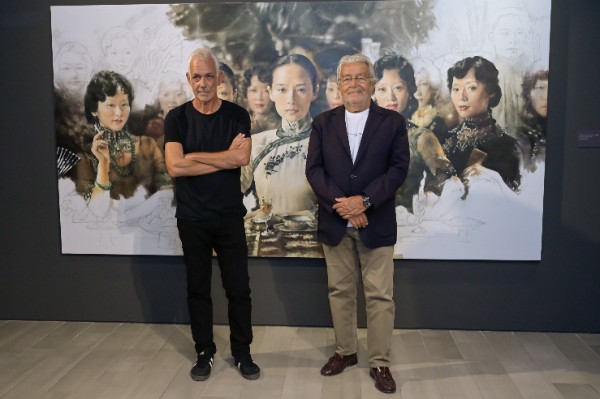
The exhibition proposes a revision of the genre of the interior with figure, framed within Girbent’s constant dialogue with Western pictorial tradition. The show brings together about twenty works, most of them monumental in format, including recent pieces created specifically for this project. Fundación Bancaja presents the exhibition Painting in the 21st Century by the Mallorcan artist Girbent at its headquarters in Valencia. The exhibition offers a look at his plastic interpretation regarding the possibilities and meaning of painting today, the result of a reflection that has been present throughout his entire career. The presentation featured the participation of the president of Fundación Bancaja, Rafael Alcón, and the artist Girbent. The show brings together about twenty works, most of them monumental in format and including recent pieces created specifically for this project, alongside others being exhibited for the first time and some older pieces upon which the artist has intervened, forming an unprecedented collection.
Curated by Arturo Castro, the exhibition proposes a revision of the genre of the interior with figure, framed within Girbent’s constant dialogue with Western pictorial tradition, and reveals the artist’s evolution in his goal of advancing the continuous refinement and exploration of his medium: oil painting. The dialogue with artistic tradition is revealed throughout the exhibition route, which refers to great works and periods in art history, such as the mosaic of Theodora and her retinue in the Ravenna cathedral; Romanesque frescoes; 17th-century Dutch interior paintings; Velázquez’s works *The Spinners* or the fable of *Arachne*; the intimate paintings of Hammershøi or Edward Hopper; Barnett Newman’s compositions with verticals; or film frames from the movies of Wong Kar Wai.
Domestic spaces, architecture, light, and human presence configure silent scenes that invite the viewer to pause and establish new relationships between space, memory, and perception. This is a series of paintings arising from the transfiguration of images from diverse sources, such as the artist’s own photographic archive, the Internet, the world of cinema, or the art world.
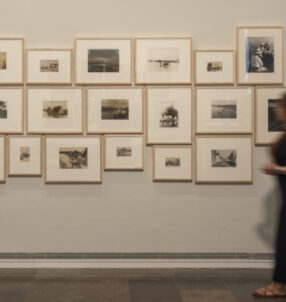
The pieces that reinterpret the pictorial genre of the interior with figure are complemented in the exhibition by works from the *Ad museum* series—a cycle of paintings featuring perspectives of museum interiors filled with figures contemplating artworks—in which Girbent explores the possibilities of oil once his palette is reduced to just two colours: black and white.
The work that closes the exhibition belongs to the *Museum walls* series. In this painting, the artist reduces the subject to its essence—painting, frame, and wall—renouncing the illusion of space and depth. At the same time, the figures that inhabited said space disappear, their role having been replaced by the viewer contemplating the work, situated in front of it. Likewise, the only painted figure that now inhabits this work is also in another dimension: it is the viewer who becomes the protagonist of the represented painting.
The exhibition route is completed with an audiovisual production in which Girbent himself recounts how his working process develops. Additionally, a catalogue has been published for the show, featuring reproductions of the exhibited works along with a text by the curator.
The exhibition can be visited at the Fundación Bancaja headquarters in Valencia (Plaza Tetuán, 23) from October 2, 2026, to January 24, 2027.
The painted image versus the digital image
For Girbent, painting in the 21st century means “dedicating myself to an extraordinarily singular activity, which is producing—from an timeless and tempestuous medium—painted images; that is, images of high ontological complexity destined to stand out above the uniform tide of digital images that surround us. And to do so while being mindful of a very peculiar context, with rules of the game very different from those of Modernity.” Girbent’s artistic practice places the creative process at the centre of his work, prioritizing the *how* over the *what*. He shifts his interest from iconography—the creation of a novel image—toward the singular act of painting itself. The artist considers his responsibility to be limited to the conversion of images from diverse origins into pictorial events, in a decisive commitment to painting, defending the current and superior relevance of the painted image against today’s dominant digital image.
His paintings emphasize the physical presence of the canvas, the thickness of the pigment, the trace of the gesture, and the deliberate construction of each surface. Girbent understands the painted image as “the image made with matter. But above all, with time. A time that transfigures the nature of these images by exponentially increasing their complexity.”
Girbent (Sóller, Mallorca, 1969)
Girbent enrolled in the Faculty of Fine Arts in Barcelona in 1986. He soon left university and for a time frequented the bohemian environments of the Mediterranean city. During this period, he dedicated himself to watching cinema, almost exclusively auteur and experimental films, and reading primarily essays and philosophy.
In 1989, he traveled to the former GDR and enrolled in the famous Leipzig Academy of Art, where he was surprised by the fall of the Berlin Wall. In 1990, he exhibited his first paintings in the group exhibition *The Wall*, in an alternative and countercultural space in the German capital.
A year later, he left Germany and travelled to Mexico City, where he explored the possibilities of video, filming in locations frequented by the *infrarrealistas*, such as the Café Quito on Bucareli Street. In Mexico, he continues to read compulsively, but his interest shifts from the essay to literature: Borges, Gadda, Benet, Pessoa, Faulkner, Joyce… He spends the years 1992 and 1993 in Mérida, on the Yucatán Peninsula.
Following what he considers his Mexican period of reflection, he returns to his native Mallorca and begins collaborating with the Horrach Moyá gallery. There, he meets Juan Antonio Horrach, who will become his gallerist and representative for the following 25 years. A result of this collaboration was the Pictures exhibition cycle, five consecutive solo shows in the galleries of Horrach Moyá over the course of two years.
In 2020, his solo exhibition Opus Nigrum at CAC Málaga marked the restart of artistic activity in Spain following its suspension due to the Covid pandemic. Since then, he has headlined solo exhibitions in Palma de Mallorca, Delft (Netherlands), Valencia, and Berlin.
Report by ’24/7 Valencia’ team
Article copyright ’24/7 Valencia’
Exhibition: Girbent. Painting in the 21st Century
Opening to the public Friday, October 2 at 4:30 p.m.
Date
From 10/02/2026 to 01/24/2027
Venue
Fundación Bancaja
Plaza de Tetuán, 23, Valencia (Valencia)
Hours
Tuesday to Sunday: 10 a.m. to 2 p.m. and 4:30 p.m. to 8:30 p.m.
Closed on Mondays, except on holidays and the eve of holidays.
Exhibition visiting rules.
Tickets
General: 10 euros.
Reduced: 5 euros (pensioners, unemployed, people with disabilities, students aged 13 to 26, large and single-parent families). Proof of each status via documentation issued by an official Spanish organization is required.
Free (children under 12 and companions of people with disabilities).
Tickets available at the box office (Plaza Tetuán, 23). Tickets are valid only for the day of purchase.
The ticket grants access to all exhibitions currently on display.
Guided tours
General public
Duration: 50 minutes.
Sessions: Wednesday (afternoon) / Thursday (morning and afternoon) / Friday (morning and afternoon).
A minimum of 6 people per session is required to conduct the activity.
Price: €5 + Exhibition ticket.
Information and reservations: visitascomentadas@fundacionbancaja.es.
Groups
Duration: 50 minutes.
Sessions: Tuesday (afternoon) / Wednesday (afternoon) / Thursday and Friday (morning).
Maximum capacity: 20 people.
Information and reservations: visitascomentadas@fundacionbancaja.es.
Related Post










Leave a comment