

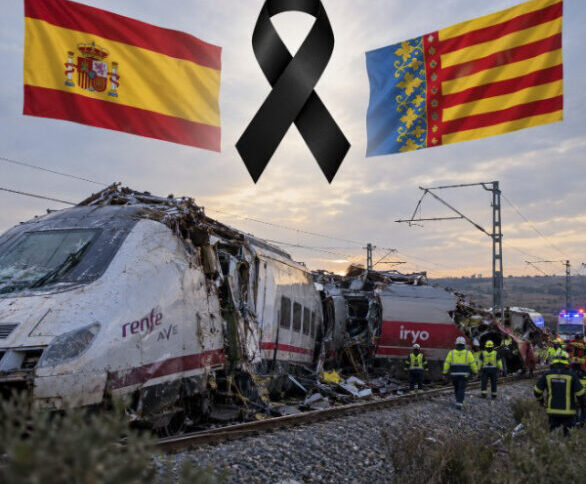

At least 68 people have died after a Renfe AVE train struck a stationary Iryo service near Toledo, nine months after the Adamuz disaster claimed 46 lives. As investigators examine a reported signalling failure and a potentially disastrous decision by rail controllers, questions are mounting over maintenance, accountability and the political future of Pedro Sánchez’s government.
Spain has spent decades building one of the most impressive high-speed railway networks in the world. Its AVE trains have become a symbol of modern Spain: fast, comfortable and capable of connecting Madrid with cities across the country in a fraction of the time required by road or conventional rail.
But two devastating accidents in the space of nine months have shaken that reputation and raised a question no government can afford to ignore: is Spain doing enough to maintain and protect the railway infrastructure on which millions of passengers depend?
On Wednesday, 28 October, a Renfe AVE train travelling from Madrid towards Seville collided with a stationary Iryo high-speed train near Urda, in the province of Toledo. At least 68 people were reported dead, with dozens more injured, making it one of Spain’s deadliest railway disasters in modern times. Rescue workers faced the grim task of searching the wreckage of carriages that had derailed and plunged down an embankment.
The tragedy came just nine months after the Adamuz crash in Córdoba province, where 46 people died in January when a derailment involving an Iryo train led to a collision with a Renfe service.
Although the precise causes of the two accidents have yet to be established conclusively, the repetition of such catastrophic events on Spain’s high-speed network has inevitably intensified scrutiny of railway safety, maintenance and the management of the system.
For the families who have lost loved ones, the immediate priority is justice and answers. For the travelling public, the question is whether the railways remain as safe as they have long been regarded. And for Prime Minister Pedro Sánchez, the disaster presents a formidable political challenge.
WHAT HAPPENED NEAR TOLEDO?
The collision occurred at approximately 08:53 on Wednesday morning on the Madrid–Seville high-speed line, near Urda, between the towns of Mora and Orgaz.
Two services were involved: a Renfe AVE train travelling south from Madrid and an Iryo train, also travelling towards Seville. The Iryo train had stopped on the track after a problem involving the signalling and safety system.
According to the initial account given by Transport Minister Óscar Puente, a failure in the LZB signalling system had caused several trains in the area to stop. The system communicates information between the railway infrastructure and trains, helping to regulate their movements and prevent dangerous situations.
The Renfe train was subsequently authorised to resume its journey, despite a red signal that should have prevented it from proceeding normally. It then struck the stationary Iryo train from behind.
The impact caused several carriages to derail. Some fell down an embankment, while parts of the Renfe train also left the track. The scale of the destruction made the emergency response particularly difficult.
Puente described the decision to allow the Renfe train to continue as inexplicable and apparently erroneous. The sequence of events points towards a potentially critical failure in the way the incident was managed, although investigators must establish precisely who made the decision, what information was available and which safety procedures applied.
The distinction matters. A signalling failure can create a dangerous situation, but railway safety systems are specifically designed to ensure that a technical problem does not automatically become a mass-casualty disaster.
The investigation must therefore establish not simply why the trains stopped, but why the collision was not prevented.
Source: initial statements by the Transport Ministry and reporting by EL PAÍS and RTVE, 28 October 2026.
A SECOND MAJOR RAIL DISASTER IN ONE YEAR
The Toledo crash has inevitably revived memories of Adamuz, where 46 people died on 18 January 2026.
In that accident, an Iryo train travelling from Málaga towards Madrid derailed and collided with an approaching Renfe Alvia service travelling towards Huelva. The circumstances differ from those now emerging in Toledo, and it would be premature to claim that the two disasters share a common technical cause.
Nevertheless, the similarities are troubling: both involved high-speed services, both affected the Madrid–Andalusia corridor, and both have raised questions about the relationship between infrastructure, signalling, operational procedures and the management of railway safety.
Two disasters do not, by themselves, prove that Spain’s entire railway system is unsafe. Nor do they establish that insufficient maintenance caused either accident.
But when catastrophic incidents occur repeatedly, the public is entitled to demand more than assurances that each was an isolated event. Authorities must demonstrate that every plausible common risk has been examined and that lessons from the first disaster have been acted upon.
The Toledo collision is particularly damaging to public confidence because it occurred after the Adamuz tragedy had already placed railway safety under intense scrutiny.
IS SPAIN’S HIGH-SPEED NETWORK BEING PROPERLY MAINTAINED?
Spain has invested enormous sums in its high-speed railway infrastructure. Its network is the largest in Europe and the second largest in the world after China, allowing passengers to travel between major cities at speeds that would have seemed extraordinary a generation ago.
Yet constructing a railway and maintaining it safely over decades are two different undertakings.
Tracks, signalling equipment, telecommunications, power systems, control centres and trains all require regular inspection, renewal and testing. Modern railway safety depends not only on the condition of the rails but also on the reliability of the technology and the procedures that govern movements when something goes wrong.
This is where the latest disaster raises difficult questions.
Reuters reported on 28 October that most Spanish railway investment between 2018 and 2022 had gone towards building new infrastructure, with around 16% allocated to maintenance, renewals and upgrades. That figure warrants scrutiny, although it does not establish whether maintenance spending on the particular section involved in the Toledo crash was inadequate.
The Madrid–Seville line is the oldest of Spain’s high-speed routes. Its signalling technology has been undergoing a transition from the existing LZB system towards the newer European Rail Traffic Management System, or ERTMS.
According to reporting in EL PAÍS, the existing LZB system was still operating while the newer technology was being introduced. Maintaining older equipment while installing and integrating replacement systems can be technically demanding. It requires careful coordination, rigorous testing and clear procedures for managing failures.
A report published by El Debate on 29 October also said the government had authorised a modification to a maintenance contract covering safety and traffic-control installations on the Madrid–Seville and related high-speed routes on the day before the collision. The report cited additional costs and the need to keep the existing LZB system operating alongside ERTMS.
That timing will inevitably attract attention. However, the contract modification is not proof that maintenance failures caused the crash, nor does its timing establish a connection with the signalling malfunction. Those questions require documentary evidence and independent investigation.
The crucial issue is whether the systems were maintained, tested and operated to the required safety standards, and whether any known faults or weaknesses had been adequately addressed.
If investigators identify shortcomings, the public deserves to know whether they arose from funding decisions, delayed upgrades, contractor performance, inadequate supervision or other causes.
RENFE, ADIF AND IRYO: WHO IS RESPONSIBLE?
Understanding the accident also means understanding how Spain’s railway system is organised.
Renfe is Spain’s state-owned passenger rail operator. Its responsibilities include operating trains, employing or contracting operational staff, maintaining its rolling stock and ensuring that its services comply with applicable safety requirements.
Iryo is a private high-speed rail operator that competes with Renfe on major routes. Its train was involved in the collision, but there is no basis for concluding that the company was responsible for the crash simply because its service was stationary on the track.
ADIF, the state-owned railway infrastructure manager, is responsible for managing the rail network, including tracks, signalling installations and the infrastructure used by different train operators.
These responsibilities overlap within a complex operational environment, but they are not interchangeable.
If a signal or communications system fails, investigators must establish the condition of the equipment, the warnings it generated and the procedures followed by the infrastructure manager and train operators.
If a controller authorises a train to move, the investigation must determine the authority under which that decision was taken, the instructions received and whether established rules were followed.
If a maintenance contractor was responsible for relevant equipment, its work records, inspections and responses to previous faults will also need to be examined.
The investigation should therefore consider the complete chain of responsibility, rather than allowing the political debate to reduce the disaster to a single institution or individual.
Ultimately, responsibility could be technical, operational, managerial or political — and more than one level could be involved.
HUMAN ERROR: THE MOST IMMEDIATE QUESTION
The preliminary account of the Toledo collision has placed human decision-making at the centre of the investigation.
If a red signal was active because another train was stationary ahead, why was the Renfe service reportedly authorised to continue at normal speed?
Was the controller aware of the position of the Iryo train? Was the signalling system providing accurate information? Had a procedure been followed incorrectly, or did the available information create a dangerous misunderstanding?
These are questions that must be answered through recordings, communications logs, control-centre data, technical evidence and witness testimony.
Human error is a possible explanation, but it is not a complete explanation in itself.
Safety-critical systems are designed on the assumption that people can make mistakes. Procedures, automatic protections, supervision and clear communication should prevent an individual error from escalating into catastrophe.
If an employee made an incorrect decision, investigators must establish why the decision was made and whether the railway’s safeguards should have prevented its consequences.
Was training adequate? Were instructions clear? Did the control centre have reliable information? Did the system provide an effective means of stopping the train? Were staff operating under unusual pressure or working with equipment that was difficult to interpret?
None of these possibilities should be assumed without evidence. But all are legitimate lines of inquiry.
Blaming an individual before the investigation is complete would be premature. Equally, invoking the complexity of the system must not become an excuse for avoiding accountability.
THE POLITICAL FALLOUT FOR PEDRO SÁNCHEZ
For Pedro Sánchez’s government, the crash presents a serious test of credibility.
Transport infrastructure is a public responsibility, and the government cannot simply distance itself from a disaster because the immediate cause may prove to be an operational mistake or a technical malfunction.
The prime minister has promised a full investigation and said that any necessary measures will be taken to strengthen safety and restore confidence in the railway network. He has also acknowledged that Spain cannot regard two such major high-speed rail disasters in the same year as acceptable.
The political consequences will depend on what the investigation establishes.
If the evidence points to an isolated operational error despite adequate equipment, maintenance and safeguards, the government may argue that the tragedy does not demonstrate a systemic failure. If investigators uncover longstanding maintenance problems, neglected warnings, delayed upgrades or inadequate oversight, the questions facing the Transport Ministry and the wider administration will become much more difficult.
The timing is particularly uncomfortable for a government already operating in a polarised political environment, with electoral pressures approaching. The opposition will be expected to scrutinise the government’s record on infrastructure spending, maintenance contracts and the management of public services.
The reported modification to the maintenance contract on the eve of the crash will add to that scrutiny, although its significance remains to be established.
The opposition, however, also has a responsibility to distinguish documented failures from political allegations. A tragedy of this magnitude should not become an excuse to declare the cause before the evidence is available.
For Sánchez, the most effective response would be transparency: publish the findings as soon as legally possible, commission rigorous independent technical scrutiny, explain the allocation of maintenance spending and set out a timetable for addressing any deficiencies.
Political damage becomes harder to contain when a government appears defensive, dismissive or more concerned with its reputation than with answering legitimate questions.
But no responsible assessment can yet conclude that this accident will determine the government’s electoral fortunes. That will depend on the findings, the government’s response and whether the public believes meaningful changes have followed.
WHAT NEEDS TO CHANGE?
The first priority is to establish exactly what happened and preserve the evidence. Beyond that, the crash should prompt a comprehensive review of railway safety, with particular attention to the following areas.
1. Independent investigation and public accountability
The investigation should reconstruct the movements of both trains, examine signalling and control-centre records, and establish the sequence of decisions that led to the collision. Its findings should be published in a clear, accessible form, with recommendations that can be independently monitored.
2. A rigorous review of signalling and automatic protection
Authorities should verify that signalling failures trigger the correct protective responses and that trains cannot be authorised to proceed unsafely because of ambiguous information or faulty communications. Where older and newer systems operate together, their compatibility and fail-safe behaviour must be rigorously tested.
3. Maintenance before expansion
Spain should publish a clear account of how railway spending is divided between new construction, routine maintenance, renewals and safety upgrades. This would allow the public to assess whether existing infrastructure receives the investment required to keep it reliable.
4. Better reporting of faults and near misses
Minor incidents, signalling irregularities and near misses can reveal weaknesses before they produce a major accident. A strong safety culture encourages staff to report problems without fear of unfair punishment, while ensuring that genuine negligence is investigated and addressed.
5. Clearer procedures for controllers and train operators
Emergency and degraded-mode procedures must be unambiguous. When communications or signalling fail, staff need clear instructions about whether trains must remain stopped, what authority is required to move them and what restrictions apply.
6. Independent safety oversight
Safety regulators and investigators must have the expertise, resources and independence to examine infrastructure managers, operators, contractors and government decisions. Their recommendations should lead to measurable improvements rather than disappear into administrative reports.
7. Support for victims and their families
The human consequences will continue long after the wreckage has been cleared. Families need reliable information, practical support and clear answers about compensation and responsibility. They should not have to fight through a maze of institutions to obtain them.
CAN SPAIN RESTORE CONFIDENCE IN ITS RAILWAYS?
Spain’s high-speed network remains a major national achievement. It has transformed domestic travel, strengthened links between cities and offered an alternative to flying and driving. Two major accidents do not erase those accomplishments, nor do they establish that travelling by high-speed train is generally unsafe.
But public confidence cannot be sustained by pointing to the network’s size, speed or technological sophistication.
It depends on the less visible work: inspecting equipment, renewing ageing components, maintaining reliable signalling, training staff and ensuring that every level of the railway system is prepared for things to go wrong.
The central lesson of the Toledo disaster may ultimately be that safety depends on the whole system working together. Even if a technical failure or an incorrect human decision proves to have triggered the collision, the investigation must establish why the available protections did not prevent it.
For Spain, the challenge is now twofold: to establish the truth about the deaths near Urda and to demonstrate that the lessons are being applied across the network.
For the Sánchez government, that means accepting scrutiny rather than treating it as an attempt to exploit a tragedy. For Renfe, ADIF, Iryo and their contractors, it means providing the evidence needed to determine what went wrong. And for the travelling public, it means being given more than reassurances.
Spain built its high-speed railway network as a symbol of what a modern country could achieve. The task now is to ensure that its reputation rests not only on how quickly its trains travel, but on the confidence passengers can place in the systems designed to bring them safely home.
Report by ’24/7 Valencia’ team
Article copyright ’24/7 Valencia’
Related Post

















Leave a comment