

From award-winning wildlife photography to the narrow streets of Valencia’s historic centre, American photographer Max Dobens is on a mission to help people see the world differently. Now offering photography tours in the city he has called home since 2020, he explains why the best images often come to those who slow down, observe and learn to look beyond the obvious. Photography is as much about learning to see as it is about knowing how to use a camera. For Max Dobens, an award-winning nature and wildlife photographer originally from Hamilton, New York, the secret lies in patience, curiosity and an eye for the details that others overlook.
His photographic journey has taken him across the globe in search of extraordinary encounters with the natural world. From spending 33 hours in a hide waiting for the elusive Iberian lynx to exploring the intricate movements of pollinators through macro photography, Dobens understands the rewards of waiting for the right moment. His work has earned international recognition, including a Gold Medal at the European Photography Awards.
Since making Valencia his permanent home in 2020, he has turned that same observational instinct towards the city’s streets, alleyways, reflections and unexpected details. Rather than concentrating on the familiar landmarks, he seeks out the overlooked corners and fleeting moments that give a place its individual character.
Dobens now shares his approach through photography tours in Valencia, welcoming participants of different experience levels, including those who use nothing more than a mobile phone. His tours are not simply about taking better pictures; they are about learning to notice more, compose more thoughtfully and experience the city with fresh eyes.
We spoke to Max about the connections between wildlife and street photography, the importance of switching off in a digitally distracted world, and why the most meaningful photograph is ultimately the one that makes someone feel something.
Seeing Valencia differently
24/7 Valencia: From wildlife to Valencia’s streets
You are best known for your award-winning nature and wildlife photography, where patience and an eye for detail are essential. What first attracted you to photographing Valencia’s streets, and what have you discovered here that you might otherwise have overlooked?
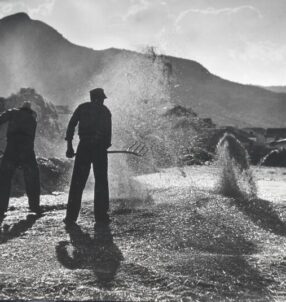
MAX DOBENS: I love capturing images of wildlife because animals are wild, unpredictable and glorious. However, I live in a city and can’t always travel to wildlife rich areas. When shooting street photography there is that same unpredictability, I find in nature which is exciting. When I visit Paris, I never shoot the Eiffel Tower because everyone else does. Similarly, when at home in Valencia, I will never shoot the Ciudad de las Artes y las Ciencias. I prefer to find an overlooked object or a special place that very few people know about and capture images in that environment.
24/7 Valencia: Seeing is not the same as observing
In your article, Why I Lead Photography Tours, you describe the difference between simply seeing something and really observing it. Could you explain what you mean by that, perhaps with an example of an ordinary scene in Valencia that becomes extraordinary when you look at it differently?
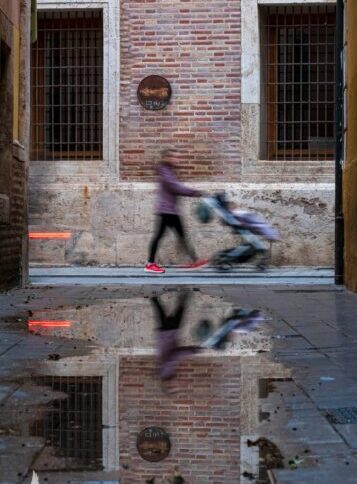
MAX DOBENS: The writer Susan Sontag once said: ‘The painter constructs; the photographer discloses.’ This quote has profoundly impacted me, as in modern society we are inundated with information and visual stimuli. The challenge for a photographer is to filter out what is unimportant and ultimately reveal what they find important. Here in Valencia, we enjoy 330 days of sun each year which means on the few days when it does rain, I go looking for a puddle. I like to show the reflection of people, bicycles or whatever passes by in a puddle because it is visually interesting, uncommon and just plain fun. I also like to use a tripod and lower the shutter speed to blur the image and see what that can create.
24/7 Valencia Beyond the tourist trail
Valencia has plenty of iconic sights, from the City of Arts and Sciences to the historic centre and the beaches. Yet your tours deliberately explore lesser-known places. What do you think visitors miss when they follow the usual tourist itinerary, and are there particular neighbourhoods or types of scene that reveal a more unexpected side of the city?
MAX DOBENS: I have a different philosophy than most people. When I go to a city I have never visited, I never take a formal “city tour” because I prefer to walk, explore and observe on my own. Valencia means different things to different people and that’s fine. On my tours, I prefer to explore the smaller streets and alleys of the Ciutat Vella because that’s where I always find plenty of character, lines, shapes, and shadows. Furthermore, I even offer a 3-hour custom tour as an alternative to my classic 3-hour tour, where the participant can specify exactly what they want to see and I will arrange the itinerary specifically for them.
24/7 Valencia: The art of waiting
When photographing wildlife, you might spend hours waiting for an animal to appear at precisely the right moment. How does that patience translate into urban photography? Is the challenge in Valencia to anticipate a moment, find the right light, or simply slow down enough to recognise a photograph when it presents itself?
MAX DOBENS: That’s a great question because there are important similarities between the two. In the Ciutat Vella, I have a special ‘callejon’ or alley that I like to shoot because there’s no visual warning as to what will pass in front of you or from which side as I shoot from about 10 metres away onto a small street. I must be prepared, prefocused on where the subject will be and wait for precisely the right moment. One time during a shoot here I even brought a small foldable camping stool to sit and wait. These are all techniques that I learned and perfected while shooting wildlife in the field.
24/7 Valencia: A different kind of photography tour
Your photography tours are designed for people with different levels of experience, including those using nothing more than a mobile phone. What do you hope participants take away from the experience beyond better photographs? Can learning to observe more carefully actually change the way someone experiences a city?
MAX DOBENS: On my photography tours I teach participants observation techniques and how to think differently to improve their compositions. I remember playing pool as a young man when someone asked me where I was going to leave the cue ball after my shot. I’d never considered that, as I assumed everyone just focused on hitting the balls into the pocket. Similarly, most people take photos with their camera or phone without considering the background, the shadows, or how all the elements are arranged in the image. Furthermore, in order to properly observe you must learn and practice observation techniques. That’s what I want people to take away from my tour.
24/7 Valencia: From America to the Mediterranean
Originally from Hamilton, New York, you made Valencia your permanent home in 2020, drawn by the prospect of a richer quality of life. How has living here influenced your photography, and has your relationship with the city changed as you have got to know it more intimately?
MAX DOBENS: Living in Valencia has introduced me to the entire country of Spain and all that it has to offer from a photographic perspective. I began digging deeper into unique wildlife and became fascinated by the Iberian Lynx. In 2024 I spent 33 hours in a photography hide over 3 days waiting patiently for an encounter and had one amazing experience. Furthermore, being so close to the Mediterranean has made it easy to become certified to scuba dive and open the new chapter of underwater photography. Living in Valencia has also introduced me to macro photography and I am excited to say that I have a photography project accepted for a solo exhibition by the University of València Botanic Garden. It involves capturing images of pollinators using ultra-fast shutter speeds to freeze them in motion.
24/7 Valencia: Photography, nature and the digital age
You have encouraged people, particularly younger generations, to put their phones away and pay attention to the world around them. Photography itself, of course, often involves looking through a screen. How do you reconcile these two things, and do you think social media has helped us appreciate images or made us less attentive to the world that produces them?
MAX DOBENS: During the 33 hours I spent in a photography hide waiting for the Iberian Lynx, I remember turning off all the audible notifications on my phone so as not to alarm any lynx. I also had to force myself to ignore the constant temptation to look at my phone while waiting. This technology cleanse helped me hone my observational skills and it was an unexpected and brilliant by-product of the experience. I found myself simply watching the leaves move, looking for patterns in the shadows and scouring the visible area for any signs of animal life. It became a meditative process whereby I was able to disconnect from technology and reconnect with observing the natural world.
Social media is a tool to be used, but it is purposefully designed to be all consuming. The user needs to understand this and use it as a tool without becoming a tool of the social media platform itself. One of most unfortunate examples of this is when I saw people with their faces buried in their phones while walking on a forest trail.
24/7 Valencia: The meaning behind the image
Max: You have spoken about wanting to bring tranquillity and joy into people’s homes through your fine-art nature photography. You also say that leading tours is about sharing something you love rather than becoming wealthy. What ultimately makes a photograph meaningful to you, and what would you most like people to discover about themselves, nature or Valencia through your work?
MAX DOBENS: At a recent art fair in Munich, I vividly recall watching people’s faces as they smiled when they looked at my work. This is what photography means to me. When someone sees my work and it elicits a smile or any emotional reaction then I know that I have achieved my goal. The most organic beauty comes from nature and I have travelled the globe to visit places that most people don’t have the opportunity to visit. Sharing that experience through images that capture a specific moment in time is what it is all about. Although I truly enjoy the sights, sounds and smells of nature during my photography trips, simply capturing a spectacular image is not enough. The image only becomes meaningful when it somehow engages the viewer.
Report by Will McCarthy
Article copyright ‘24/7 Valencia’
Photos copyright Max Dobens
More info about Max Doben
🏆 The European Photography Awards – Gold Medal Winner
Max Dobens Photography: Nature Photography Galleries
Related Post





Leave a comment