

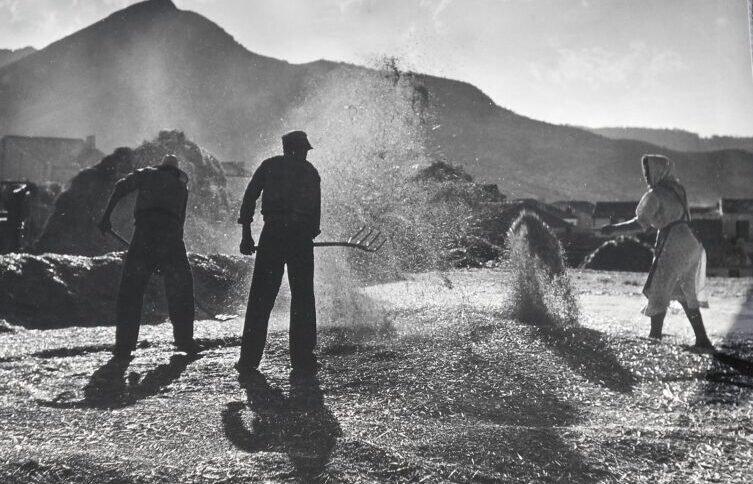
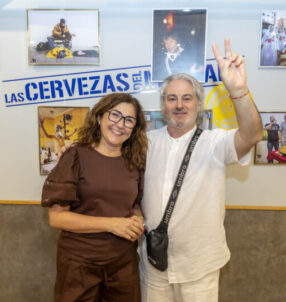
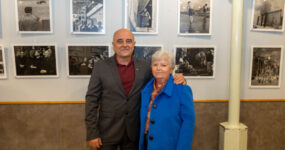
This exhibition recovers the work of a Valencian amateur photographer who documented, with sensitivity and precision, the landscapes, trades, customs, and scenes of everyday life in the countryside during the 1950s and 1960s. This is *El campo en la Valencia de los 60* (The countryside in the Valencia of the 60s), which has just opened at the ‘Casino de Agricultura’ in ther city of centre of Valencia. It recovers the photographic gaze of Enrique Borredá Puyo (Aiacor, Canals, 1921 – Xàtiva, 2005), an amateur photographer whose work constitutes a valuable artistic and documentary testimony of Valencian rural life in the mid-20th century.
An inspector for the National Statistics Institute, Borredá Puyo travelled extensively to carry out agricultural censuses and discovered his passion for photography in the mid-fifties when he acquired his first camera, a Rolleiflex. This began a photographic activity that would eventually become a true vocation. He installed a darkroom in his own home to develop his photographs and personally perfect the entire process. In the late fifties, he joined Foto Club Valencia, one of the leading photographic entities in Valencia at the time, where he eventually served as president for several years. In this role, he promoted local, national, and international photography competitions. His participation in international contests led him to obtain the FIAP distinction, a recognition that accredits the quality achieved by his work within the field of amateur photography. Throughout the sixties and seventies, he continued his photographic work with special attention to the landscape, people, and ways of life in his surroundings. In the early seventies, he incorporated two Asahi Pentax cameras, as well as various telephoto lenses, expanding his technical possibilities, though he never abandoned his beloved Rolleiflex.
A window to rural Valencia
The photographs gathered in *El campo en la Valencia de los 60* allow one to journey through a rural world that was beginning to change and which, to a large extent, has disappeared or been radically transformed. Borredá Puyo directs his camera toward agricultural labour, landscapes, domestic spaces, traditions, and human relationships. His images show agriculture not as a simple backdrop, but as a way of life: men and women, animals, tools, paths, harvests, and moments of rest are all part of the same reality. The exhibition includes images linked to different points in the Valencian regions, such as Canals, Aiacor, La Costera, Bolbaite, Rotglà i Corberà, Enguera, or Chera, in addition to photographs taken in Alto Palancia. Among them are three images dedicated to the Tribunal de las Aguas (Water Tribunal), one of the oldest institutions linked to Valencian agricultural culture; scenes of citrus cultivation, such as *Plantant tarongers I* and *Plantant tarongers II*, taken in 1962 in the Fontanars area of Canals; or the interior of an old “cebera,” the sheds in the orchards where onions, garlic, and other vegetables were dried. Also present are works depicting field labour in images such as *Faena acabada* (Work finished) and *Aventando la mies* (Winnowing the grain), both from 1961 and taken in Alto Palancia, as well as scenes of everyday life: a father and son returning from work with their mule in *Vida rural I* (Rural life I), women filling pitchers at the village fountain in *Dos veces agua* (Twice water), or a gathering of retired farmers at the Rotglà i Corberà casino.
Landscapes and small stories
Borredá Puyo’s camera is not limited to mere recording. There is a clear intention of composition, a search for form, and an attention to light in his photographs—traits that also explain his recognition in the field of amateur photography. Landscapes such as *Els Serrans I, II and III*, *Sombra* (Shadow), or *Secano* (Dryland) show his interest in the plastic possibilities of the territory. In other images, his gaze stops on seemingly mundane details and turns them into protagonists: a spiderweb in an orange grove in *Geometría* (Geometry), the objects and forms of wood in *Formas, madera y animales* (Forms, wood and animals), or the old *bengalero*, a common piece of furniture at the entrance of houses where hats, caps, and sticks used in the fields were hung. The exhibition also gathers moments of leisure and social life. In *Jocs* (Games), Borredá Puyo portrays the forms of entertainment in the villages of the era, while *Izquierda* (Left) brings together in a single scene some of the elements that were part of daily street life: a game of pelota, the ice cream man, or the sale of *porrat* and sweets.
Contrasting these collective scenes is the intimacy of *Soledad* (Solitude), where a shepherd from the Enguera area rests in his mountain hut.
An archive to recover memory
The value of this exhibition also lies in the archival dimension of Enrique Borredá Puyo’s work. His son preserves more than 5,000 negatives, as well as numerous developed photographs. Many of them retain notes on the back made by the photographer himself, including the title, the date, and, in some cases, the contest or exhibition in which they participated. This archive allows for the reconstruction not only of the career of an amateur photographer with notable artistic curiosity but also of a part of the social and cultural memory of rural Valencia during those years.
The exhibition thus presents a dual reading. On one hand, it allows for the discovery of the work of a photographer who dedicated much of his life to observing and capturing his surroundings with his camera. On the other, it offers the visitor the opportunity to reconnect with the landscapes, labors, objects, customs, and ways of relating that form part of the recent history of Valencian towns.
The countryside in Valencia during the 60s is, ultimately, an invitation to look back to discover what that territory was like and how those who inhabited it lived. It is a personal gaze that, more than half a century later, also takes on the value of a collective memory. Enrique Borredá Puyo passed away at his home in Xàtiva on August 2, 2005, at the age of 84. This exhibition now recovers a small part of his photographic legacy and returns to the public eye those images of a Valencian countryside that now belongs to memory. The exhibition is open to the public and is until November.
Photography Exhibition visiting hours:
Monday to Friday (second floor)
12h-14h
17h-20h
Report by ’24/7 Valencia’ team
Article copyright ’24/7 Valencia’
Casino de Agricultura de Valencia
C/ de les Comèdies, 12
Ciutat Vella
46003 València, Valencia
Tel: 963 51 71 42
Related Post
















Leave a comment