

The Valencian Community’s most important national day returns with its historic Senyera procession, the spectacular Moros y Cristianos parade and a special tribute to Jaume I. But this year, the cancellation of the traditional mascletà in Plaza del Ayuntamiento brings the city’s housing crisis into the heart of the celebrations.
Every 9 October, Valencia looks back to the moment that helped shape its identity. Flags appear across the city, traditional music fills the streets, the historic Senyera takes centre stage and thousands of people gather to celebrate the history, language and culture of the Valencian Community.
Yet this year’s celebrations arrive against an unusually charged backdrop. An encampment protesting against the housing crisis has occupied Plaza del Ayuntamiento, forcing the cancellation of the traditional 9 d’Octubre mascletà on safety grounds. At the same time, the campers have indicated their willingness to move their tents to one side to facilitate the passage of the civic procession.
The result is a celebration in which centuries-old traditions and one of contemporary Valencia’s most urgent social issues find themselves sharing the same public space.
What exactly is 9 d’Octubre?
9 d’Octubre, or Nou d’Octubre in Valencian, is the official day of the Valencian Community. It commemorates the entry of King Jaume I of Aragon into Valencia on 9 October 1238, during the Christian conquest of the city.
Following the conquest, Valencia became the centre of the newly established Kingdom of Valencia, which developed its own legal framework, institutions and distinctive cultural identity within the Crown of Aragon.
For Valencians, the date represents much more than a military victory. It is associated with the historical development of their political institutions, the evolution of Valencian as a language, and the traditions that continue to distinguish the region today.
Modern celebrations bring together people with different political views, cultural backgrounds and interpretations of Valencian identity. For some, the day is primarily about historical continuity and regional pride; for others, it is an opportunity to celebrate the language, popular culture and distinct character of the Valencian people.
Whatever their perspective, 9 d’Octubre remains one of the most significant dates in the city’s calendar.
Jaume I: the king behind the celebration
Jaume I, known in English as James I of Aragon, was one of the most influential monarchs of medieval Iberia.
Born in 1208, he led the expansion of the Crown of Aragon into territories that included Mallorca and Valencia. His forces entered Valencia in 1238, following a prolonged campaign against the Muslim-ruled taifa of Valencia.
The conquest transformed the political and religious character of the territory. The Kingdom of Valencia subsequently developed its own institutions and laws, known as the Furs de València, which helped establish a distinctive legal and political tradition.
The history is complex. The conquest also brought profound changes for the Muslim population, including displacement, religious transformation and the reorganisation of society under Christian rule. Understanding 9 d’Octubre today means recognising both its importance in the formation of Valencian institutions and the wider historical consequences of the conquest.
Jaume I died in 1276, making 2026 the 750th anniversary of his death. This milestone gives this year’s festivities additional significance.
The Reial Senyera: a flag unlike any other
One of the most moving moments of 9 d’Octubre is the appearance of the Reial Senyera, Valencia’s historic royal flag.
The Senyera is not simply another regional flag. Its distinctive design, featuring red stripes on a yellow background and a blue band along the hoist, has become one of the most recognisable symbols of Valencian identity.
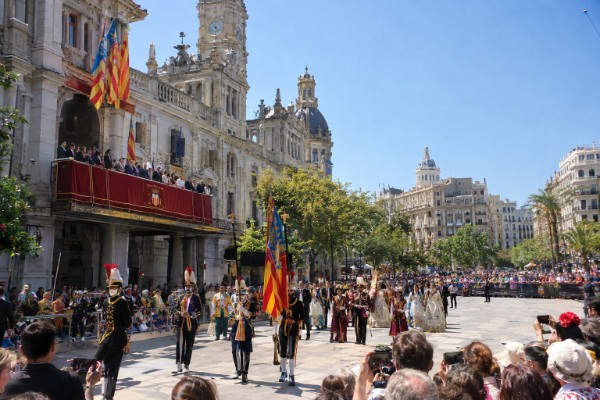
Its ceremonial treatment is particularly important. During the annual civic procession, the flag is lowered from the balcony of the Town Hall without being tilted or bowed. The ritual reflects the traditional honours accorded to the historic royal standard.
The procession is a solemn occasion, bringing together municipal representatives, civic organisations, traditional musicians and members of the public.
Since 2016, the civic procession has been recognised as an Asset of Cultural Interest (Bien de Interés Cultural), reflecting its historical and cultural importance.
A special year for the Senyera and Jaume I’s sword
The 2026 programme places particular emphasis on the 750th anniversary of Jaume I’s death.
A major feature is the return of Jaume I’s historic sword to the civic procession after approximately 50 years of absence from this particular ceremony.
The sword’s precise connection to the weapon carried by Jaume I himself cannot be definitively established. However, the piece has a long documented history in Valencia’s civic commemorations, dating back to the seventeenth century.
On 8 October, visitors had the opportunity to see the Reial Senyera and the sword together at the Town Hall’s Salón de Cristal.
Their appearance in the procession on 9 October adds a powerful historical dimension to this year’s celebrations, connecting Valencia’s medieval past with its modern civic identity.
The civic procession: the heart of 9 d’Octubre
The main civic ceremony begins at midday in Plaza del Ayuntamiento with the traditional lowering of the Reial Senyera.
The procession then follows a historic route through the city centre, passing along Calle de San Vicente and Plaza de la Reina before reaching Valencia Cathedral, where a Te Deum is held.
The procession continues through the historic centre towards Plaza de Alfonso el Magnánimo and the Parterre, where a floral tribute is paid to the equestrian statue of Jaume I.
The cortege subsequently returns towards Plaza del Ayuntamiento.
For residents and visitors, this is an opportunity to see Valencia’s traditions at their most formal: the Senyera, the historic sword, ceremonial music and the participation of civic representatives.
This year, the procession also carries a practical significance. Its route must be accommodated alongside the housing encampment in the square, making cooperation between the organisers and the protesters particularly important.
Why has the 9 d’Octubre mascletà been cancelled?
The most controversial development of this year’s festivities concerns the traditional mascletà, the powerful daytime firecracker spectacle that normally concludes the civic procession.
On 8 October, Valencia City Council announced that the mascletà scheduled for Plaza del Ayuntamiento on 9 October would not take place.
The decision followed safety concerns raised by the Government Delegation, with the large housing encampment occupying space required for the security arrangements around the pyrotechnic display.
A mascletà is not simply a matter of lighting a few fireworks. It involves carefully planned firing positions, controlled access, protective barriers and a designated safety perimeter. With hundreds of tents and large numbers of protesters occupying the central square, the necessary arrangements could not be guaranteed.
The cancellation was confirmed by the city council, which said the decision followed the Government Delegation’s response to its request concerning the security of the celebrations.
Importantly, the cancellation of the mascletà does not mean that 9 d’Octubre has been cancelled. The civic procession and other principal events are continuing, while the afternoon Moros y Cristianos parade remains on the programme.
For many Valencians, the absence of the mascletà will be a disappointment. The sound of the explosions is an integral part of the city’s festive identity, and the 9 d’Octubre display traditionally provides a dramatic finale to the morning ceremony.
Nevertheless, public safety has become the determining factor in this year’s decision.
The housing encampment: a social crisis in the city’s main square
The protest in Plaza del Ayuntamiento began in early October and has grown into a substantial encampment, with hundreds of tents and a large number of participants.
Its central demand is action on access to affordable housing. Protesters have called for measures including greater public housing provision, controls on housing costs and action concerning properties held by large investment funds.
The demonstration has also drawn attention to the difficulties experienced by people facing eviction or struggling to afford accommodation in Valencia.
The encampment has become a visible expression of a debate affecting cities across Spain: how to reconcile tourism, investment, rental demand and the interests of property owners with the need for homes that ordinary residents can afford.
Plaza del Ayuntamiento is an especially prominent location for such a protest. It is one of Valencia’s principal civic spaces and the setting for major celebrations, public demonstrations and the daily life of the city.
Its occupation has therefore brought the housing debate into direct contact with the traditional public rituals of 9 d’Octubre.
The two issues are not necessarily incompatible. The celebrations express a sense of collective identity, while the protest concerns the conditions in which people live and their ability to remain in the city. The disagreement lies partly in how the square should be used and how public events can proceed safely while the demonstration continues.
An agreement to make room for the procession
Although the mascletà has been cancelled, the housing protesters have indicated that they are prepared to reorganise the encampment and move tents aside to facilitate the civic procession.
The distinction is important: moving some tents to clear a route is not the same as dismantling the protest.
The campers have maintained their intention to continue demonstrating for housing rights, while also acknowledging the cultural importance of 9 d’Octubre to the city.
This willingness to accommodate the procession offers a possible example of two different forms of civic participation sharing the same space. One is a long-established public ceremony rooted in Valencia’s history; the other is a contemporary movement demanding change.
The practical challenge is ensuring that the procession can pass safely without undermining the demonstrators’ right to peaceful assembly.
There has also been disagreement between political representatives over responsibility for managing the situation, including the respective roles of the city council and the Government Delegation.
The immediate priority, however, is the safe and orderly running of the day’s events.
Moros y Cristianos: history brought to life
The celebrations continue in the afternoon with Valencia’s 21st annual Moros y Cristianos parade.
The event features elaborately dressed groups representing the Moors and Christians, accompanied by music, pageantry and colourful costumes. Inspired by the historical encounters between Christian and Muslim forces in medieval Iberia, these celebrations have become an important part of the region’s popular festive culture.
The programme includes the Bajada de Gloria, scheduled for 15:45, followed by the main parade at 17:00.
The procession begins in the Jardines de la Glorieta and proceeds along Calle de la Paz, Calle Poeta Querol and Calle de las Barcas, passing through Plaza del Ayuntamiento before continuing along Avenida del Marqués de Sotelo.
This year’s parade also includes representatives associated with 11 municipalities affected by the devastating October 2024 DANA floods: Catarroja, Massanassa, Benetússer, Aldaia, Sedaví, Paiporta, Alaquàs, Quart de Poblet, Manises, Riba-roja and Chella.
Their participation provides a gesture of solidarity with communities that suffered severe damage and loss during the floods.
The parade brings another dimension to the day: the ability of popular traditions to connect different generations and communities through music, costume and shared public celebration.
The mocadorà: Valencia’s romantic tradition
There is also a sweeter side to 9 d’Octubre.
The date coincides with the feast of Sant Donís, traditionally regarded as Valencia’s equivalent of a lovers’ day.
Couples exchange the mocadorà, a collection of marzipan sweets wrapped in a handkerchief. The sweets often include figures known as the piuleta and tronaor, shaped to recall traditional firecrackers.
The custom has its roots in the history of the celebration following the conquest and the changing religious and political traditions of the period. Over time, it developed into a distinctly Valencian expression of affection and craftsmanship.
Today, the mocadorà remains a popular way for couples to celebrate the date, with local bakeries producing elaborate marzipan creations.
It is a reminder that 9 d’Octubre is not exclusively about official ceremonies or medieval history. It is also a living popular festival, expressed through food, family, romance and local traditions.
What else is happening in Valencia?
The official programme began on 2 October and has included cultural activities, historical exhibitions, traditional music and dance.
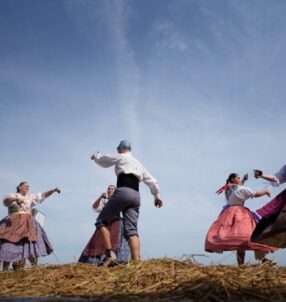
The programme has featured an exhibition exploring the image of Jaume I, readings connected with his chronicle, traditional Valencian dances and a popular dansà in Plaza del Ayuntamiento.
The international fireworks festival on the eve of 9 October has also formed part of the wider celebrations, with displays at the Monteolivete Bridge.
On the main day, the civic procession and afternoon Moros y Cristianos parade remain among the principal events, despite the cancellation of the mascletà.
Visitors should check the Valencia City Council’s official 9 d’Octubre programme for the latest information and any changes to arrangements.
A celebration that reflects Valencia today
The story of 9 d’Octubre has always involved questions of identity, history and the kind of society Valencia wishes to be.
The celebration commemorates a decisive medieval event, but its meaning is not frozen in the thirteenth century. The Senyera, the civic procession, the Moros y Cristianos parade and the mocadorà have all acquired significance through generations of changing social and cultural life.
In 2026, the housing encampment adds a particularly visible contemporary issue to that story.
For the protesters, the square is a place to demand a more affordable future. For the city, it is also a historic setting for ceremonies that many residents regard as essential to Valencian identity. The cancellation of the mascletà demonstrates the practical consequences of trying to accommodate both.
The willingness of the campers to move their tents aside for the procession suggests that, at least in this respect, a degree of cooperation remains possible.
Valencia will therefore celebrate 9 d’Octubre without one of its most familiar pyrotechnic spectacles, but with its central civic traditions intact.
And perhaps this year’s events offer a timely reminder: a city’s identity is shaped not only by the history it commemorates, but also by the challenges its citizens face in the present—and by how they choose to confront them together.
Report by ’24/7 Valencia’ team
Article copyright ’24/7 Valencia’
FAST FACTS: 9 D’OCTUBRE 2026
- Date: Friday, 9 October.
- What it commemorates: Jaume I’s entry into Valencia in 1238.
- Historical anniversary: 750 years since Jaume I’s death in 1276.
- Main morning event: The civic procession featuring the Reial Senyera and Jaume I’s historic sword, starting at 12:00.
- Mascletà: Cancelled in Plaza del Ayuntamiento because the required safety arrangements could not be guaranteed amid the housing encampment.
- Afternoon highlight: The 21st Moros y Cristianos parade, scheduled for 17:00.
- A local tradition: The mocadorà, the Valencian custom of exchanging marzipan sweets on Sant Donís.
- The issue behind the headlines: The continuing debate over affordable housing and the right to peaceful protest
Related Post











Leave a comment