

Will McCarthy takes the BBC audience inside Valencia’s world-famous tomato battle — from Buñol’s 1945 origins to Bollywood, Nino Bravo and Hollywood. There are some assignments where you arrive with a notebook. And then there are assignments where you arrive knowing that, before the day is over, you are probably going to be covered in tomato. I had the privilege of representing ‘24/7 Valencia’ as the BBC’s live English-language commentator for La Tomatina 2026, broadcasting for 90 minutes from Buñol as thousands of people from across Spain and around the world descended on the Valencian town for one of the most extraordinary festivals on the international calendar.
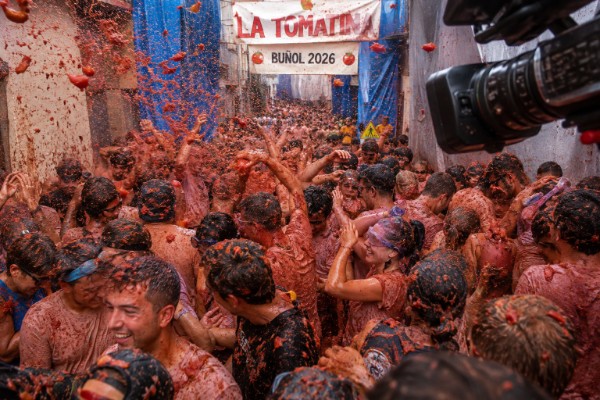
For one unforgettable hour, Buñol became a sea of red.
More than 120 tonnes of ripe tomatoes were thrown through the streets as around 22,000 participants from numerous countries joined one of the world’s most famous — and certainly messiest — celebrations.
But behind the spectacular pictures there is a fascinating story of history, local tradition, international tourism, popular culture and, above all, an extraordinary Valencian ability to turn something completely unexpected into a global phenomenon.
That was what I wanted to bring to the BBC audience.
Welcome to La Tomatina
If you’ve never experienced La Tomatina, it is difficult to explain quite how surreal it looks.
Imagine thousands of people packed into the narrow streets of a small Spanish town.
Now add hundreds of tonnes of tomatoes.
Then throw them at each other.
Within minutes, the streets, buildings and participants become progressively redder until the entire scene resembles something between a food fight, a carnival and a particularly enthusiastic tomato harvest.
But La Tomatina is much more than simply throwing tomatoes.
There is an extraordinary atmosphere in Buñol long before the battle begins. Music fills the streets, people dance, bars and restaurants become packed with visitors, and groups of friends from completely different countries quickly become part of the same enormous celebration.
There is anticipation, excitement, noise and an infectious sense that everyone is about to participate in something slightly ridiculous — but incredibly enjoyable.
And then the tomatoes arrive.
From 1945 to the World Stage
One of the things I was able to explain during the BBC’s live coverage was how this apparently chaotic festival actually has a fascinating history.
La Tomatina traditionally traces its origins back to 1945, when a spontaneous disturbance during a local celebration resulted in participants throwing tomatoes.
What began as an improvised street incident eventually evolved into the festival we know today.
The transformation is remarkable.
A local tradition in a small Valencian town has become an event recognised around the world, attracting visitors from virtually every continent.
And that international dimension was impossible to miss in Buñol.
A Truly International Tomato Fight
One of the most interesting aspects of providing live commentary was being able to put some numbers behind the international nature of La Tomatina.
I was able to explain to BBC listeners the percentage of participants coming from different countries, highlighting the remarkable international mix in the streets.
There were large groups of visitors from Britain, Japan, India, Australia and the United States, alongside participants from across Europe and many other parts of the world.
For a small town such as Buñol, the international reach of the festival is extraordinary.
You could hear different languages everywhere — and yet everyone had come for exactly the same reason.
To get covered in tomatoes.
It is difficult to think of many other festivals capable of producing quite such a universal form of participation.
Why Are So Many Indians Coming to La Tomatina?
One particularly interesting aspect of the international audience is the strong Indian presence at La Tomatina.
During the broadcast, I was able to explain that the connection goes back to 2011, when the Bollywood film Zindagi Na Milegi Dobara featured its stars participating in a La Tomatina-style sequence filmed in Buñol.
The film was an enormous success in India and introduced La Tomatina to millions of Bollywood fans.
For many Indian visitors, therefore, coming to Buñol is not simply about attending a famous Spanish festival.
They have actually seen it on screen.
The film helped create a cultural connection between India and this small town in the Valencian Community — and you can see the legacy of that connection on the streets during the festival.
It is a perfect example of how modern popular culture can transform a local tradition into an international tourism phenomenon.
Britain and Buñol
There is also a particularly strong British connection.
British visitors have long been among the most visible international participants at La Tomatina, and during the BBC coverage I was able to provide context about the importance of the British market to Spanish tourism and to explain just how popular the festival has become among British travellers.
For many people in Britain, La Tomatina has become one of those quintessentially Spanish experiences — something that appears almost too extraordinary to be real.
But it is very real.
And if you are standing in Buñol with a tomato flying towards your head, there is absolutely no doubt about it.
When Hollywood Came to Buñol
The international cultural connections don’t stop with Bollywood.
La Tomatina has also attracted the attention of the film industry.
British actress Tilda Swinton participated in La Tomatina for a scene in We Need to Talk About Kevin, the acclaimed 2011 film directed by Scottish filmmaker Lynne Ramsay.
The sequence captures the extraordinary visual possibilities of the festival — thousands of people, a town covered in red and an atmosphere that is almost impossible to recreate anywhere else.
I was able to mention this during the BBC broadcast because I had previously interviewed Lynne Ramsay about her experience of filming at La Tomatina.
It is another fascinating chapter in the story of how Buñol’s tomato festival has travelled far beyond Spain.
And Then There Was Nino Bravo
The festival also provided an opportunity to introduce BBC listeners to an important part of Valencian musical history.
At the end of La Tomatina, Nino Bravo’s ‘Libre’ was played as the festival drew towards its conclusion.
I explained to the audience who Nino Bravo was and why this particular song has such resonance.
Born in Aielo de Malferit in Valencia, Nino Bravo became one of Spain’s most celebrated singers before his tragic death in 1973 at just 28 years old.
For an international audience, the song provided a powerful musical finale to an extraordinary day.
For Valencians, however, hearing Nino Bravo’s voice at the end of an event of such international significance added a distinctly local and emotional note to the occasion.
After all the noise, laughter and chaos, there was something rather beautiful about ending the festival with the voice of one of Valencia’s most beloved singers.
Controlled Chaos
One of the misconceptions about La Tomatina is that it is simply uncontrolled mayhem.
It isn’t.
Behind the apparent chaos is a huge amount of organisation.
With tens of thousands of people converging on a relatively small town, safety, crowd management, access, transport, medical provision and the handling of the enormous quantity of tomatoes all require careful planning.
There are rules governing the event, and participants are expected to follow instructions designed to keep the festival safe.
The tomatoes themselves are specially selected for the occasion and are over-ripe, making them suitable for the event rather than being the sort of tomatoes you would normally want to put in your salad.
And once the battle is over, another extraordinary operation begins: cleaning Buñol.
The streets that have effectively become a gigantic tomato soup have to be washed down, allowing the town to return remarkably quickly to something approaching normality.
The Real Stars: The People of Buñol
For all the international attention, however, the real stars of La Tomatina are the people of Buñol.
There is something wonderfully generous about opening your town to thousands of visitors from around the world and allowing them to participate in such an unusual local celebration.
The friendliness of the town is a major part of the experience.
Visitors don’t simply attend La Tomatina.
For a few hours, they become part of Buñol.
That is perhaps the secret of its success.
The festival has become enormously international without losing its connection with the place where it began.
Why La Tomatina Matters to Valencia
From a tourism perspective, La Tomatina is an extraordinary advertisement for the Valencian Community.
It demonstrates that Valencia isn’t simply about beaches, sunshine and paella — although we are certainly very good at all three.
It is also about character, humour, tradition and events that you simply cannot experience anywhere else.
La Tomatina joins an extraordinary calendar of Valencian celebrations, from Las Fallas to local fiestas, concerts, gastronomic events and cultural festivals.
Each attracts different audiences, but they share something important: they give visitors an opportunity to experience Valencia rather than simply look at it.
Bringing Valencia to a Global Audience
Working with the BBC was a genuine honour.
The BBC brings an enormous international audience, but international broadcasting is at its best when spectacular pictures are accompanied by someone who can explain what is actually happening.
That was my role.
As editor of 24/7 Valencia, and having lived in Valencia for more than 30 years, I was able to provide the BBC audience with the local context behind the pictures — from the history of the festival and the international visitor figures to the Bollywood connection, Nino Bravo, Tilda Swinton and the practical realities of organising one of Europe’s most unusual mass events.
It was a wonderful opportunity to demonstrate what local knowledge can add to a global broadcast.
24/7 Valencia — Telling the Story
For more than 25 years, 24/7 Valencia has been telling the story of Valencia in English.
We have always believed that there is far more to this region than the standard tourist postcard.
Our coverage ranges from restaurants and gastronomy to music, art, sport, festivals, personalities, history, nightlife and the people who give Valencia its character.
Yesterday, that meant taking our readers — and a global BBC audience — into the middle of La Tomatina.
It was noisy.
It was chaotic.
It was spectacular.
And, inevitably, it was very, very red.
A Festival That Belongs to Buñol — and the World
Perhaps the most remarkable thing about La Tomatina is the journey it has taken.
From a spontaneous incident in 1945, to a local tradition, to a Spanish curiosity, to a global tourism phenomenon featuring in Bollywood and Hollywood films, La Tomatina has travelled an extraordinary distance.
Yet it remains rooted in the streets of Buñol.
That is what makes it special.
This week, people from Britain, Japan, India, Australia, America, Spain and countless other countries stood shoulder-to-shoulder in the same streets, speaking different languages but sharing exactly the same experience.
For one hour, everyone was equal.
Everyone was laughing.
Everyone was covered in tomatoes.
And everyone was part of La Tomatina.
Thank You, Buñol
A huge thank you to the organisers of La Tomatina 2026, the people of Buñol, the BBC production team and everyone who made yesterday’s broadcast possible.
For me personally, it was a particularly proud moment.
To represent 24/7 Valencia on an international broadcast and to have the opportunity to explain the history, humour and cultural significance of one of the Valencian Community’s most famous celebrations was a privilege.
And when the final tomatoes had been thrown, the streets had turned red and the festival was coming to an end, Nino Bravo’s ‘Libre’ provided the soundtrack.
A Valencian voice.
A Valencian song.
A Valencian festival.
And an audience watching from around the world.
Report by Will McCarthy
Article copyright ‘24/7 Valencia’
Related Post


















Leave a comment