

More than a century of tapas, clochinas, characters and Valencian history. There are restaurants you visit because somebody recommends them, and there are places that feel as though they have always been there.
La Pilareta is one of the latter.
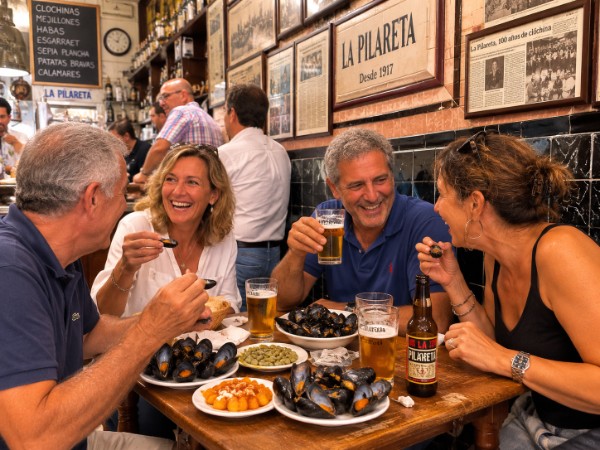
Tucked away on Carrer del Moro Zeit, just off the Plaça del Tossal in the old ‘Mercat’ district bordering the ‘Carmen’, La Pilareta is one of those increasingly rare Valencia establishments where the passing of time seems to have been largely ignored. The black-and-pink tiled walls, wooden tables, old bottles, crowded bar and battered buckets waiting beneath it all contribute to the impression that you have somehow stepped through a door and arrived in another Valencia.
And, in a sense, you have.
Because although the name La Pilareta is relatively modern, the story behind the bar stretches back to 1917.
A Valencia institution born in 1917
On 27 March 1917, the establishment then known as Bar Pilar received its licence to operate as a bar. Before that, the premises had been a grocery shop dealing in food, wine and spirits. The business was therefore already part of everyday neighbourhood life before it officially became the bar that Valencians would come to know and love.
It was an extraordinary year for Valencia.
The city’s magnificent Estació del Nord opened on 8 August 1917, and La Pilareta’s own history records that railway inspectors and officials travelling from Madrid became regular customers of Bar Pilar. In those early days the food was considerably more elaborate than the straightforward tapas for which the establishment would eventually become famous, with dishes including escabeche-style partridge and crayfish.
The bar’s founder was Pilar Contell, a remarkable woman who remained at the helm for more than six decades, from 1917 until 1983.
That is an astonishing length of time for any business, let alone a bar in the constantly changing centre of a major European city.
From Bar Pilar to La Pilareta
For generations of Valencians, however, the place was simply Bar Pilar.
The nickname La Pilareta eventually became so deeply embedded in local usage that in 2010 the business was formally registered under the name by which most Valencians already knew it.
There is even a little piece of La Pilareta vocabulary connected to its founder.
A “pilar” is the bar’s traditional term for a large beer, while an “entero” refers to a full portion of clochinas. Thus, ordering a pilar and an entero is not merely ordering a drink and a plate of mussels: it is participating in a little piece of the bar’s own language and history.
The clochina takes centre stage
If there is one food that defines La Pilareta, it is undoubtedly the clóchina.
For visitors unfamiliar with Valencia, clochinas can look rather like ordinary mussels. They are, however, the smaller and more delicate Valencian variety, highly prized locally for their flavour.
The distinction between clóchinas and mejillones matters greatly to Valencians. Clochinas have a relatively short seasonal availability, traditionally associated with the warmer months, and La Pilareta’s own menu specifically marks them as a seasonal product. Outside the clochina season, the bar serves conventional mussels instead.
And this is not merely a case of putting mussels in a pot and hoping for the best.
At La Pilareta, the clochinas are cooked in their own juices with the characteristic combination of white pepper, bay leaf and spicy paprika, producing a delicious, intensely flavoured broth. Owner Juan Carlos Santos has explained that the cooking liquid is allowed to reduce for hours, developing a depth of flavour that is difficult to reproduce at home.
The result is one of those wonderfully uncomplicated Valencian dishes in which the quality of the principal ingredient does most of the talking.
And there is a correct way to eat them.
As you work your way through the pile of shells, the empty ones disappear into the containers positioned beneath the bar.
The buckets are not decorative.
They are there because La Pilareta serves a lot of clochinas.
The famous buckets
For first-time visitors, the sight of containers underneath the bar can be slightly bewildering.
For regulars, they are simply part of the furniture.
Historically, empty shells were even thrown onto the floor in some old-fashioned establishments. La Pilareta’s buckets provide a considerably more hygienic solution while retaining the wonderfully practical spirit of the old tapas bar.
There is something wonderfully unpretentious about it.
No elaborate presentation. No foam. No architectural plating.
Just eat the clochinas, drink your wine or beer, and put the shells in the bucket.
The post-war transformation
Although food had always been part of the establishment’s identity, the post-war period marked an important change. Tapas became increasingly central to the business, and the clochinas began their transformation into the house speciality for which La Pilareta would eventually become famous.
This was also when much of the atmosphere we recognise today began to emerge.
The distinctive black-and-pink ceramic tiling dates from this period, as do the traditional wooden tables. The tables themselves were designed around the bar’s eating habits, with space for six diners and six portions of clochinas, accompanied by the beers known as pilares.
It is difficult to imagine a modern restaurant designing its furniture around the number of portions of one particular tapa that six people might consume.
But that is precisely what makes places such as La Pilareta special.
The surroundings developed around the food and the customers rather than the other way round.
A bar for railwaymen, actors, students and Valencians
Over the decades, La Pilareta has attracted a remarkable cross-section of Valencia.
Its proximity to the old Teatro Princesa, opened in 1853, brought actors and people from the entertainment world into the bar. The theatre itself has long since disappeared, but La Pilareta remains.
Later, particularly from the 1970s onwards, Valencia’s historic centre became an increasingly important destination for nightlife and Sunday tapas, bringing another generation into the establishment.
It also became a favourite among students and people looking for good food without spending a fortune.
And that may be one of the most important reasons why La Pilareta survived.
It has never needed to become fashionable.
It simply remained itself.
The sound of La Pilareta
Part of the pleasure of La Pilareta has nothing whatsoever to do with the food.
It is the noise.
The shouts from the bar.
The shouted orders.
The clatter of plates.
The voices of customers squeezed around narrow wooden tables.
The waiters moving rapidly between the bar and the kitchen.
It is a performance in itself.
At busy times, La Pilareta can feel less like a restaurant and more like a small piece of organised chaos. Yet there is a rhythm to it, and once you understand that rhythm, it becomes part of the attraction.
This is not the place for someone looking for whisper-quiet fine dining.
La Pilareta is a bar.
And it behaves like one.
But don’t come only for the mussels
Although the clochinas are the undisputed stars, reducing La Pilareta to a mussel bar would be a mistake.
The current menu includes a wonderfully traditional collection of Valencian and Spanish tapas, including patatas bravas, habas, esgarraet, sepionet, calamares, tortilla de patata, fried fish, Russian salad, artichokes when in season and mussel croquettes. There are also the substantial montaditos and bocadillos that make the place suitable for a quick lunch as well as a leisurely session of tapas.
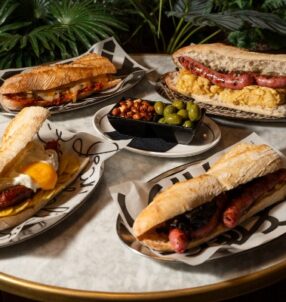
Among the dishes that have acquired something approaching cult status is the Valencian pepito.
This is not the chocolate-filled pastry that English-speaking visitors might associate with the name. The Valencian pepito is a small filled bread roll, traditionally associated with the city’s cuisine, and La Pilareta has maintained its own version for decades.
The bar’s pepito has been praised for its crisp exterior and juicy filling, while the kitchen prepares its ingredients itself rather than relying on industrial substitutes. The dish is particularly associated with the colder months and has developed a loyal following of its own.
Then there are the habas, the broad beans, traditionally cooked and seasoned; the esgarraet, combining roasted peppers with salted cod, garlic and olive oil; sepionet; grilled cuttlefish; patatas bravas and the increasingly difficult-to-find traditional faves.
There is nothing remotely fashionable about the food.
And that is exactly the point.
The interior is part of the menu
Walk into La Pilareta and look around before sitting down.
The old tiles, the wooden furniture, the traditional bar, the barrels, old bottles and historic photographs are not an attempt to manufacture nostalgia. Much of the character is genuinely inherited.
The place has changed, inevitably, but it has not been polished into oblivion.
The result is one of those interiors that contemporary restaurants spend enormous amounts of money trying to imitate.
La Pilareta simply kept the original.
A new generation takes over
The story could easily have ended in 1983 when Pilar Contell retired after running the bar for 66 years.
It did not.
After a succession of owners and managers, Juan Carlos Santos and his wife Paloma took over the business in 2000. They were not members of the Contell family and therefore did not inherit La Pilareta as a family business. Instead, they inherited something arguably more difficult to preserve: its identity.
Juan Carlos has spoken about arriving at La Pilareta almost by chance after spending many years working in his parents’ neighbourhood bar.
More than two decades later, the couple have become part of the establishment’s story themselves.
They have resisted the temptation to reinvent it.
That is important.
Because the easiest way to destroy a historic bar is sometimes to modernise it.
La Pilareta goes to the cinema
La Pilareta has even acquired a small place in Spanish cinema.
The bar appears in María Ripoll’s 2019 film Vivir dos veces, which was filmed extensively around Valencia. The film uses the establishment as one of its recognisable locations in the historic centre, allowing audiences to see the bar’s distinctive interior on screen.
It is an appropriate choice.
If a film wants to show visitors something of the real Valencia — rather than the Valencia of glossy tourist brochures — La Pilareta is an obvious location.
A place that has outlived fashions
Perhaps the greatest achievement of La Pilareta is not that it has survived for more than a century.
It is how it has survived.
Valencia’s historic centre has changed dramatically since 1917. The old neighbourhoods have been transformed. Shops have disappeared. Buildings have been restored. Bars have opened and closed. Nightlife has moved around the city. Tourism has exploded.
Yet La Pilareta remains in the same historic setting, still doing essentially what it has always done:
serving simple food, pouring drinks and bringing people together around a table.
There are tourists there now, naturally. La Pilareta has become internationally known and is regularly recommended to visitors looking for an authentic Valencian tapas experience.
But it has not entirely become a tourist attraction.
That distinction matters.
Walk in at the right moment and you can still find Valencians doing exactly what Valencians have done for generations: meeting friends, ordering a drink, sharing some food and talking far longer than they originally intended.
The La Pilareta experience
My own introduction to La Pilareta was much like that of countless other people.
You take somebody who has fallen in love with Valencia and wants to experience the city properly.
You show them the sights, introduce them to the food and eventually say:
“There’s a little bar in the historic centre I think you’ll like.”
You arrive and there may well be a queue.
You take your number.
You wait.
Perhaps you order a bottle of wine while you wait.
Then, suddenly, somebody shouts your number.
You squeeze inside.
You find a tiny table.
Someone asks what you want.
“Clochinas.”
Of course.
Then perhaps some esgarraet, habas, bravas, sepionet, a pepito or some of the mussel croquettes.
The plates arrive.
The conversation gets louder.
The shells begin accumulating.
The wine disappears.
And eventually you realise that you’ve been there for several hours.
That, really, is La Pilareta.
The real taste of old Valencia
In an age when restaurants increasingly compete to look spectacular on Instagram, La Pilareta offers something altogether different.
It offers continuity.
It is not pretending to be old.
It is old.
It does not need a carefully designed vintage interior because the interior is genuinely part of its history. It does not need to invent a story because there is already more than a century of one behind the bar.
And while the clochinas remain its great speciality, the real attraction is the combination of food, atmosphere, history and people.
You go for the mussels.
You stay for the experience.
And if you are lucky, you leave with the unmistakable smell of the sea, garlic and paprika still clinging to your clothes.
La Pilareta has been doing this since 1917.
Long may it continue.
Report by ‘24/7 Valencia’ team
Article copyright ‘24/7 Valencia’
LA PILARETA
La Casa de les Clòtxines
Carrer del Moro Zeit, 13
Ciutat Vella / El Carmen
46001 Valencia
Telephone: 963 910 497
Opening hours: Monday–Sunday, 12.00h–24.00h
Closed: 1 January and 25 December
Website: www.barlapilareta.es
La Pilareta’s current menu includes seasonal clochinas, mussels, patatas bravas, habas, esgarraet, sepionet, calamares, pepito, tortilla, fried fish and other traditional tapas.
Related Post










Leave a comment