

Thirty years of watching a Mediterranean city open itself to the world! When I first arrived in Valencia in 1995, I had no idea that I was going to stay for good but I did take to it immediately. I felt this is somewhere I could explore for years and years. By then, learning Spanish was another motive too. It was a language that would enable me to communicate with many people and not just from Spain. However, I had very little Spanish then and, if I’m being completely honest, very little idea of what I was getting myself into. I had chosen Valencia partly because I wanted somewhere that felt genuinely Spanish but wasn’t as overwhelming as Madrid or Barcelona. I wanted sunshine, Mediterranean life, music, football, bars, tapas, beaches and the possibility of doing something different with my life.
What I found was a city that already had plenty of energy — but which was, in many ways, a very different Valencia from the one we know today.
Three decades later, I sometimes walk through the centre and wonder whether I am looking at the same city.
In some ways, I am.
In other ways, almost everything has changed.
A city that was still looking inward
Valencia in the mid-1990s was not exactly isolated, but it was considerably less international.
There were foreigners living here, of course. There were British residents on the coast, language teachers, students, travellers and the beginnings of a more established expatriate community.
But the international Valencia we know today had not yet arrived.
The city felt overwhelmingly Valencian and Spanish. You could walk through the historic centre without constantly hearing half a dozen different languages around you. English was much less visible. International businesses were fewer. Tourism existed, but Valencia was not yet the major international destination it has become.
For a young British newcomer, this could be both exciting and slightly bewildering.
I arrived with approximately three words of Spanish:
¡Hola! ¡Olé! ¡Cerveza!
Not exactly enough to build a new life on.
But perhaps there was an advantage to being unable to understand everything. I could simply observe.
And what I observed was a city with an extraordinary capacity for enjoying itself.
The first year seemed like one long fiesta.
During the week I taught English. At weekends there was drinking, eating out, football at Mestalla , music and plenty of nightlife! Sundays could mean playing football in the Turia Gardens and finishing the evening with a pub quiz. Having an Irish girlfriend meant that I enjoyed Valencia as an English speaker rather than someone full integrated. Valencia’s nightlife was pretty wild back then when it came to rules and regulations. There were individuals of all ages who openly smoked joints in bars, powerful absinthe was available under the counter in some places and the closing hours seemed to be very hazy!
The Valencia of the 1990s
The city was already beautiful, but some parts were much rougher around the edges.
The old riverbed was there, of course, but the transformation of the Turia into one of Europe’s great urban parks was still relatively recent.
The historic centre had enormous character but also plenty of buildings that had seen better days.
The Carmen had a bohemian atmosphere that felt less polished than it does today.
Ruzafa had not yet become the fashionable, international neighbourhood it is now.
Cabanyal was still very much a working-class maritime district rather than one of the places everyone suddenly wanted to live.
And there was far less sense that Valencia was competing for attention on an international stage.
The city had potential.
But it didn’t always seem to know quite what to do with it.
That would change dramatically.
Then Valencia discovered the world
The transformation came in stages.
The internet changed the way people travelled and communicated.
Low-cost airlines made European city breaks much easier.
Erasmus students began arriving in greater numbers.
International companies became more visible.
Tourism expanded.
And Valencia started appearing on the radar of people who previously might have chosen Barcelona, Madrid, Seville or the Costa del Sol.
Then came some enormous statements of intent.
The City of Arts and Sciences became an instantly recognisable symbol of modern Valencia.
The America’s Cup put the city on the international sporting map.
Formula 1 temporarily brought another global audience.
Major concerts, festivals, exhibitions and sporting events followed.
The International Federation of Football History & Statistics (IFFHS) ranked Valencia CF #1 in the Club World Ranking for that calendar year 2004!
- La Liga: They beat out Real Madrid’s “Galácticos” and Barcelona to win the Spanish domestic league titles in 2002 and 2004
- UEFA Cup: They defeated Olympique de Marseille 2–0 in the final in Gothenburg in 2004.
- UEFA Super Cup: They defeated Champions League winners Porto 2–1 in Monaco to cement their European dominance in 2004.
Valencia stopped being simply a place that people visited because they were already in Spain.
It increasingly became somewhere people deliberately chose to visit.
That distinction matters.
From Spanish city to international city
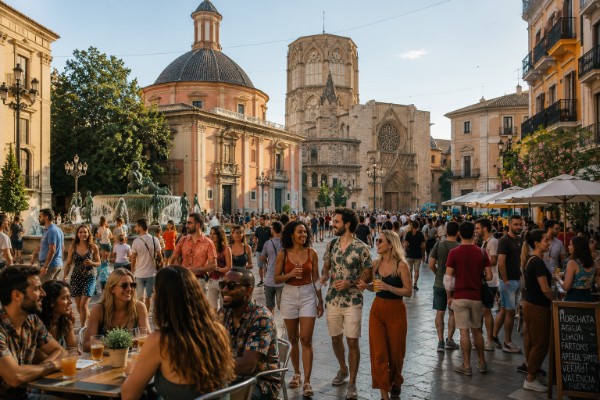
Walk around Valencia today and the difference is obvious.
You hear English, French, Italian, German, Dutch, Ukranian, Russian, Punjabi, Urdu, Portuguese and a whole range of Spanish accents.
You see international restaurants alongside traditional Valencian bars.
There are digital nomads, Erasmus students, entrepreneurs, artists, retirees, tourists and people who have simply fallen in love with the city and decided to stay.
The old idea of the foreigner in Valencia being an unusual presence has disappeared in many parts of the city.
And that is perhaps one of the biggest changes I have witnessed.
When I arrived, being a British resident could sometimes make you feel like an outsider.
Today, being foreign in Valencia is hardly unusual.
But has Valencia lost something?
This is where the story becomes more complicated.
Because progress isn’t simply a matter of replacing the old with the new.
There are things about the Valencia of the 1990s that I miss.
There was a certain innocence.
Things were less polished.
There was less international pressure on neighbourhoods.
People seemed less concerned about whether a particular street was “cool”.
You could discover places rather than finding them through Instagram.
And because the city was smaller in international terms, you had a greater chance of repeatedly bumping into the same people.
That remains one of Valencia’s great strengths.
It is big enough to offer an extraordinary range of people and experiences, but small enough for coincidence to remain part of everyday life.
You can meet somebody at a bar, see them three weeks later somewhere completely different and gradually become friends.
That still happens.
The foreigner who became local
Something else changed during those years.
I changed.
When I arrived, I was the foreigner trying to understand Valencia.
Today, after more than thirty years here, I often find myself explaining Valencia to other foreigners.
My Spanish improved.
My work became increasingly connected to the city.
In 2000, I began editing 24/7 Valencia, an English-language magazine that I have continued to develop ever since. It’s been 26 years!
What began as an opportunity to write about Valencian culture gradually became a way of life.
The magazine has allowed me to meet an extraordinary cross-section of the city — Valencians, foreigners, musicians, artists, politicians, footballers, restaurant owners, students, business people, journalists and people simply passing through.
And that has probably taught me more about Valencia than any guidebook ever could.
I have seen the city from backstage, from football press boxes, from bars at four in the morning, from concert venues, from the streets during Fallas and from the middle of international events.
I have watched generations come and go.
And I have watched Valencia become increasingly confident about presenting itself to the outside world.
The cosmopolitan Valencia
Perhaps the biggest change is psychological.
Valencia no longer seems to ask:
“Why would foreigners want to come here?”
It increasingly says:
“Why wouldn’t they?”
The city has realised that it possesses something extremely valuable.
It has the Mediterranean climate and beaches.
It has extraordinary food.
It has history.
It has architecture.
It has nightlife.
It has culture.
It has football.
It has one of Europe’s most impressive urban parks.
And perhaps most importantly, it has a human scale.
You can still walk across much of the city.
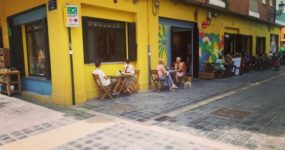
You can sit outside a bar for a couple of euros and watch the world go by.
You can go from the historic centre to the beach in a short time.
You can have a completely different experience depending on which neighbourhood you turn into.
That combination is difficult to manufacture.
The danger of becoming too successful
Of course, there is another side.
The internationalisation of Valencia brings investment, jobs and opportunities.
But it also brings rising property prices, pressure on traditional neighbourhoods and concerns about overtourism.
Some parts of the city increasingly risk becoming places designed for visitors rather than the people who live there.
That is the challenge facing Valencia now.
The city should not become another version of somewhere else.
Its greatest attraction is precisely the fact that it is Valencia.
The answer, in my view, is not to close the doors again.
It is to manage growth intelligently while protecting the things that made people want to come here in the first place.
From outsider to participant
I sometimes think about the young man who arrived here in 1995.
He didn’t speak Spanish properly.
He didn’t know that he would still be here thirty years later.
He certainly didn’t know that he would eventually be writing about Valencia every week,
The city I arrived in was more provincial, more Spanish and perhaps a little more mysterious.
The city I live in now is more international, more connected and much more confident.
But underneath all that, I still recognise it.
The morning cafés are still there.
People still argue passionately about football.
The Fallas still explode into life every March.
Someone is still having a very loud conversation at the next table.
A group of friends can still sit outside for hours over a coffee or a beer.
The Mediterranean is still there.
And the sun still does most of the advertising.
Perhaps that is the real story of Valencia.
It hasn’t abandoned its past.
It has simply opened the doors.
And after thirty years of watching that happen, I think that is what makes Valencia so fascinating.
I arrived as a foreigner.
I stayed long enough to become part of the place.
And now, when I walk through the streets, I don’t really see a foreign city anymore.
I see home.
Report by Will McCarthy
Article copyright ‘24/7 Valencia’
Photo copyright 24/7 Valencia








Leave a comment