

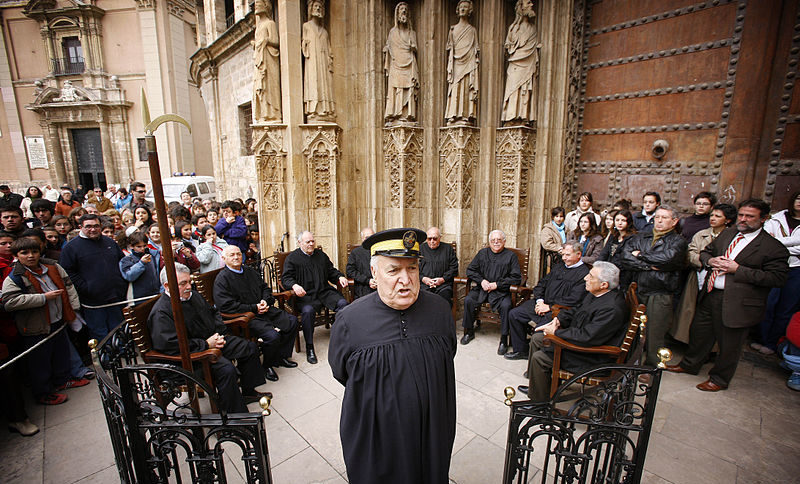

On the doorstep of Valencia’s Cathedral, the Puerta de los Apóstoles de la Catedral de València, a group of people in black robes ascend the cathedral steps. No, not monks or farmers. They are Judges of Europe’s oldest continuing legal institution, the Tribunal de las Aguas (the Water Court). This body meets every Thursday at 12 noon to discuss the water issues of the city of Valencia and the surrounding farmland. Its mission is to guarantee the correct functioning of the region’s vast and complex network of irrigation channels and safeguard the interests of the communities of irrigation water-users.
The court’s primary concerns are stolen water amongst Valencia’s farmers, when water is being used by a farmer when it is not their turn to irrigate their crops, a serious issue in drought-prone Spain and due to the irregular amounts of water provided by the River Turia. Issues have also occurred of farmers’ building works polluting the water channels, which are also brought swiftly before the court. Disputes can occur at any point throughout the year but they are more frequent during droughts when special irrigation rules are implemented and “supervision is enforced to control the availability of water,” said historian Daniel Sala, a Water Court expert.
The court consists of nine members, a representative or síndic, from each of the areas corresponding to the seven ancient “royal water channels”, which make up the city’s ancient irrigation system, and a court bailiff. These officials are democratically elected by the 10,000 or so farmers that make up the inhabitants of the areas presided over by the Tribunal de les Aigües, namely: Valencia, Quart, Benàger-Faitanar, Tormos, Mislata, Mestalla, Favara, Rascanya, Rovella and Xirivella. Every two years one of the síndics is elected president.
This court settles conflicts between irrigation water-users orally, with no documentation, and most importantly quickly and cheaply. While the modern legal system could take months to reach a verdict, incurring hefty legal fees, all disputes are heard and judged within the same session in which the complaint is brought before the court. If no one contests the decision in the next three sessions, the ruling is final. There are no appeals, and decisions are upheld by the respect in which the court is held and the trust placed in the judges, who are farmers themselves with first-hand expert knowledge of local water customs. A legal system of the farmers, by the farmers, for the farmers. Abraham Lincoln, take notes.
Proceedings begin when the bailiff, with the permission of the president, calls for cases from each canal in turn using the traditional phrase “denunciants de la séquia de…!” (“claimants from the irrigation canal of…!”). The president indicates with his foot who has the right to speak or reply, declaring “Parle vostè!” to grant the right to speak or “Calle vostè!” to withdraw it. The court is conducted entirely in Valenciano, and any fines imposed on those found guilty of stealing water are calculated in Valencian pounds, a long-discontinued currency—although payments in euros are graciously accepted. The proceedings are widely regarded as fair and impartial, and if a complaint of corruption or favouritism is brought against a judge, they must immediately remove their black robe and face the charges as an ordinary citizen before either reclaiming it or leaving it off forever, depending on the ruling of the other judges.
The rulings of the Tribunal apply to all members of the Valencian community, regardless of status. As was explained during Thursday’s session, in times of drought, on some days those downstream of Valencia are permitted to water their crops, while on others it is the turn of those upstream. This rule even applied to the Valencian nobility, many of whom cultivated rice, historically Valencia’s most profitable crop. The irrigation of rice was strictly regulated during periods of drought because of its enormous water requirements.
The court is not universally admired, however. At Thursday’s session, a protester held up a placard alleging pollution of the waters near Náquera by a chemical company.
Even celebrity status does not grant special access to the court. The only people allowed to sit on the court without election by the farming community are the King of Spain and the President of the Valencian Generalitat. Even these illustrious positions are not guaranteed entry. Former Generalitat president Emiliano Zaplana was denied entry after failing to contact the court within his first year in office. Hell hath no fury like a tribunal scorned. Even Francisco Franco was refused a seat because he declined to wear the traditional black cloak, preferring his military uniform instead.
This remarkable institution has its origins in Al-Andalus. It was first established under the rule of the Caliphs Abd-ar-Rahman III and Al-Hakam II in 960 CE. Because water was so scarce across North Africa and the Arabian Peninsula, water protection and governance were of paramount importance, and these practices were introduced into Spain by the Islamic rulers. Indeed, the irrigation system that the Tribunal was created to protect was itself established by the Muslim caliphs. Originally, the Tribunal met inside Valencia’s mosque, but following the Reconquista, when the mosque was demolished and replaced by the Cathedral of Valencia, the Christian clergy moved the Tribunal to the Cathedral steps, where it still meets today. The fact that it convenes on a Thursday also reflects its Islamic origins, as Thursday was traditionally the last working day of the Islamic week before Friday prayers (yaum al-jum’a).
Yet with the Reconquista’s destruction of so much Islamic heritage, including the burning of Granada’s Great Library and the demolition of Valencia’s mosque, it raises an obvious question: why was this Islamic legal institution allowed to survive? Over the centuries it has been fully integrated into the Spanish judicial system, carrying the same legal weight as any civil court. This is a testament to its effectiveness, impartiality, and crucial role in maintaining the sophisticated Andalusí irrigation network that transformed the once-arid landscape surrounding Valencia into one of Spain’s most fertile agricultural regions. Following the Christian conquest of Valencia in 1238, King Jaume I confirmed the customary water laws and restored the irrigation system to the city’s farmers.
Yet for all its long and distinguished history, the Tribunal de les Aigües is clearly in decline. The court depends upon the survival of Valencia’s huerta, which is increasingly threatened by urban expansion. The growth of the city has resulted in the disappearance of many historic water channels and tributaries, while the construction of the Benagéber Reservoir has greatly improved Valencia’s water security. Excellent news for the city—but less encouraging for the Tribunal. As a result, the court hears far fewer cases than in previous centuries. Thursday’s session illustrated this perfectly: only one case was heard, and the audience consisted largely of schoolchildren and tourists rather than members of Valencia’s farming community.
The rural farming communities of Moncada and Del Oro have applied to join the court. Their applications were initially refused but are now under consideration. Although admitting these communities would undoubtedly strengthen the institution, doing so would also break with its centuries-old tradition of overseeing only the seven historic irrigation channels.
It is clear that the court faces a fundamental question: tradition or survival? History is littered with institutions that refused to adapt to changing times.
Report by Danny Weller
Article copyright 24/7 Valencia



















Leave a comment