

In Valencia’s historic city centre, some festivals don’t just happen, they change how the city is used. Streets that are normally part of everyday movement start to function differently, filling with gatherings, performances, and events that bring people into public space in ways that feel less routine and more collective. Corpus Christi is one of the clearest examples of this. It is traditionally held on the eighth Sunday after Easter Sunday, 63 days after Holy Week, but in practice the celebration unfolds over several days leading up to it. This year, the main festival runs from June 4th to 7th.
The festival dates back to the 14th century, when it spread across medieval Europe as a public celebration of the real presence of Jesus Christ in the Eucharist. However, in Valencia, it did not remain only as a religious ceremony. Over time, it expanded to include local dances, civic participation, and allegorical storytelling, creating a hybrid tradition between religious observance and public celebration. What defines it today is its ability to shift between different forms while staying rooted in the same streets. A solemn procession can pass through spaces that, on other days, host street games, music, and neighborhood life.
To understand Corpus Christi, it is more useful to see these days not as a list of events, but as a sequence of how the city is used and celebrated.
Thursday the 4th: A quiet beginning that signals something bigger
The festival begins in a calm and formal way on Thursday, June 4th at 20:00h with a Solemn Mass and Pregón at the Iglesia del Patriarca. At street level, the city still feels normal. Inside the church, however, the atmosphere shifts, with hymns, prayers, and a formal proclamation marking the start of Corpus Christi.
This reflects the festival’s medieval structure. Since its origins, it has begun in a religious setting before moving into the streets. It starts in a controlled, ceremonial way before expanding into a public celebration.
Friday the 5th: History starts moving through the streets
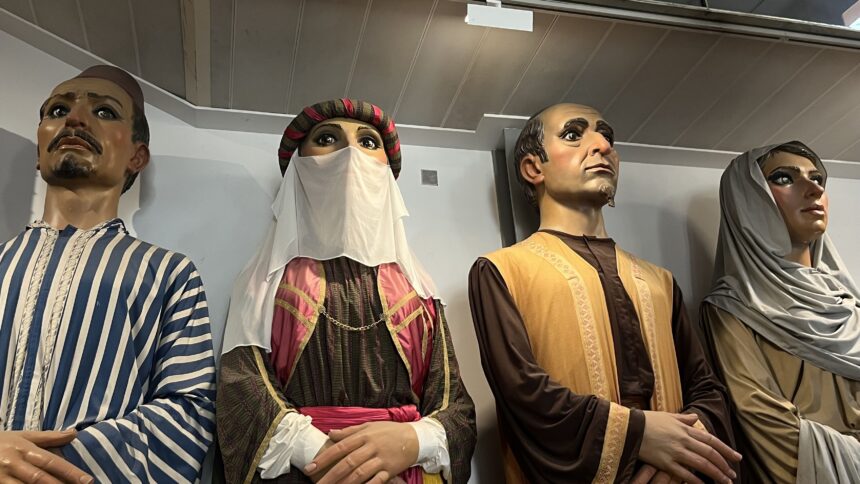
By Friday evening, the festival begins to enter public space. At 20:00h, the Rocas, large medieval floats usually kept in storage, are moved from their museum to the Plaza de la Virgen. It is a simple act, but it changes the atmosphere of the centre as objects from the past return to the streets.
Later at 23:30h, the Nit d’Albaes moves through the old town. This is a procession of folk singers performing short Valencian songs in a call-and-response style as they walk, stopping at different points, so their music carries between buildings and balconies.
Saturday the 6th: The tradition becomes visible across the city
Saturday is one of the most active days, with events spread across the historic centre from midday into the night. At 12:00h, the bells of the Micalet Tower ring across Valencia Cathedral and surrounding streets, drawing people into the centre to begin the day.
At 18:00h, the Representació dels Misteris takes place in the Plaza de la Virgen. These are short biblical plays performed by children on a simple outdoor stage with minimal staging. That simplicity is part of what makes them feel unchanged and unique, continuing a tradition that has lasted for centuries.
Later comes La Poalà in Calle de los Caballeros. Buckets are hung from balconies as part of the Penja de poals tradition and filled with water. As groups pass below, residents throw or pour water from above, turning the street into a loud, playful exchange between balconies and the crowd. It is one of the most recognizable moments of the festival, and you do not want to miss it. At midnight, a musical parade moves through the Barrio del Carmen. Local groups walk through decorated streets while balconies are informally judged. Music fills the neighbourhood as people lean out to participate and follow the movement on the music.
Sunday the 7th: The Finale
Sunday is when the festival reaches its peak, with major events within a few hours. At 12:00h, the Cabalgata del Convite begins. It is a colourful parade in which allegorical characters march through the streets and formally invite the city to join in on the celebration. Traditional dances stand out, especially La Moma, which represents virtue fighting against the seven deadly sins, and La Magrana, performed by the Associació Amics del Corpus. The parade is a highly structured and visual experience with music and movement filling the city.
At 14:00h, the Mascletà in the Plaza del Ayuntamiento takes place. Instead of fireworks in the sky, it consists of ground-level firecrackers building in rhythm and intensity until the square is filled with sound. You stand among thousands of people as the noise increases in waves, with locals reacting together to each shift in intensity. It is less about watching a display and more about sharing a collective physical experience.
At 19:00h, the Solemn General Procession begins. It moves slowly through the historic city centre with religious figures, historical characters, and floats known as Rocas. At the centre of this act is the 600-kilogram silver Custodia, a decorated religious object that holds the Eucharist and is the most important symbol of the procession. As it passes, flower petals are thrown from balconies, filling the streets. The atmosphere for this last event is quieter than earlier acts, with most people watching in silence as the procession closes the festival celebrations.
By the end of Corpus Christi, what stands out is not a single event, but how the same streets are used in different ways over a few days. The historic city centre shifts from church ceremonies to street performances, to children’s theatre, and finally to the slow Sunday procession. Taken together, these moments show the festival’s importance both to Valencia and to its religious tradition, rooted in the Eucharist. It remains one of the city’s oldest and most respected events, briefly reshaping familiar streets before everything returns to normal.
Report by Lilly Salvador
Article copyright ‘24/7 Valencia’
Photos copyright Lilly Salvador / ’24/7 Valencia’
Related Post







Leave a comment