

La Alegría de la Huerta has reopened in Valencia, marking the return of one of the city’s most established seaside dining institutions. The reopening on June 12th, 2026, follows a full reconstruction of its former site as part of the wider redevelopment of the Malvarrosa coastline. While the building has been rebuilt, the restaurant’s identity remains closely tied to its origins as a family-run merendero established in 1950 by the Miralles family.
The location itself is central to understanding what this reopening represents. Situated along the Malvarrosa beachfront, the restaurant has always been shaped by its direct relationship with the Mediterranean and the surrounding maritime district. That proximity is not just geographical but cultural. It has historically defined the type of food served, the style of service, and the informal coastal dining culture that emerged in Valencia’s seaside neighborhoods. The renovation, therefore, had to address not only the building but also how that identity could be maintained in a modernized urban setting.
The restaurant closed in January 2026 as part of wider redevelopment works along the coastline. This urban transformation has affected and reshaped many of the waterfront locations, requiring many long-standing establishments to adapt or relocate. In the case of La Alegría de la Huerta, the closure led to a full redesign and reconstruction rather than a relocation. The result is a newly built structure that aims to integrate contemporary architectural standards while preserving the spirit of a traditional Valencian merendero that defines the restaurant.
Architect Francesc Rifé led the design of the new building, which is composed of eight modular units arranged across two levels. The structure is designed to maximize natural light and movement, with large openings that frame views of the sea and allow daylight to shape the interior throughout the day. Sliding wooden panels at ground level create flexibility between enclosed dining areas and open-air connection, ensuring the space responds to weather, season, and atmosphere rather than remaining fixed. This architectural approach is less about transformation for its own sake and more about clarity and function. The building is designed to feel open and responsive, reinforcing the idea that the dining experience belongs to its coastal environment without relying on literal separation between inside and outside.
Inside, the design brings together references to different eras of coastal dining in Valencia. Traditional materials such as terrazzo flooring and textured ceilings evoke earlier generations of seaside restaurants, while more contemporary elements like steel and ceramic introduce a cleaner, modern finish. Rather than separating past and present, this space allows both to coexist, creating an environment that feels grounded in memory while remaining functional today.
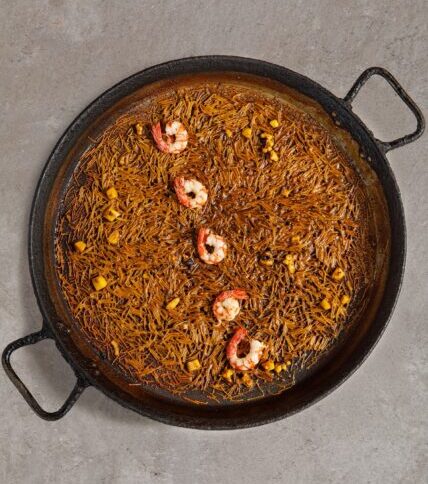
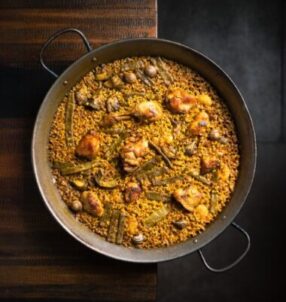
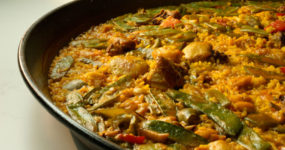
The same emphasis on continuity is evident in the restaurant’s culinary approach. The menu remains grounded in traditional Valencian cooking, with a strong focus on seasonal ingredients and coastal recipes. Dishes such as snails in sauce, stews, suquet, and regional rice preparations continue to define the offering. Among them, rossejat de fideos, a traditional dish of toasted noodles cooked in a rich seafood broth and typically finished with shellfish, is widely known as seafood fideuà and remains one of the most recognizable and emblematic plates.
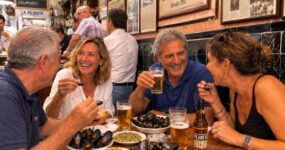
What gives the restaurant its character, however, extends beyond the kitchen. Service plays a central role in shaping the experience, too, with many front-of-house staff having worked there for more than twenty-five years. This long-standing team structure creates a rare sense of connection in hospitality, where familiarity and consistency become part of the atmosphere itself. The result is a service style that feels personal and homelike without being formal, built on recognition and repetition over time.
The reopening was preceded by an institutional presentation linked to the wider redevelopment of the Malvarrosa area, as well as a smaller soft-opening gathering attended by staff, collaborators, and industry guests. These moments positioned the restaurant within the broader evolution of the waterfront, while the focus internally remained on returning to daily service and reconnecting with regular diners.
Taken together, this reopening shows how long-standing coastal restaurants can evolve without losing what makes them recognizable. The real challenge is not only architectural renewal but also preserving its flavour, service, and atmosphere as the surroundings continue to change. In that context, La Alegría de la Huerta returns not as something new, but as a familiar presence in a renewed form. With its return to daily service and extended hours, it re-establishes itself as a steady fixture in the Malvarrosa dining scene and a clear must-visit for anyone wanting to experience one of Valencia’s most well-known seaside restaurants firsthand.
Report by Lilly Salvador
Article copyright ‘24/7 Valencia’
LA ALEGRIA DE LA HUERTA
Paseo Marítimo, Module 6, Malvarrosa Beach, 46011 Valencia
Website – https://restaurantealegriadelahuerta.es/
Instagram – https://www.instagram.com/somoslaalegriadelahuerta
















Leave a comment