


Arriving at the City of Arts and Sciences feels like stepping into a completely different version of Valencia, where everything opens up at a massive scale. Wide walkways, long reflecting pools, and striking white structures spread across the former riverbed, with water doubling the architecture and making the space feel even larger and more continuous. It is designed for movement and exploration, with buildings spaced so you naturally walk between them while keeping each one in view, creating a constant sense of discovery as the landscape unfolds.
Palau de les Arts Reina Sofía
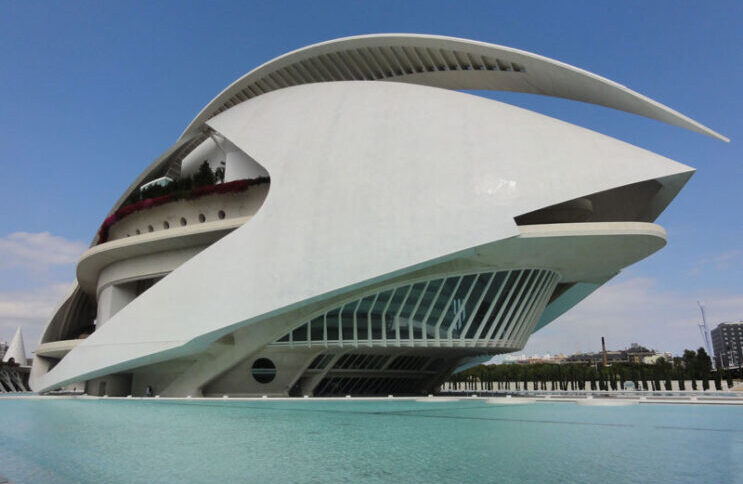
The Palau de les Arts Reina Sofía is the most sculptural building in the complex. As you approach, its curved exterior reveals layered sections that wrap around the structure and rise in different directions. The smooth, light-coloured surface reflects sunlight throughout the day, and from different angles the building seems to shift shape, sometimes appearing open and fluid, other times more solid and grounded. Gaps and glass sections hint at the scale of the interior performance halls, while the surrounding water amplifies its presence. As Valencia’s opera house, it hosts music, theatre, and major cultural events. Inside, it contains vast auditorium spaces and acoustically designed halls built for full immersion. It stands as the most formal and performance-focused building in the complex, marking a clear shift toward more interactive spaces ahead.
Museu de les Ciències
The Museu de les Ciències is a large, open structure with an exposed framework that already signals accessibility before you enter. Its long horizontal lines and repeating structural ribs give it a sense of rhythm, as if the building itself were laid out in sections you can read visually from the outside. One of its most distinctive features is the curved outer wall, which allows sound to travel clearly from one end to the other, creating a striking acoustic effect that highlights its design. Inside, everything is hands-on. You are encouraged to touch, test, and interact with the exhibits rather than simply observe them. The spaces explore topics like the human body, space, energy, and technology through interactive installations. The atmosphere is active, with constant movement as visitors move between experiments, making it feel more like a space for learning through doing than a traditional museum. Exiting the building, the openness returns, and the next structure appears across the water.
L’Hemisfèric
L’Hemisfèric is shaped like a large eye resting on the water, its reflection making the form even more striking. The elongated roofline and mirrored surface give it precise, almost mechanical symmetry. It functions as an IMAX cinema, planetarium, and laserium designed for immersive audiovisual experiences. Inside, the seating tilts back and the curved screen surrounds the entire space, so the image fills your full field of vision. You are completely enclosed by the projection, which covers subjects such as space, nature, and science, making the experience fully immersive rather than observational. Stepping outside, the brightness and open geometry of the complex feel immediate again.
L’Umbracle
L’Umbracle is an elevated open-air walkway lined with palm trees and Mediterranean plants. Steel arches run along the path overhead, creating a repeating structure that frames the sky as you move through it. It feels more natural than the surrounding architecture, and alternating light and shade create a steady rhythm as you walk. From this height, the full layout of the City of Arts and Sciences becomes clear, with each building spaced across water and open ground. You can trace your entire route visually from here, which adds perspective to the scale of the complex. It becomes a moment to slow down and take in everything you have passed through. The path then gradually descends toward the next structure.
L’Àgora
L’Àgora is a tall, angular building with a folded form that contrasts with the smoother shapes around it. Its exterior rises inward and upward, creating a strong vertical presence defined by intersecting lines and panels that emphasize its geometry. The surface shifts in tone depending on the light, sometimes appearing matte and heavy, other times sharper and more reflective. It is used for events, exhibitions, and sporting competitions, with an interior designed as a flexible space adaptable to different uses. Even when empty, the scale of the structure keeps it visually active, acting as a transitional point between the open landscaped areas and the more enclosed spaces ahead.
L’Oceanogràfic
L’Oceanogràfic is the largest aquarium in Europe and feels like a separate world within the complex. It is divided into marine zones that shift in atmosphere, lighting, and layout depending on the environment being represented, from Arctic habitats with pale, open structures to warmer tropical sections filled with dense aquatic life. Large open tanks allow wide views of marine animals moving through vast water spaces, while submerged tunnels place you beneath and among sharks, rays, and fish. The glass curves overhead and around you, creating the sensation that the environment extends beyond the structure’s edges. Water, movement, and light dominate every space, removing distance between the visitor and the ecosystem. It is the most nature-focused part of the complex, linking scientific ideas directly with living systems in a fully physical way.
Conclusion
By the time you leave, the experience feels less like visiting separate attractions and more like moving through a connected sequence of spaces with different functions and atmospheres, from performance and science to nature and immersive viewing. What stays with you is the openness of the entire area and how naturally you move between very different environments in one place. It is designed for exploration, where each stop changes what you notice and how you engage with it.
Report by Lilly Salvador
Article copyright ‘24/7 Valencia’
Photos copyright Lilly Salvador/ 24/7 Valencia
The City of Arts and Sciences in Valencia is located at Av. del Professor López Piñero, 7, 46013 València, Spain.
- Science Museum: Av. del Professor López Piñero, 7
- Hemisfèric: Av. del Professor López Piñero, 3
- Oceanogràfic (Aquarium): C/ Eduardo Primo Yúfera,
- Website: https://cac.es/











Leave a comment