

There are places in Valencia that tourists visit and places that locals actually use, and then there is the ‘Mercado Central’, which somehow manages to be both at once without ever feeling like it has lost itself in the process. Stepping through the doors of one of Europe’s largest and most beautiful covered markets on a weekday morning is one of those experiences that reminds you why food culture in this city operates at a completely different level from most places on earth.
A Market Before the Building
The site on which the Mercado Central stands has been a place of trade for centuries. During the Moorish period, merchants set up their stalls just outside the city walls in this part of the old town, and after the Reconquista in the 13th century, the various Christian kings gradually reauthorised the market on the same spot. By 1839 a formal open air marketplace called the ‘Mercat Nou’ had been inaugurated here, and as Valencia grew through the 19th century and its population and appetite both expanded, the need for something larger and more permanent became obvious.
The city launched a design competition, and after a number of political and financial setbacks, construction finally began in 1914 under architects Francisco Guardia Vial and Alejandro Soler March, both influenced by the Art Nouveau movement sweeping Europe at the time. The market was not completed until 1928, when it opened to the public on January 23rd of that year, and it has been in continuous operation ever since. In 2007, it was declared a Historic and Artistic Monument by Spain’s Ministry of Culture.
The Building Itself
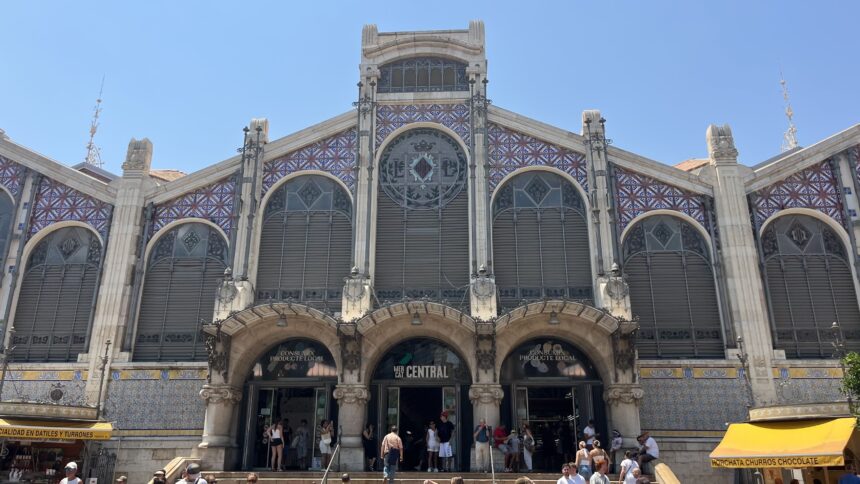
Nothing quite prepares you for the interior. From the outside, the Mercado Central is already impressive, its ceramic tiled facade decorated with rural scenes of Valencian agriculture and orange picking, its entrance framing the view of the nearby Llotja de la Seda, the UNESCO World Heritage silk exchange (La Lonja) that sits directly opposite. But the moment you step inside, the scale of the thing takes over completely.
The market covers more than 8,000 square metres of indoor space, held up by tall iron columns that rise toward twenty breathtaking domes, the largest of which soars 30 metres above the floor. That main dome is decorated with stained glass depicting oranges and lemons, a nod to the produce that has defined the Valencian economy for generations. The ironwork, the mosaics, the colourful ceramic tiles, and the way natural light filters down through the glass give the interior an atmosphere that has been compared, more than once, to a cathedral, and the comparison is not an exaggeration. Art historian Daniel Benito has described the market as a cathedral of food, and walking its aisles it is easy to understand why.
Perched at the very top of the main dome, feet resting on a golden ball, is the Cotorra del Mercat, the big green parrot that has become the market’s emblem. Cotorra means parrot in Spanish, but it also means chatterbox, and the weather vane is meant to represent the noise and bustle of the trading taking place fifty metres below it. On a busy morning, the Cotorra earns its name.
What You Find Inside
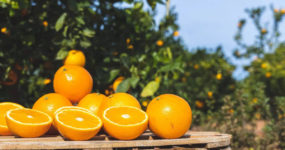
With more than 1,200 stalls spread across the building, the Mercado Central is genuinely overwhelming in the best possible sense. The market is divided into sections, each with its own character. The fish market fills the air with the salt and brine smell of the sea, its stalls piled high with fresh catches from the Mediterranean, including the clóchinas, Valencia’s own smaller, sweeter variety of mussel that locals will tell you is categorically better than anything else in a shell. The fruit and vegetable section runs heavy with seasonal produce from the huerta, the fertile farmland that surrounds Valencia and has fed the city for more than a thousand years. Oranges, of course, but also tomatoes, artichokes, broad beans, and the freshest herbs you will find anywhere in the city.
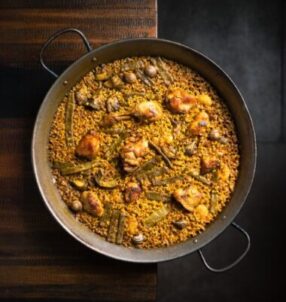
Elsewhere there are stalls devoted to cured meats and jamón, to artisan cheeses, to spices including saffron (one of the most useful and easy to carry gifts you can take home), to Valencian rice in its three main varieties, Senia, Bomba, and Albufera, and to tigernuts, the small root vegetable from which Valencia’s signature drink, horchata, is made. There are also souvenir stalls selling ceramic pieces and paella pans in every conceivable size, from single portion to the kind of pan that feeds an entire extended family at a Sunday lunch.
Central Bar and the Esmorzaret
For anyone who arrives hungry, the Central Bar, now run by celebrated Valencian chef Ricard Camarena, is the place to stop. The bar sits inside the market and specialises in the esmorzaret, Valencia’s beloved mid-morning meal, a tradition that involves a substantial sandwich, usually on thick bread with a combination of cured meats, cheese, or tortilla, accompanied by a glass of something cold. Eating an esmorzaret at the Central Bar, surrounded by the noise and colour of one of Europe’s greatest markets, is as close as you can get to understanding what daily life in Valencia actually feels like.
The Experience
What strikes you most, spending a proper morning at the Mercado Central, is that it is not performing authenticity. It is not a food hall designed for tourists to take photographs of artfully arranged produce. Real Valencians come here to do their actual shopping, speaking Valencian to the stall holders they have known for years, arguing good naturedly about whether the tomatoes are better this week than last, carrying their bags home the same way people have been carrying bags home from this spot for eight centuries. The tourists are there too, and the market accommodates them without changing itself for them, which is a balance very few places manage. It is one of the most visited buildings in Valencia, and one of the most deserving of that attention.
Report by Faith Callaway
Photos copyright Lilly Salvador / ‘24/7 Valencia’
Article copyright ‘24/7 Valencia’
Mercado Central
Plaça de la Ciutat de Bruges, 46001 València
Opening hours, Monday to Saturday, 7.00h to 15.00h. Closed Sundays and public holidays.
Entry is free, no tickets required.
Nearest metro, Xàtiva (lines L3, L5, L7, L9) or Àngel Guimerà, approximately 5 minutes on foot.
Website, https://www.google.com/url?q=http://mercadocentralvalencia.es&source=gmail&ust=1783592647851000&sa=E












Leave a comment