

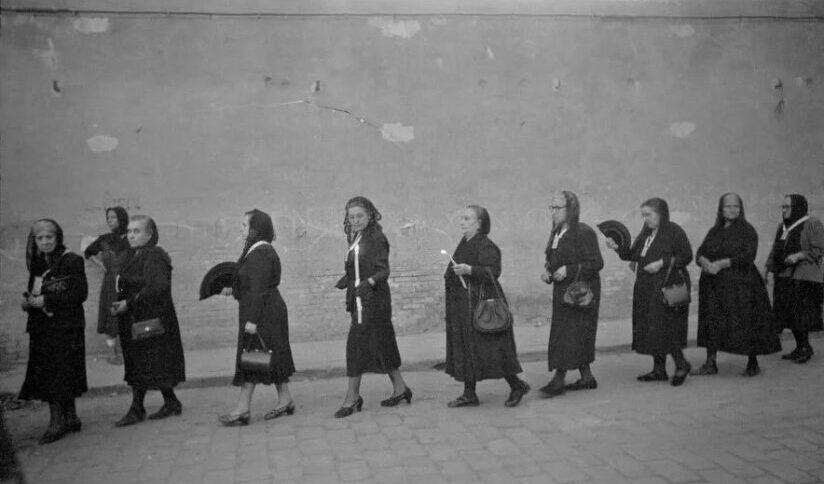
Robert Frank, the legendary Swiss-American photographer, is best known for his groundbreaking book The Americans (1958), a raw and deeply personal exploration of post-war American society. However, before embarking on that transformative journey across the United States, Frank spent an important period in Valencia, Spain—an experience that played a key role in shaping his artistic vision. His time in the humble fishing district of El Cabanyal in 1952 resulted in a remarkable yet lesser-known photographic series, later published as ‘Valencia 1952.’
A Photographer in Transition
In 1952, Frank, along with his wife Mary Lockspeiser and their young son, travelled to Europe, seeking new inspiration. They settled for five months in Valencia, drawn to the unique character of El Cabanyal, a working-class neighborhooud by the Mediterranean. At the time, Spain was still struggling under the Franco dictatorship, and the country’s economic and social hardships were evident. Yet, in this coastal enclave, Frank found a vibrant community with strong traditions, where daily life carried on despite the challenges.
Capturing the Soul of El Cabanyal
During his stay, Frank documented the streets, people, and rhythms of El Cabanyal with an intimate and unembellished approach. His photographs captured children playing barefoot on the beach, fishermen mending their nets, religious processions, bustling markets, and moments of solitude in quiet alleyways. The images reflect not only a documentary record of the neighborhood but also Frank’s growing inclination toward subjective storytelling—an element that would later define his work.
Unlike traditional documentary photographers, Frank was not merely an observer; he immersed himself in the daily life of El Cabanyal, developing a more intuitive and poetic way of seeing. The photographs from this period showcase his emerging ability to distill profound meaning from seemingly ordinary moments, a skill that would become central to his later masterpieces.
The Rediscovery: ‘Valencia 1952’
For decades, the images Frank took in Valencia remained largely unpublished. It was not until 2012 that they were compiled into ‘Valencia 1952’, a book created in collaboration with Vicente Todolí, the former director of Tate Modern. Featuring over 40 black-and-white photographs, the book offers a glimpse into a Valencia that has since changed, yet whose essence remains alive in Frank’s images.
Todolí described Frank’s time in Valencia as pivotal in his artistic evolution. Unlike his later structured photographic essays, the work he produced in El Cabanyal was freer, more instinctive. It was a moment of quiet exploration that allowed him to refine his signature visual language—an approach that would define The Americans just a few years later.
A Lasting Impact
Although Frank’s time in Valencia is often overshadowed by his later achievements, ‘Valencia 1952’ stands as a powerful document of a place and time. His images not only preserve the memory of a barrio and its people but also serve as a reminder of how travel and immersion in different cultures shaped his artistic vision.
More than a historical record, Frank’s Valencia photographs reveal his deep sensitivity to human experience. They capture both the resilience and beauty of everyday life, reflecting his lifelong quest to find truth in the ordinary. Today, as El Cabanyal faces the pressures of urban development, his images remain a tribute to its rich past and enduring spirit.
Robert Frank’s time in Valencia was brief, but it left a lasting mark—on both his own artistic trajectory and the photographic memory of a neighbourhood that, through his lens, became immortal.
Report by ‘24/7 Valencia’ team
Article copyright ’24/7 Valencia’
Photo ‘Procession, Valencia, 1952’ copyright © June Leaf and Robert Frank Foundation
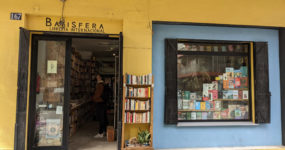
The book ‘Robert Frank, Valencia 1952′ is available in Spanish in local bookshops. In English, it can be found online.



















Leave a comment