

In Parc Central you have many different spaces: within a few hundred metres, it moves from botanical gardens to quiet niches, open lawns and a landscape of water. This photographic report shows my walk through the park and asks one question: how does the design of each area shape the way people use it?
The park is located in the heart of Valencia, on former railway land next to the Estació del Nord. It was designed by the American landscape architect Kathryn Gustafson, who won an international competition for the project. Today it combines historic railway buildings, a traditional farmhouse, themed gardens and water features.
I started my walk at the Moll de Ruzafa (No. 14 on the park map) in the northern part of the park. From there, I followed a circular route through the Jardí de l’Horta (No.2) and the Jardí de les Flors (No.3) down to the open lawns of the Jardí de la Infància (No.4) and the Estany de la Xitxarra (No.9). On my way back, I focused on the ponds and fountains that run through the whole park.
Station 1: Moll de Ruzafa
The first building I came across is not where it was originally built. The Moll de Russafa is a former freight shed with brick arches, and it immediately shows that this park grew out of an industrial site. According to the information board, the shed was built between 1906 and 1910. Engineer Javier Sanz designed it, and architect Demetrio Ribes directed the works. It was one of four freight sheds for slow goods traffic and among the first buildings of the new Estació del Nord. When the high-speed AVE station Joaquín Sorolla was built, the shed was taken apart and rebuilt at its current location inside the park. Demetrio Ribes (Born in Valencia in 1875) is a key figure here. He belonged to the Secession and its strand of Modernisme and was one of the first to use reinforced concrete, paving the way for modern architecture. His most important work is the Estació del Nord, considered one of the finest historic stations in Europe.
Next to the shed stand two more buildings. The Ribes Espai Esportiu (No.10) was once a workshop where axles were turned and bearings cleaned. The Ribes Espai Universitat (No.11) stored mechanical parts, gears and fittings for passenger carriages. Today, they serve as a sports centre and a university space. Their architecture is simpler than the decorated station building, but it speaks the same language of brick, stone and arches.
The first station shows that the park does not erase Valencia’s industrial past. Instead, it gives the old buildings new public uses and makes history part of the walk.
Station 2: Jardí de l’Horta: The Botanical Garden
The Jardí de l’Horta is the greenest and calmest part of my route. A wide variety of plants, flowers, shrubs and trees grows here, and benches are placed directly within the planting, inviting visitors to sit down and look around.
Dogs are not allowed in this area. Together with the dense vegetation, this rule protects the plants and keeps the garden quiet. The name of the garden also refers to the Huerta, the traditional farmland around Valencia, so the garden connects the park to the region’s agricultural roots.
Small information boards with QR codes stand between the plants. One of them introduces the Mediterranean cypress (Cupressus sempervirens). It explains that the cypress has been a symbol of mourning since antiquity and is often planted in cemeteries, that it lives very long, and that its wood hardly ever rots. These boards turn the garden into an open-air classroom: visitors do not only relax here, they can also learn about what they see.
Station 3: Jardí de les Flores: Quiet Niches And the Flower Tunnel
In the Jardí de les Flores, the park becomes more private. Tables and benches are arranged in small areas that are divided by paths and enclosed by bushes. These niches feel sheltered without being cut off from the rest of the park, creating semi-private spaces within a public one. During my visit, these spaces were used mainly by young people who were studying or doing creative work. The quiet, enclosed setting seems to encourage concentration. From this point on, dogs are allowed, but only on a leash. The rules change as the character of the space changes.
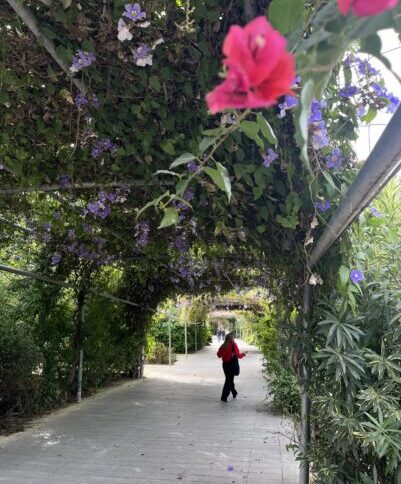
The central route through this part of the park leads through a tunnel of climbing plants, flowers and leaves. Sunlight shines through the vegetation and creates patterns of light and shadow on the ground. This passage shows that there are two ways to move through the park: visitors can take their time and explore the many hidden side paths, or they can take the central route as a quick and much more pleasant shortcut through the city.
Station 4: Open Lawns and Playgrounds
After the enclosed niches, the park suddenly opens up. Around the Jardí de la Infància (No. 4), the space is wide and bright, and the focus shifts from retreat to activity. Coming from the north, a huge lawn stretches out on the left. It is ideal for playing football or other games and for having a picnic. Two large bouldering towers stand at the edge, where visitors can climb. Behind that, there is also a bigger playground and some table tennis tables. On the right side, there is a smaller lawn. It is quieter and invites people to sit in the grass and take a break from the busy city.
The park also offers free Wi-Fi, so these open spaces can be used not only for leisure but also for working or studying outdoors. This part of the park is about movement, play and spending time together.
Station 5: The Water Landscape
On my way back, I realised that water runs through the entire park. It begins in the Estany de la Garrat (No.7) and continues in channels, ponds and small pools, often right next to the seating areas. At the Estany de la Panderola (No.6), countless fountains make it look almost like a water park.
This is part of Gustafson’s design, in which water structures the whole park. It refers to the region’s water, from the Turia and the irrigation channels of the Huerta to the Albufera and the sea, and was inspired by Ausiàs March’s poem Aigua plena de seny («Water full of wisdom»). To me, the water also looked like a railway network: basins like stations, channels like tracks, everything connected. On a former railway site, the water seems to retell the history of the place, turning old networks for goods and water into one for people. Signs prohibit swimming, so the water is only there to be seen and heard. It reflects the trees, masks the noise of the city and gives the seating areas a calm atmosphere.
On the way back, I also passed the Alqueria (No.16), today the park offices. This traditional Huerta farmhouse already appears on a city map from 1924 and reminds visitors that the site was farmland before it became a railway yard.
Conclusion:
Parc Central shows how one public park can meet very different needs. The botanical garden invites people to slow down and learn, the quiet niches offer privacy, the open lawns encourage play, and the water ties it all together. Although the park lies next to the tracks, I hardly heard the trains: city noise mixed with birdsong and the sound of water. Every age group was there, from families and joggers to students and older people on their daily walk. Almost every area can be reached without stairs, and clear rules for dogs, bicycles and opening hours organise how each space is used.
The park also tells Valencia’s story in three layers: the farmland of the Huerta, the railway of Demetrio Ribes and today’s city where people of all ages meet. Parc Central is both an escape from the busy city and a part of its history. What surprised me most were the wide lawns and the many places to sit down and relax. Only 200 metres away, the city is loud and hectic, but here it feels like a completely different world. Parc Central is like a small oasis in the middle of Valencia.
Report by Anna Kolmerer
Article copyright 24/7 Valencia
Photos copyright Anna Kolmerer/ ‘24/7 Valencia’
Parc Central
C/ de les Filipines, s/n
L’Eixample
46006
València
Hours: 07:30 AM – 9:30 PM
Phone: 963 25 78 81
Website: https://valenciaparquecentral.es/












Leave a comment