

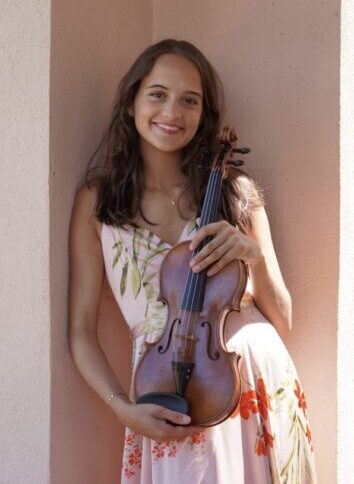

Valencia-native violinist Gabriela Salvador Riera’s musical journey began with a simple but unusually persistent request. At just five years old, she asked for a violin for Three Kings’ Day and continued asking until her parents eventually enrolled her in Suzuki training. Neither she nor her family can fully explain why the instrument felt so inevitable, but that early insistence became the starting point of a lifelong path in music.
From an early age, music quickly grew from a childhood interest into something central to her identity. Surrounded by constant singing, movement, and sound at home, she gradually began to see the violin not just as an instrument she played, but as the primary way she could express herself.
Her early training in Valencia played a key role in shaping her musicianship. At Cortes Espai Educatiu in Alboraya, she was immersed in a structured Suzuki environment that placed strong emphasis on ear training and solfège from the beginning. That foundation, she says, continues to influence her work today in a very practical way. Gabriela reflects that she did not fully understand the value of that training until much later. In hindsight, she recognizes how rare that level of early aural development is in other systems. Today, those skills remain an essential part of how she learns, collaborates, and prepares new repertoire.
Growing up between Spanish and Dominican American cultures also shaped her artistic outlook. Rather than seeing music as belonging to a single tradition, she came to understand it as something shaped by identity, perspective, and lived experience. That awareness has influenced her desire to bring a broader cultural lens into her playing and storytelling.
A major turning point came when she was accepted into the Sphinx Performance Academy at the Curtis Institute of Music. There, she encountered chamber music in a more serious and structured way for the first time. Just as importantly, she was surrounded by mentors and peers who reflected aspects of her background, allowing her to see a clearer path forward. This experience fundamentally changed her sense of possibility. For the first time, she saw what a professional career in music could look like for her. After those two weeks, she made the decision to pursue music seriously and has remained committed to that path ever since.
That commitment eventually led her to Oberlin Conservatory, where she is currently refining both her technical foundation and artistic voice. Studying under violinist Sibbi Bernhardsson, she has focused on building a more efficient and physically sustainable approach to playing, with the goal of removing barriers between intention and sound. Alongside the technical development, Oberlin has also expanded her artistic range. The collaborative environment and exposure to a wide breadth of repertoire have challenged her to think more deeply about interpretation and expression. She also credits her peers and faculty for shaping a musical culture that is both supportive and demanding in the best way.
Her performance experience has grown alongside her studies. She has received recognition at the Sphinx Competition, performed solo with orchestras, and served in leadership roles with youth ensembles including the National Youth Orchestra of the United States. Each of these experiences has contributed to a deeper understanding of performance, particularly in high-pressure environments.
Over time, she has learned that the greatest challenge in performance is often mental rather than technical. She has worked to shift her focus away from external judgment and toward clarity of intention. This mindset, she explains, allows her to stay grounded and present, even in competitive or high-stakes situations.
Gabriela’s new mental approach was put into practice this summer at the Sarasota Music Festival, where she was selected from more than 450 applicants to join 40 college-age Fellows. The experience brought together intensive rehearsals, chamber performances, and close collaboration with internationally renowned faculty artists.
The first week of the festival was especially demanding, with rehearsals and workshops leading up to chamber performances of Beethoven’s Septet, Op. 20 and Schumann’s Piano Quintet, Op. 44. The condensed rehearsal schedule required a level of preparation and efficiency that closely reflected professional musical life. She described this process as both challenging and formative. Preparing music at that pace required her to arrive at rehearsals with a deep understanding of the score, which in turn allowed her to listen more actively and make more informed musical decisions in real time. In the second week, she performed in the orchestra under conductor Nicholas McGegan, gaining firsthand experience of professional orchestral structure and pacing. Playing Beethoven’s Seventh Symphony alongside faculty musicians provided a rare opportunity to observe and participate in a high-level ensemble environment.
One of the most significant aspects of the festival, she notes, was performing directly alongside faculty artists rather than only receiving instruction from them. This shifted the learning dynamic, allowing her to observe their approach in real time and apply those insights immediately in rehearsal and performance. This kind of collaboration also elevated her level of communication within the ensemble. She found that working so closely with experienced musicians encouraged a stronger sense of awareness, listening, and shared musical responsibility among all performers.
Looking ahead, Gabriela remains focused on continued growth rather than fixed outcomes. She hopes to keep expanding her musical experiences through collaboration, chamber music, and opportunities that challenge her both artistically and personally.
More than anything, she is drawn to music as a form of storytelling and connection. She is interested in how performance can build empathy and create space for audiences to engage with perspectives different from their own. This sense of purpose continues to guide her as she moves into the next stage of her musical journey. At this point in her career, what excites her most is not a single achievement or destination, but the ongoing process of learning how to communicate more deeply through music.
Report by Lilly Salvador
Article copyright ‘24/7 Valencia’















Leave a comment