

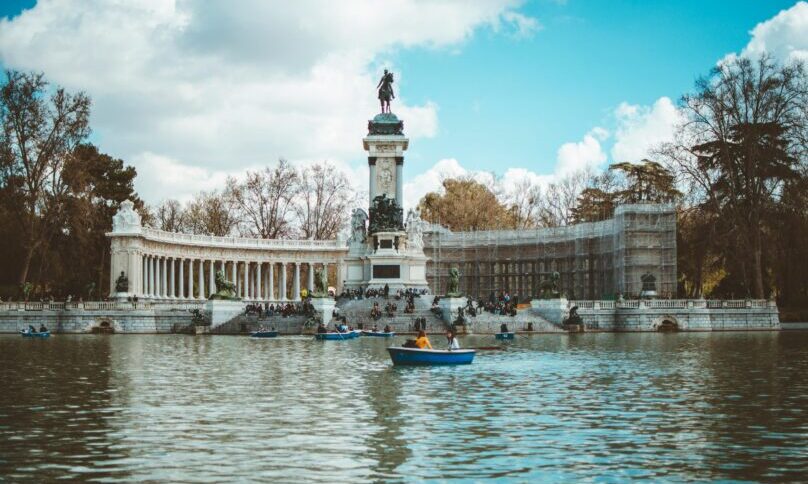

Madrid, the capital of Spain, is located in the centre of the country and boasts a population of about 3.3 million. Over a thousand years of history are present in all the corners of the city, and all you have to do is find them to soak up all that Madrid has to offer. From armories and government buildings to botanical gardens and art museums, there is so much to see and do that you can’t possibly explore everything in one weekend; nevertheless, I attempted it anyway. Early on Friday morning, a friend and I got on the 7:30 am high-speed train to Madrid from Valencia. A short two hours or so later, we were breathing in the hot air of the capital city. Madrid’s climate is noticeably warmer than Valencia’s, and although it is less humid, it doesn’t have the sea breezes that Valencia enjoys on hot summer days. My friend and I found a café to rest and recharge in, enjoying café con leche and pastries. From there we checked into our hostel, The Loft House, and planned for the rest of the day.
First on our schedule was the Real Jardín Botánico, a large garden where I was able to pay only one euro for entry because I showed my student ID. Immediately, we were struck by the natural beauty of the garden, a stark and welcome contrast to the structured charm of the surrounding city. Deep purple lilies with striking yellow centres caught our eyes, statues on pedestals overlooked their sections of the gardens, and American cacti stood in direct sunlight, hot to the touch. Then we entered a room full of butterflies pinned to every surface of the walls. The stunning display was followed by a walk through a vineyard-like path; with grapevines growing all around us while signage told us what kind of wine each vine would produce. A greenhouse stood close to the exit of the gardens, a humid room with an enchanting lily pond and vines growing up every wall.
We exited the gardens, refreshed from a walk through nature and all its freshness enclosed in an old city, and made our way to the Museo del Prado. The Prado was only a couple minutes away from the botanical gardens, and it has free entry two hours before closing time every day. Taking advantage of the free entry, we got in line. Even from the line out the door of the museum, I could appreciate the columns that lined the walls of the façade, as well as the large statue of the artist Velázquez, whose pieces are on display in the Prado. We also saw the Gothic-style Church of Saint Jerome the Royal up the hill from the entrance to the Prado. Pictures were not allowed inside the museum, which, to me, only emphasized the importance of being totally present to the artwork we were seeing. Some highlights were pieces by Rembrandt, Fra Angelico, and, of course, lots of Velázquez.
Thoroughly impressed by the artwork, my friend and I debriefed over tacos from our favorite Spanish chain, TKO. We got gelato from Regazzi Gelateria, and then regrouped at the hostel. At the hostel, we met several other travellers, some solo travelling, some with a friend or two. We even met someone who had recently graduated from our university in the US, surprised by how small the world really is. Then we headed to O’Connell’s, and Irish pub a short walk from our hostel. Almost everywhere we went played American and British pop music, making it especially easy for us to feel welcome in the city, as well as connect with other travellers who were singing along with American, British, or Irish accents.
Rising bright and early on Saturday morning, we hit the ground running with breakfast and tea at the Nomade Café, and then headed to the west side of the city. The gardens of the Royal Basilica of Saint Francis the Great, followed by a visit to the Catedral de Santa María la Real de la Almudena, were our first quick stops for the day.
Right next to the Cathedral stands the Palacio Real de Madrid, which may be the largest building I have ever seen, containing 3,418 rooms with over a million square feet of floor space. Though we did not go into the palace, we stood outside and tried to take in the sheer magnificence of the building in front of us. It towered over the gardens below and offered a view of the city that is unmatched, with red roofs on display and jagged mountains standing in the distance. The gardens below showcased staggering trees and Romantic architecture in the pathways and statues that broke up the flowers and underbrush. The side of the palace visible from the garden was just as breathtaking as the front, with tiers of the palace that each contained several floors. French doors opened onto the veranda from the bottom floor of the palace, no doubt offering a luxurious view of the statues, fountains, and immense amount of land that belonged to those who lived in the palace before.
Hungry from a full morning of walking and sightseeing, my friend and I went back to the hostel for lunch and siesta, running into more Americans who regaled us with stories of their ongoing European adventures. Once revived, I ventured off alone to the Museo Nacional Centro de Arte Reina Sofia while my friend took a much-needed rest. The Reina Sofia features art from the twentieth and twenty-first centuries, with a focus on modern and contemporary Spanish art. Artists like Gris, Dalí, and Picasso were on full display, showcasing pieces most have only ever heard of. The star of the show, however, was Picasso’s Guernica, the large-scale cubist painting that was commissioned as a response to the 1937 bombing of the Spanish town after which the painting is named. Though I had seen photographs and copies of the piece before, seeing it in real life was a completely new experience. Its size, lack of colour, and irregular shapes and themes were disarming, leaving the audience in the Reina Sofia in a quiet stupor as they gathered around it.
Collecting myself in preparation for the rest of the day, I walked across town to meet up with friends in the Mercat de San Miguel. This bustling center for tapas and authentic Spanish food gave our group of six so many options that everyone could pick and choose exactly what they wanted, no debates about where to eat or sit needed. Full of tapas and sangria, my friend and I then went to our last stop of the trip, the Museo Nacional Thyssen-Bornemisza.
Monets, Pissarros, more Picassos, and even a Georgia O’Keeffe painting were on display at the Thyssen, offering the perfect artistic relaxation after a day of high-profile art in all forms. Finishing the night off with churros con chocolate from Maestro Churrero, my friend and I reflected on our trip, comparing and contrasting Madrid and Valencia.
Madrid is a much larger city—the largest in Spain, in fact. As two students who are used to walking everywhere on our campus, and now, to our workplaces in Valencia, it was different for us to take public transportation more than we were used to. However, we enjoyed the constant availability of buses and taxis, as well as the walkable plazas and streets that had plenty of options for food from around the world. We loved Madrid for its constant ability to balance the history of the city with its newness and the demands of a modern capital. But, when we arrived back in Valencia, we couldn’t help but re-appreciate the Turia gardens, the walkability of the city, and all our favorite little restaurants again. Overall, our weekend in Madrid was fantastic, and while we were happy to be there, we were also happy to return to our beloved Valencia.
Learn more about each of the places I visited at the following links:
Real Jardín Botánico: https://rjb.csic.es/
Museo del Prado: https://museopradotickets.com/en
The Loft House Madrid: https://www.theloft.house/destinos/madrid/lavapies
The Royal Palace of Madrid: https://www.patrimonionacional.es/visita/palacio-real-de-madrid
Museo Nacional Centro de Arte Reina Sofía: https://www.museoreinasofia.es/
Museo Nacional Thyssen-Bornemisza https://www.museothyssen.org/
Report by Fiona Pacious
Article copyright ‘24/7 Valencia’
‘Madrid’ photo copyright Nicolas Postiglioni











Leave a comment