

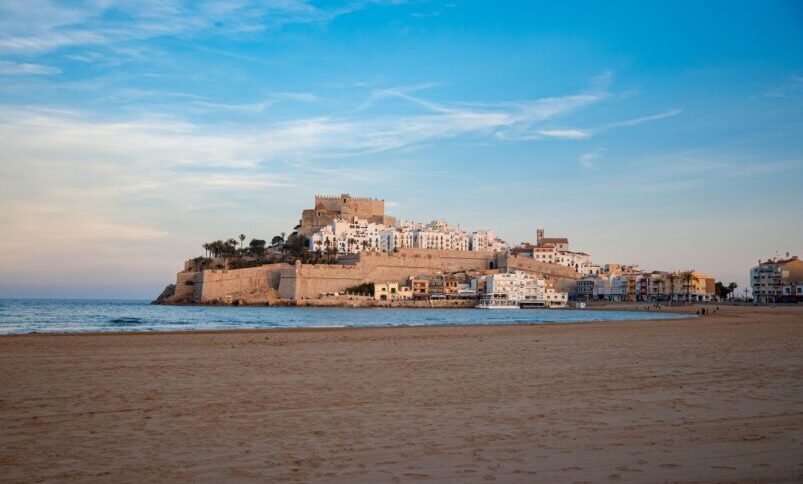

To understand the geographic drama of the Costa Azahar, one must look toward the horizon where the land makes a final, defiant stand against the Mediterranean. Here, perched on a rocky tombolo that was once an island during high tide, sits the Castillo de Peñíscola. Often referred to as the “Gibraltar of Valencia,” this fortress is not merely a relic of military defense; it is a layered narrative of religious schism, Templar ambition and modern cinematic fame.
Our journey began in the neighbouring town of Benicarló, a quieter, authentic hub known for its agricultural roots and maritime industry. The short transition from the bustling streets of Benicarló to the narrow, white-washed ascending alleys of Peñíscola feels like a deliberate step back through time with a “Then and Now” experience that defines the Valencian coast.
The Fortress of the Knights: A Templar Foundation
The “Then” of the Castillo de Peñíscola begins with the Knights Templar, who constructed the current fortress between 1294 and 1307. Built upon the remains of an old Arab citadel, the castle reflects the austere, formidable architectural style of the Order. The walls are composed of carved stone blocks, devoid of excessive ornamentation, designed to withstand both the crashing waves of the sea and the sieges of land-based enemies.
Walking through the main gate, visitors are immediately struck by the sheer scale of the limestone masonry. The Templars, ever the masters of logistics and fortification, utilized the natural elevation of the rock which is 64 metres above sea level that creates a vantage point that remains unparalleled. Today, as you stand on the battlements, you aren’t just looking at a view; you are observing the same strategic horizon that medieval sentries once guarded.
The Papal Shadow: Papa Luna’s Sanctuary
Perhaps the most compelling chapter of the castle’s history is its role during the Great Western Schism. In the early 15th century, the castle became the residence of Benedict XIII, known colloquially as Papa Luna. Refusing to acknowledge his deposition by the Council of Constance, he fled to Peñíscola, transforming this remote fortress into a Papal seat.
The interior of the castle still carries the weight of this period. The Papal chambers, the library where he guarded his precious codices and the austere chapel where he prayed for the legitimacy of his claim all remain remarkably preserved. Unlike the grand, sprawling palaces of Avignon or Rome, Papa Luna’s sanctuary is intimate and intense and a testament to a man who remained steadfast in his convictions until his death within these very walls in 1423.
From Papal Seat to Cinematic Icon
The “Now” of Peñíscola is inextricably linked to its visual power, which has caught the eye of international filmmakers including for the epic historical drama ‘El Cid’ starring Charlton Heston and Sophia Loren. For modern visitors, the castle might look familiar not from history books, but from the screen. Most recently, the fortress and its surrounding plazas served as the backdrop for the city of Meereen in the ‘Game of Thrones’ series.
This cinematic layer has breathed new life into the historic centre. While the castle remains a site of erudite study, the surrounding streets are now filled with a vibrant energy that bridges the gap between historical preservation and contemporary tourism. The contrast is striking: 700-year-old stone walls now frame bustling boutiques selling local artisanal crafts and terraces where visitors enjoy modern Mediterranean cuisine.
Reflection
The Castillo de Peñíscola is a masterclass in functional history. It refuses to be a “dead museum piece” because it continues to adapt to the needs of the city it guards. Whether you are drawn by the architectural brilliance of the Templars, the defiant history of Papa Luna, or the cinematic allure of a fictional kingdom, the castle offers a profound sense of continuity. It is a place where the salt air of the Mediterranean meets the enduring stone of human ambition, reminding us that Valencia’s story is one that is still being written.
Report by Faith Callaway
Article copyright 24/7 Valencia
Photo copyright BM Garcia
Additional photos copyright Faith Callaway/ ’24/7 Valencia’: https://www.facebook.com/247valencia/










Leave a comment