

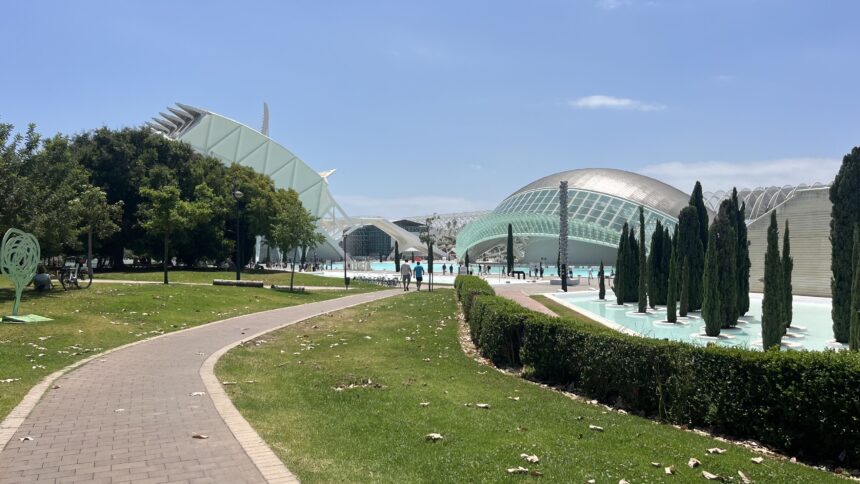

At first glance, it is difficult to believe that one of Valencia’s most active public spaces was once a river. Today, the ‘Jardín del Río Turia’ stretches nearly nine kilometres across the city, connecting neighbourhoods, landmarks, and communities through a continuous corridor of green. What was once the Turia River is now one of Spain’s largest urban parks, a place where history and everyday life meet in unexpected ways.
Beginning at the eastern end of the gardens, the futuristic silhouette of the Ciudad de las Artes y las Ciencias immediately dominates the landscape. Its white structures rise above the trees, reflecting in the surrounding pools of water and creating one of the most recognizable views in Valencia. This contrast between the highly modern architecture and the greenery of the former riverbed provides a fitting introduction to a park, setting the unique tone for the rest of the walk through the gardens.
Moving away from the complex and deeper into the gardens, the pace of the city begins to slow. Wide pathways stretch forward beneath rows of trees, carrying a constant flow of walkers, runners, and cyclists. Rather than competing for space, each group moves comfortably through the park with its own designated lane, creating a rhythm that remains present throughout the entire route. Some people are clearly exercising, focused on training and fitness goals, while others walk at a slower pace, enjoying the shade and open space. Together, they create a sense of movement that gives the gardens much of their character.
What quickly becomes clear is that the Turia Gardens are far more than a place for walking. Throughout the former riverbed, sports facilities appear one after another, reflecting the park’s important role in recreation. Football fields host training sessions and casual matches, while nearby rugby pitches provide space for additional team sports. Softball and baseball fields bring another layer of activity to the landscape, often filled with local clubs practicing during the afternoon. Skateparks attract younger visitors, with skateboarders and scooter riders spending hours perfecting tricks beneath the Valencian sun. The variety is remarkable, and it is difficult to walk more than a few minutes without encountering another area dedicated to sport or exercise for our community.
The infrastructure supporting these activities is equally impressive. Water fountains are scattered throughout the gardens, offering places for runners to refill bottles, cyclists to cool off, and visitors to wash their hands before continuing their journey. Though simple, these details help explain why the gardens feel so integrated into daily life. They are designed not only to be visited but to be used.
Further along the route, one of the park’s most distinctive attractions emerges. Gulliver Park transforms Jonathan Swift’s famous literary character into an enormous interactive playground. From a distance, the giant figure appears almost surreal, stretched across the landscape as children climb over ropes, slides, and ramps built directly into the structure. Parents gather nearby while visitors stop to admire one of the most creative public spaces in the city. The attraction captures the playful spirit of the gardens and demonstrates how successfully the former riverbed has been adapted for people of all ages.
As the walk continues west, the atmosphere gradually shifts from active recreation to social gathering. Near the Palau de la Música, the gardens take on the feeling of a community plaza. Fountains provide a welcome break from the summer heat while shaded pathways encourage people to linger rather than simply pass through. Friends sit together on benches, students gather in small groups, and families spread out across the grass. Unlike many urban parks that feel separated from city life, this section of the Turia Gardens feels deeply connected to it. The space functions almost as an outdoor living room for Valencia, where people come together without any particular agenda beyond enjoying the surroundings.
The landscaping throughout this area helps create that atmosphere. Palm trees rise above the pathways while orange trees add a distinctly Valencian character to the park. Flower beds introduce bursts of colour between stretches of green lawn, and fountains add movement and sound to the environment. Despite being located in the centre of a busy city, the gardens manage to feel surprisingly peaceful.
Overhead, bridges serve as constant reminders of the site’s history. Long before the gardens existed, these structures carried people across the Turia River. Today, they span pathways and sports fields instead of flowing water, creating a visible link between Valencia’s past and present. Some bridges display traditional stone architecture that has stood for centuries, while others reflect a more modern vision of the city. Among the most striking is the Puente de la Exposición, designed by Valencian architect Santiago Calatrava. Its sleek white form echoes the architectural style of the Ciudad de las Artes y las Ciencias, creating a visual connection between two of the city’s most recognizable landmarks.
Standing beneath these bridges, it becomes easier to appreciate the scale of the transformation that took place here. What was once a river prone to flooding has become a public space used by thousands of people every day. Yet the history of the site has not disappeared. It remains visible in the shape of the landscape, the bridges overhead, and the long corridor that continues to cut through the heart of Valencia.
Perhaps the most memorable aspect of the Turia Gardens is not any single landmark but the people who fill the space. An elderly couple walking hand in hand beneath the trees, children racing across a playground, athletes training on nearby fields, and friends sharing conversation beside a fountain all contribute to the identity of the park. These everyday moments reveal what makes the gardens successful. They are not simply a tourist attraction or an ambitious urban planning project. They are a place where the city gathers.
By the end of the walk, the Turia Gardens feel less like a park and more like a reflection of Valencia itself. Modern architecture stands alongside historic bridges. Sports facilities share space with gardens and fountains. Visitors and residents move through the same pathways, creating a constant flow of activity across the former riverbed. The river may no longer run through Valencia, but its path continues to shape the city in a different way. Today, the current comes from the thousands of people who walk, run, cycle, play, and gather here each day, giving new life to a landscape that has become the heart of Valencia.
Report by Lilly Salvador
Article copyright ‘24/7 Valencia’















Leave a comment