


There is a moment, somewhere between turning off Avenida de la Constitución and stepping into the narrow streets around the Plaza de la Iglesia, when Valencia stops feeling like a city and starts feeling like something older and quieter. That moment is Benimaclet, and once you find it, it is hard to believe it took you this long.
A Village That Never Quite Left
Benimaclet sits in the northeast of Valencia, technically part of the city since being absorbed into it in 1972, but spiritually still its own world. The name itself gives away its origins, coming from the Arabic Beni Majlad, meaning sons of Majlad, a remnant of the Moorish settlements that once dotted the land surrounding the old city. Even today, longtime residents will casually say “Voy a Valencia,” I am going to Valencia, when heading into the city centre, an instinct that speaks to just how distinct this corner of the city still feels from everything surrounding it.
The heart of Benimaclet is its Plaza de la Iglesia, a wide, sun baked square anchored by the Church of the Asunción, whose origins stretch back centuries. On any given day the plaza functions as the neighbourhood’s living room, filled with locals catching up over coffee, kids cutting across on bikes, and older residents watching the square do what it has always done. A Friday street market sets up here each week, bringing fruit, vegetables, and a lively neighbourhood energy that feels more village than urban district.
The Casa de Trencadís
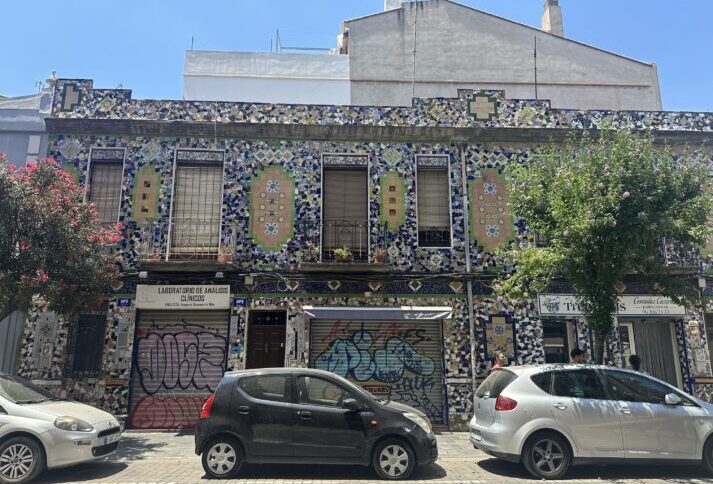
No visit to Benimaclet is complete without standing in front of the Casa de Trencadís on Calle Mistral, numbers 37 and 39. The building is impossible to miss and impossible to forget. Its facade is covered entirely in a mosaic of multi-coloured glazed tiles, assembled by a local bricklayer named José Sanmartín Zarzo at the turn of the 20th century. Zarzo was not an architect, but he was a devoted admirer of Antoni Gaudí, and he spent years collecting leftover tile fragments from construction sites across Valencia to build these two houses as a quiet tribute to the Catalan master. The result is one of the most photographed facades in the city, and one of the most charming pieces of vernacular architecture anywhere in Valencia. Pedro Almodóvar thought so too, using the building as a location in his 2004 film La Mala Educación, a fact that still gets mentioned with quiet pride by neighbours today.
Students, Artists, and the Alternative Spirit
What defines Benimaclet now, beyond its village bones, is the energy that proximity to Valencia’s university campuses has brought over the past few decades. The barrio has become a magnet for students, artists, musicians, and international residents, creating a community that is simultaneously rooted in tradition and genuinely open to the new. The streets are full of independent bookshops, small galleries, and cafes that double as cultural venues most nights of the week.
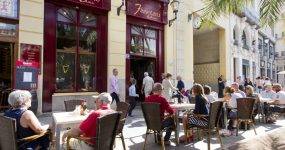
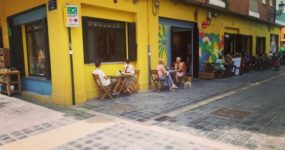
The emblem of this spirit is Kaf Café, a place that is at once a bar, a community library, an art gallery, and a live music venue, depending on the hour. It is the kind of space that could only exist in a neighborhood like Benimaclet, where the line between a coffee and a conversation and a concert has always been deliberately blurred. Alongside it, spots like L’Obrador for breakfast, Estudio 64 for books and art, and the emblematic ‘El Glop’, which occupies the old village town hall building, make up a neighbourhood dining and cultural scene that punches well above its size.
Murals and Street Art
Walking the streets beyond the plaza, it becomes clear that Benimaclet has also become one of Valencia’s most significant canvases for street art and murals. Large scale works cover entire building facades throughout the barrio, turning an afternoon wander into something close to an open-air gallery. The art ranges from bold graphic pieces to more delicate, figurative work, and the overall effect adds another layer to a neighbourhood that already had more character than most.
Worth the Walk
Benimaclet is not on the standard Valencia tourist trail, and that is exactly its strength. It asks nothing of visitors except a willingness to slow down, take the wrong turn, and end up somewhere genuinely surprising. Whether it is the tiled splendour of the Casa de Trencadís, the easy rhythm of the plaza on a weekday morning, or a late night at Kaf Café with someone you just met, Benimaclet consistently delivers the kind of experience that makes Valencia feel less like a destination and more like a place people actually live.
If you are spending any real time in the city, this is the neighbourhood you should find your way to at least once. The locals will probably not mind, as long as you remember to say you are going to Valencia when you leave.
Report by Faith Callaway
Article copyright ‘24/7 Valencia’
Photos copyright Faith Callaway/ ’24/7 Valencia’
Benimaclet
District 14, northeast Valencia
Getting there, Metrovalencia Line 3 (Metrovalencia stop: Benimaclet) or EMT bus lines 12, 29, 41, 70, and 99.
Casa de Trencadís, Calle Mistral, 37 and 39, 46020 Valencia.
Kaf Café, Calle de Murillo, 9, Benimaclet.













Leave a comment