

There is a particular kind of confidence that belongs to certain neighbourhoods. Not the loud, performative kind you find in tourist-heavy areas, but something quieter and more assured with confidence of a place that has always known exactly what it is. Walking through the interconnected districts of Colón, Ensanche, and Cánovas in Valencia, that confidence is present in every detail: the immaculate tree-lined boulevards, the architecture that seems almost too beautiful to be functional, the café terraces where well-dressed locals linger over afternoon coffee without any particular urgency. This is not a neighbourhood that needs to try. It simply is.
The Boulevard: Calle Colón
Any exploration of this quarter logically begins on Calle Colón, Valencia’s answer to the grand European shopping street. Wide, tree-shaded, and lined with a curated mix of international fashion houses and independent boutiques, it sets the tone for everything that follows. This is where Valencia puts its most polished face forward. The window displays are impeccable, the architecture above the shop fronts is ornate and confident, and the rhythm of the street unhurried, purposeful signals immediately that you are in a different register of the city than the chaotic, beautiful energy of the old town.
What makes Calle Colón distinctive is that it manages to be genuinely upmarket without feeling exclusionary. Locals shop here, businesspeople walk here, families wander through on a Wednesday afternoon. The elegance feels lived-in rather than performative, which is perhaps the most Valencian quality of all.
The Crown Jewel: Mercado de Colón
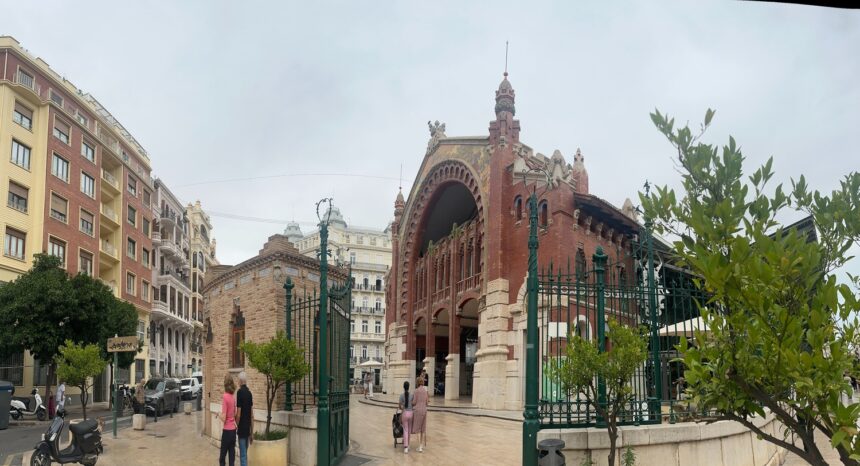
If Calle Colón sets the tone, the Mercado de Colón is the undisputed architectural centrepiece of the neighbourhood. Stepping through its grand triumphal archway that is 24 metres of intricate brick, wrought iron, and vibrant mosaic tiles depicting scenes of Valencian rural life that feels less like entering a market and more like being welcomed into a cathedral dedicated to the art of living well.
Designed by architect Francisco Mora Berenguer, a student of Antoni Gaudí, and inaugurated on Christmas Eve 1916, the building was conceived as a monument to the neighbourhood’s affluent residents as much as a place to buy groceries. The ambition is still palpable today. The cast-iron columns, the soaring glass canopy that floods the interior with Mediterranean light, the polychrome ceramic details on every surface and every element speaks to a moment in Valencia’s history when the city was expanding outward and upward, and the new bourgeoisie wanted architecture that announced their arrival.
Today the market has evolved far beyond its origins as a food hall. Following a comprehensive restoration in 2003, it has been reimagined as one of the city’s premier gastronomic and social destinations. Inside, spaces like Mi Cub continue the building’s long connection to local agriculture by hosting exclusive presentations of regional Valencian wines, while Horchatería Daniel remains one of the finest places in the city to experience the authentic ritual of cold horchata and fartons on a warm afternoon. A visit here is not an errand. It is an experience.
Worth noting for visitors heading there now: the lower level is currently undergoing renovation, so some businesses are temporarily closed, but the magnificent main pavilion is fully open and as breathtaking as ever.
The Street Behind the Street: Calle Cirilo Amorós
Running parallel to Calle Colón, Calle Cirilo Amorós operates at a slightly different frequency with less international flagship, and with more carefully curated independent boutiques. This is where the neighbourhood reveals a more personal side of its upmarket identity. The shops here tend toward the artisanal and the considered: fashion with a point of view, interiors with genuine character, the kind of retail that rewards slow browsing over efficient shopping.
The architecture along Cirilo Amorós is also worth pausing for. The residential buildings that line the street represent some of the finest examples of Valencian Modernism in the city, their ornate facades and wrought-iron balconies a reminder that this neighbourhood was designed from the beginning to be beautiful.
The Dividing Line: Gran Vía Marqués del Turia
To understand the subtle social geography of this part of Valencia, you need to stand on the Gran Vía Marqués del Turia and look in both directions. This broad, tree-lined boulevard functions as more than a major arterial road as it is the invisible boundary between two distinct expressions of Valencian wealth.
To the north, the Colón side represents new money: sleek, international, forward-looking. The energy is cosmopolitan and contemporary, the buildings slightly more modern, the commercial activity more globally connected. Cross to the south, and you enter Cánovas where the old money side of the equation lives. The change is subtle but unmistakable, like switching from a crisp modern sans-serif font to something with elegant serifs and a long history.
The Old Soul: Plaza Cánovas del Castillo
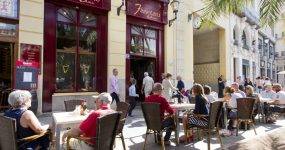
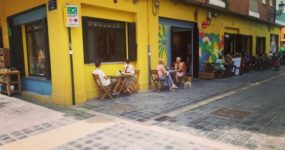
Cánovas began taking shape in 1912 as the second phase of Valencia’s great Ensanche expansion, designed to house the city’s newly wealthy industrialists and merchants who had built their fortunes on rice, oranges, and Mediterranean trade. The neighbourhood was conceived as a lasting monument to their success, and in many ways it remains exactly that. The centrepiece is the Plaza Cánovas del Castillo itself, a gracious square flanked by two elegant crescents of Modernist architecture that curve around the space like cupped hands. On the corner, the famous Edificio Chapa, built in 1913 and designed by Demetrio Ribes, announces itself with showy corner galleries and elaborate stone detailing that bridges Art Nouveau and the coming wave of Art Deco. It is the kind of building that stops you mid-stride. The square’s café terraces are filled on any given afternoon with a particular cross-section of Valencian society: older residents who have known this neighbourhood for decades, young professionals drawn by the area’s enduring prestige, and visitors who have wandered south from the Colón bustle and found themselves unexpectedly charmed. The atmosphere is one of quiet celebration of a neighbourhood that has maintained its identity through a century of change and has no intention of surrendering it now.
A Tale of Two Monies
What makes the Colón-Ensanche-Cánovas corridor so compelling as a subject is precisely this layering of identities. Cánovas is old money, Colón is new money. But walking through both on a single afternoon, what strikes you most is not the difference between them but the continuity. Both share the same fundamental Valencian conviction that life is best lived beautifully, publicly, and without excessive haste. The addresses may signal different kinds of wealth, but the values underneath them are the same: good architecture, good food, good company, and the long Valencian afternoon stretching out ahead.
Report by Faith Callaway
Article copyright ‘24/7 Valencia’
Photos copyright Faith Callaway/ ’24/7 Valencia’











Leave a comment