


To walk through Ciutat Vella, the historic heart of Valencia, is to participate in a centuries-old conversation. Unlike European old towns that feel preserved under glass like sterile museum exhibits, Valencia’s historic centre is a loud, breathing, unapologetically messy convergence of eras. It is a place where 2,000-year-old Roman foundations support medieval walls, which in turn frame vibrant terraces where locals argue over football and sip coffee under the morning sun. The “Then and Now” of Valencia isn’t a split timeline; it is a single, continuous reality. Understanding this space requires stepping past the generic travel guides and looking closely at how the architectural heavyweights of the past have seamlessly integrated into modern Mediterranean life.
Where Empires Crossed: Plaza de la Virgen
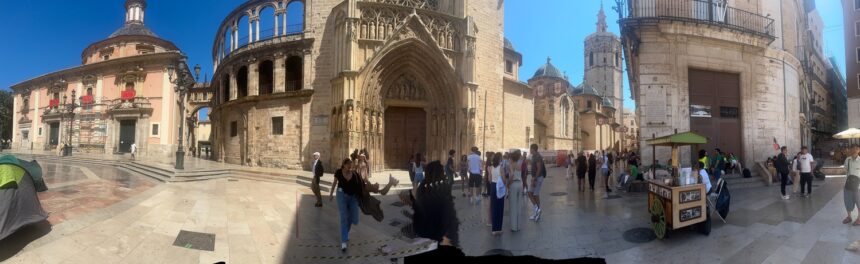
The logical starting point for any exploration of the centre is the Plaza de la Virgen. Standing
beside the central fountain which depicts an allegorical Neptune representing the Turia River. Surrounded by eight nude maidens, representing the traditional irrigation canals, you are standing on the literal birthplace of the city. Then: This exact square was the Roman Forum of Valentia Edetanorum, founded in 138 BC.
Centuries later, under Moorish rule, it sat adjacent to the central mosque. When the Christian conquest swept through in the 13th century, the mosque was dismantled to lay the groundwork for the Cathedral we know today.
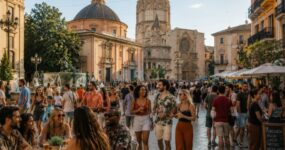
Now: The plaza functions as the city’s communal living room. The ancient forum is gone, replaced by smooth marble stones polished clean by millions of footsteps. On any given afternoon, the air is filled with the sounds of children chasing pigeons, street musicians playing Spanish guitar, and the clinking of glasses from the surrounding outdoor cafes. The cathedral’s famous Puerta de los Apóstoles still hosts the Tribunal de las Aguas (Water Court) every Thursday at noon. The oldest legal institution in Europe, operating continuously since the Moorish caliphate, proving that local traditions refuse to die.
The Architectural Peak: La Lonja and Mercado Central
Just a short walk down the winding alleyways of the historic centre brings you to a stunning physical manifestation of economic evolution: the La Lonja de la Seda (The Silk Exchange) and the Mercado Central.
Then: Built between 1482 and 1533, La Lonja is a masterpiece of late Gothic architecture and a testament to Valencia’s Golden Age. This was the trading floor where merchants from across the globe bartered over silk and spices. Its main hall, with towering, twisting stone pillars that mimic palm trees reaching toward a vaulted heaven, was designed to showcase the immense wealth of the Mediterranean trade routes.
Now: Directly across the street sits the Mercado Central, a magnificent modernist structure built in the early 20th century out of iron, glass, and colourful ceramics. While La Lonja stands as a silent, majestic monument to yesterday’s trade, the market is the loud engine of today’s culinary scene. Inside, under a massive 30-metre-high dome decorated with stained-glass oranges, over 300 local vendors scream out daily prices for fresh seafood, Iberian ham, and local produce. It is a masterclass in functional history: an architectural landmark that refuses to become a tourist trap because the neighbourhood still relies on it for their daily groceries.
Defending the Narrative: The Medieval Gates
To truly understand the physical footprint of Ciutat Vella, you have to look at how the city once kept the outside world at bay. The ancient Christian walls that once completely enclosed the historic centre were demolished in the 19th century to make way for urban expansion, but two magnificent stone gatekeepers survived.
Then: The Torres de Serranos, built at the end of the 14th century, served as the grand northern entrance to the city. These massive, robust Gothic twin towers were designed not just for defense, but to terrify and impress visiting royals and foreign ambassadors. For centuries, they also served as a prison for the nobility.
Now: The gates no longer defend anything. Instead, they serve as the ultimate viewpoint for travellers and locals alike. For a small fee, you can climb the stone steps to the top of the ramparts, looking out over the ancient rooftops of the historic centre on one side and the sweeping green expanse of the Turia Garden bed on the other. Every year, it is from these very towers that the Fallera Mayor declares the start of the Las Fallas festival, turning a medieval defensive fort into a launchpad for the city’s modern celebrations.
The Bottom Line
Ciutat Vella’s magic doesn’t lie in its ability to freeze time, but in its capacity to absorb it. As you wander through the labyrinth of backstreets, past walls covered in contemporary graffiti and ancient stone arches, you realize that the historic centre is not a relic of the past. It is a canvas that Valencia continues to paint over, day after day, century after century.
Report by Faith Callaway
Article copyright ‘24/7 Valencia’
Photos copyright Faith Callaway / 24/7 Valencia














Leave a comment