

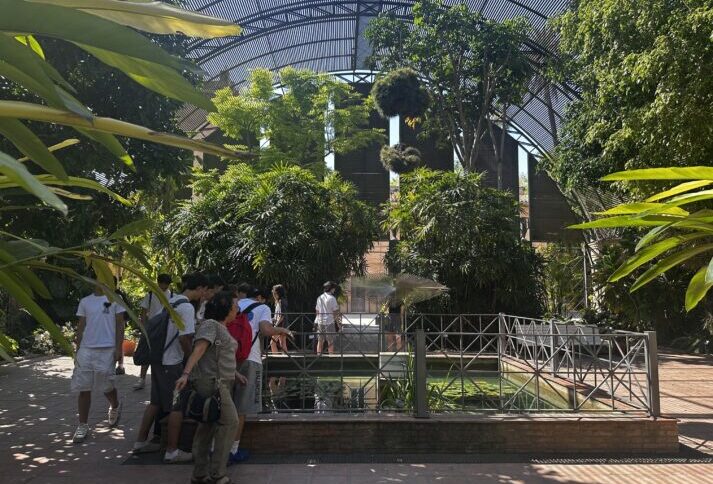

Tucked into Calle Quart, just steps from the bustling Torres de Quart and a short walk from the city centre, the Jardín Botánico de la Universitat de València offers something increasingly rare in a city, silence, shade, and four hectares of living history. While Valencia’s tourists flock to the Ciudad de las Artes or the Turia Gardens, this 16th century botanical garden remains one of the city’s quietest and most rewarding cultural spaces with a living museum that has been continuously cultivated for over 200 years.
The garden’s roots go back further than most of Valencia’s historic landmarks. Its origins trace to a physics garden founded in 1567 by Juan Plaza, professor of medicinal botany, created to cultivate plants used in the teaching of medicine. For roughly two centuries, this modest plot served the university’s medical faculty, evolving alongside Valencia’s own development as a centre of learning. It wasn’t until 1802, with the ideas of the Enlightenment taking hold across Spain, that the University purchased the Huerto de Tramoyeres, the plot of land outside the old city walls, near the Torres de Quart, where the garden still stands today.
The 19th century was the garden’s golden age. Under the direction of botany professor Félix Pizcueta, who led the garden from 1829 to 1863, the collections expanded dramatically, and exotic plants from around the world were successfully acclimatised to the Mediterranean climate. It was during this era that the garden extended toward the Paseo de la Pechina, and the elegant glasshouse known as the Invernadero de la Balsa was constructed. Toward the end of the century, the Valencian architect Arturo Mélida designed the garden’s iconic umbráculo, a large shaded structure that remains one of its most photogenic features today.
Like much of Spain’s cultural infrastructure, the garden suffered a long period of neglect throughout the 20th century. It wasn’t until 1987 that the Universitat de València began a full restoration project, finally completed in the year 2000. The result of that painstaking work is what visitors see today, a meticulously maintained scientific institution that doubles as one of the most peaceful green spaces next to the historic centre.
Walking through the garden today feels like a journey across continents compressed into a single afternoon. The collection now spans more than 3,000 species of trees and plants gathered from all five continents. Mediterranean natives sit alongside towering palms, dense tropical specimens, and an entire section dedicated to cacti and other desert flora, a small botanical world tour without ever leaving the city walls. Monumental trees, some predating the garden’s modern restoration, tower over visitors and offer some of the best shade to be found anywhere in central Valencia during the summer months.
Beyond its role as a public garden, the Botánico continues to function as a genuine research institution. It maintains a germplasm bank and an active herbarium, and conducts ongoing research into plant diversity and the conservation of rare, endemic, and endangered Mediterranean species. This dual identity is part of what makes a visit feel different from an ordinary park stroll. Information panels throughout the grounds reflect genuine academic care, and the garden regularly hosts guided tours, educational workshops, and seasonal events tied to its scientific mission.
The garden has also recently leaned further into cultural programming, including a new initiative connecting its living plant collections with rare volumes held in the university’s historical library, a reminder that the Botánico’s identity has always straddled science, history and culture simultaneously. The institution has also picked up recognition for its applied conservation research, an indication that what might look, at first glance, like a simple city garden is in fact part of a much larger and more serious botanical mission.
For visitors, the appeal is straightforward, this is one of the few spots in central Valencia where you can wander largely undisturbed, surrounded by genuine biodiversity, in a setting with real historical depth. Photographers in particular will find no shortage of material as the interplay of dappled light through the umbráculo, the dramatic silhouettes of palms against blue sky, and quiet corners of cacti and succulents feel almost otherworldly against Valencia’s urban backdrop.
In a city often defined by its modern architectural icons and its buzzing nightlife, the Jardín Botánico offers something different, a quiet continuity with Valencia’s past, stretching back nearly five centuries, and a living reminder that some of the city’s most valuable cultural assets are the ones that simply continue to grow.
Report by Faith Callaway
Article copyright ‘24/7 Valencia’
Photos copyright Faith Callaway/ 24/7 Valencia
Jardí Botànic de la Universitat de València
Calle Quart, 80, 46008 València
Telephone, +34 963 156 800
Opening hours, open daily. November to February, 10:00h to 18:00h. March and October, 10:00h to 19:00h. April and September, 10:00h to 20:00h. May to August, 10:00h to 21:00h.
General admission, 4 euros. Reduced admission, 1.70 euros.
Website: https://www.jardibotanic.org/?idioma=_eng



















Leave a comment