

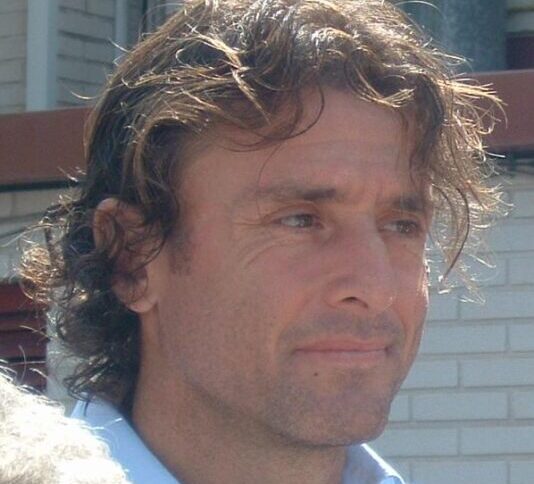
Few players in the long and passionate history of Valencia CF have built a connection with the Mestalla faithful quite like Amadeo Carboni. Arriving in Valencia at an age when many footballers begin to think about the final chapters of their careers, the Italian defender instead wrote one of the most memorable stories the club has ever seen. With his tireless runs down the left flank, relentless competitiveness, and unmistakable passion for the badge, Carboni quickly became much more than just a player — he became a symbol of commitment and belief.
During one of the most successful eras in Valencia CF’s modern history, Carboni’s presence embodied the fighting spirit that defined the team. Whether facing Europe’s elite on Champions League nights or battling through intense La Liga clashes, he carried himself with a leadership and charisma that resonated deeply with supporters. His connection with the Mestalla crowd was not built on flashy headlines, but on consistency, sacrifice, and an unwavering desire to win for the club.
Even years after hanging up his boots, Carboni remains one of the most beloved figures among Valencia fans — a player whose personality, professionalism, and passion helped forge an unbreakable bond with the stands. In this interview, we look back at his unforgettable years at Valencia CF, the special relationship he built with the supporters, and the legacy he left behind at Mestalla.
24/7 VALENCIA: You joined Valencia in 1997 at age 32, quite late in your career. How did that move come about, and what were those first weeks like?
AMADEO CARBONI: “. That summer, Roy Hodgson had offered me to sign for Blackburn Rovers who were a big team at that time. I went to see Blackburn and in the centre there was a coal factory… I had a pregnant wife and two children. I talked with Víctor Muñoz, who I’d played with at Sampdoria. He told me great things about Mestalla and the city. The alternative was Blackburn Rovers. I looked at the map and thought, ‘If I take my wife to a coal‑mining town, she’ll throw me out of the house.’ And look, I was right. Taking them to a place like that didn’t seem the best life option, so I chose Valencia. I arrived two days before the transfer window closed, and I wasn’t fully recovered from an Achilles injury. It was a strange situation, because they basically signed me blind. I remember walking into the office and asking if they had already agreed a deal, and I will never forget the face of the Valencia president.”
His start on the pitch wasn’t much smoother. “In my first five games I was sent off twice. My debut wasn’t even that bad, but I was shown a red card for two fouls.” He laughs about it now, but at the time it was a tough beginning for a player trying to prove himself in Spain.
With such a difficult start, how did you win over the fans? “That was my great fortune in Valencia — not starting well. It forced me to work even harder and to earn the greatest title a footballer can ever achieve: changing the opinion of the people.”
Carboni recalls that his relentless style, never giving up on a challenge, slowly made him a cult figure. He wasn’t the fastest or the flashiest, but his toughness and professionalism stood out.
When did you first feel that the team was building toward something special?“In my first year, I couldn’t even imagine that within a short time we would be building a team capable of being champions.” He credits Claudio Ranieri for starting to shape the side, giving it tactical discipline. “We had to sell players, but even with two or three of real quality we were able to compete at the same level and win something.”
That foundation grew under Héctor Cúper and then Rafa Benítez. Suddenly, Valencia were not just competing — they were among Europe’s elite. You played in two consecutive Champions League finals. What do you remember about those nights?
On the first, against Real Madrid in 2000: “We were the Cinderella of the competition… just reaching the final was already an incredible dream. Unfortunately, that night we didn’t show the best Valencia.” Madrid’s 3–0 win was brutal, but it didn’t break the group’s spirit.
The second final, in 2001 against Bayern Munich, still hurts more. “Getting back to the final was already a demonstration of strength… this time I was convinced we could win. That is why losing on penalties hurt so much.” He recalls that the team felt destined to lift the trophy that night, and the cruel shootout defeat left scars: “At that moment, your world falls apart. You feel everyone’s pain. I felt the pain of all Valencian fans.”
After so much pain, the team finally lifted trophies. What did that feel like? “There was the anger of having lost two huge opportunities, and the knowledge that every year it would get harder to achieve something big. But then Europe smiled on us and we were finally able to celebrate a title the way we deserved.”
He is especially proud of 2003–04: “That season was spectacular. We won La Liga and the UEFA Cup. A historic double.” For him, it was not just about trophies but redemption after years of near misses.
Was there one moment that stands out as the most emotional in your Valencia career? “I remember most of all the day after the Copa del Rey in 1999. It had been a long time since Valencia had won anything, and seeing so many people in the streets, so happy… that is the most beautiful thing that ever happened to me. That celebration, he says, made him feel part of the city forever.”
What did it mean to play at Mestalla? “For me, Mestalla is the best there is. Every time you step on that pitch, you feel the same mix of satisfaction, pride, and responsibility. I am proud to have worn that shirt… the fans have seen who I am, both my defects and my virtues. Mestalla has a unique atmosphere, intimate and electric, which made every game unforgettable.”
You always seemed to have a strong bond with the supporters. How did you live your life in Valencia? “I always had a very good feeling with the fans… I lived here in the centre of the city itself, which is not what many footballers choose to do. I was a footballer in the morning, a normal man in the afternoon.”
He believes that being approachable and part of the community was key to being accepted as more than just a foreign player. “I feel more Valencian than many others,” he once said, and it wasn’t just a line — he meant it.
24/7 Valencia: You retired at 41, which is incredible for a defender. What was that farewell like? “Very emotional and memorable too. I finished in 2006, becoming the oldest outfield player to appear in La Liga and to win a European competition. Just three days later, I was appointed Valencia’s sporting director. It was a natural transition, but of course, nothing could ever compare to being on the pitch at Mestalla.”
Looking back, how do you sum up your nine years with Valencia? “My nine years in Valencia were one of the most beautiful periods of my life, something historic. I am proud to have played for this club, and the connection I had with the people… it makes me feel at home even now.”
Legacy at Valencia CF:
- 9 years at Valencia CF
- 1 La Liga (2001–02, 2003–04)
- 1 UEFA Cup (2004)
- 1 Copa del Rey (1999)
- 2 Champions League finals (2000, 2001)
- 1 UEFA Super Cup (2004)
- Oldest outfield player in La Liga history at retirement (41 years old)
Why did you choose Sampdoria when you moved there in 1988?
“Inter also wanted me… Napoli called me, too, but in the end the right contact was with Paolo Mantovani, president of Sampdoria — the most fascinating team of the era: Vierchowod, Dossena and above all Mancini and Vialli. Pagliuca and I were the youngest. On the bench there was Vujadin Boskov. Inter won the Scudetto that year, but we were the strongest.”
What was your arrival and time at Sampdoria like?
“My arrival at Sampdoria felt like a culmination. I had already tasted Serie A, but coming to Samp after a big season at Parma marked the start of a real career. It was my first big experience in a beautiful environment — I lived wonderful seasons there.”
How do you remember Genoa as a place to play for Sampdoria?
“Genoa, at the time, was a paradise. At that moment every player wanted to go there. It was the classic paradise of Serie A, thanks to an extraordinary president at Sampdoria.”
You spent seven years at Roma — what was it like to play and live there?
“In Rome, you realize what it is to live the passion of three million people: you can be celebrated like the Pope or insulted in the street. Rome is a city that transports you — when you leave Rome you can play anywhere.”
Interview by Will McCarthy
Article copyright ’24/7 Valencia’
Related Post
















Leave a comment