

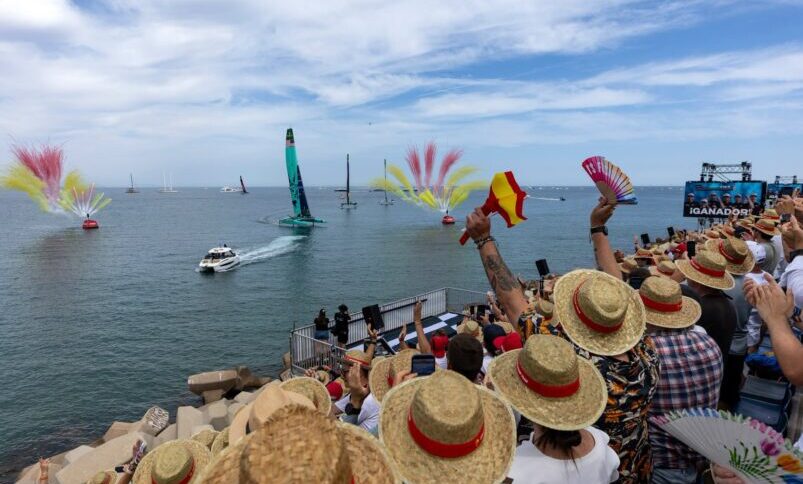

America steals victory from Australia as Valencia provides a spectacular – and sometimes frustrating – first taste of SailGP.Valencia has always had a taste for spectacular sailing.From the America’s Cup to the countless regattas staged along its waterfront, the city has a long relationship with high-performance boats. But even by Valencia standards, this weekend’s Spain Sail Grand Prix was something rather different. For two days, the Mediterranean became a racetrack as 13 national teams battled it out aboard identical F50 hydrofoiling catamarans – extraordinary machines capable of travelling at more than 100 km/h and literally lifting themselves above the water. And the first SailGP weekend in Valencia certainly did not disappoint.There was drama, speed, sunshine, light winds, Hollywood glamour, a brilliant Spanish performance on Saturday – and, ultimately, a cruel twist for the home team. The USA’s Taylor Canfield produced a sensational late comeback on Sunday to beat Australia and win the inaugural Valencia event, while Red Bull Italy made history by taking its first-ever SailGP podium.
For Spain’s Los Gallos, however, it was a case of what might have been.
 LOS GALLOS FLY HIGH – THEN RUN OUT OF WIND
Saturday could hardly have gone better for the Spanish team.
With thousands of supporters creating a home atmosphere around the Race Stadium, Diego Botín and Florian Trittel’s Los Gallos produced one of the performances of the season.
They won two of Saturday’s three races and finished second in the other, ending the opening day at the top of their group with 14 points.
The second race was particularly impressive, with Spain fighting off Denmark in a thrilling sprint to the finish.
The F50 Victoria appeared to be perfectly suited to the tricky Mediterranean conditions.
But SailGP has a cruel habit of reminding everyone that sailing is still sailing.
On Sunday the wind faded.
And when the wind disappears, these extraordinary boats lose their most spectacular characteristic: the ability to fly.
Los Gallos struggled to generate enough speed to get properly onto their foils and eventually finished fifth overall in Valencia, despite having looked like potential winners after Saturday’s racing.
It was a particularly frustrating result for a team that arrived in Valencia second in the championship and dreaming of a first home victory.
Still, Spain leaves Valencia second in the overall championship, with the season still very much alive.
 THE AMERICANS COME FROM BEHIND
The eventual winners were the United States, skippered by Taylor Canfield.
And their victory was anything but straightforward.
Australia’s BONDS Flying Roos, led by the hugely experienced Tom Slingsby, appeared to have the final under control.
The Australians led from the opening mark and looked set to add another event victory to an already remarkable season.
Then Canfield’s crew began to close the gap.
The USA passed Australia – only for the Australians to fight back and retake the lead.
With just one crucial manoeuvre remaining, the Flying Roos still appeared to have victory in their hands.
Then came the decisive move.
Canfield and his crew launched one final attack, found the extra speed and swept past Australia near the finish.
USA first. Australia second. Red Bull Italy third.
It was the kind of finish SailGP was invented for.
 A HISTORIC DAY FOR ITALY
If the USA provided the comeback story, Red Bull Italy provided perhaps the biggest surprise.
Italy claimed third place to secure its first-ever SailGP event podium since joining the championship.
And the achievement came after an extraordinary day in which the Italian boat also won two races.
It was a major breakthrough for a team that is still relatively new to SailGP – and Valencia’s unpredictable conditions clearly suited them.
 SO WHAT EXACTLY IS SAILGP?
If you watched the boats this weekend and wondered what on earth was going on, you were not alone.
SailGP is sometimes described as Formula 1 on water, and it is not a completely ridiculous comparison.
The teams race identical F50 catamarans, meaning that technological differences between boats are deliberately minimised. The result is supposed to put the emphasis on the sailors, tactics and split-second decisions.
The boats are around 15 metres long and use hydrofoils to lift the hulls out of the water.
When conditions are right, only the foils remain in contact with the sea and the boat effectively flies.
The result is spectacular.
And extremely fast.
The F50s can approach 100 km/h, with the sailors making constant adjustments to keep the boat balanced just above the water.
This is sailing compressed into short, intense races where a bad start can cost you everything.
Indeed, on Saturday every race winner led at the first mark, underlining just how difficult it was to recover after losing clean air.
 FORMULA 1 WITHOUT THE ENGINE
Perhaps the most fascinating thing about SailGP is that, despite all the technology, the basic ingredient remains completely natural.
Wind.
There is no engine.
No accelerator.
No brake.
No second chance if the breeze disappears.
And that was demonstrated perfectly on Sunday.
The same Mediterranean that had allowed the boats to fly on Saturday became frustratingly gentle, with some boats reduced to speeds of around 15 km/h.
The Americans, however, found a way to accelerate to approximately 35 km/h in the crucial final and turned that advantage into victory.
That unpredictability is part of what makes SailGP so compelling – but it also explains the disappointment felt by the Spanish camp.
 DEADPOOL VS WOLVERINE – VALENCIA STYLE
There was also a rather more Hollywood-style subplot.
Two of the world’s most recognisable actors, Ryan Reynolds and Hugh Jackman, brought their Deadpool vs Wolverine rivalry to Valencia.
The pair took part in a special SailGP showdown, with Reynolds representing the Canadian NorthStar boat and Jackman aboard Australia’s Flying Roos.
Reynolds came out on top.
The two actors are also investors in the Australian team, helping demonstrate just how far SailGP has moved beyond traditional sailing circles.
For a city accustomed to attracting celebrities during major sporting events, it was a suitably Valencian touch.
 VALENCIA: A NEW HOME FOR SAILGP
The most important story may ultimately be the simplest one:
SailGP is coming back.
Valencia has signed a three-year agreement to host the Spanish event, meaning this weekend was not a one-off experiment.
The city joins a growing international SailGP circuit featuring major waterfront destinations around the world.
And the choice makes considerable sense.
Valencia has the marina infrastructure, the America’s Cup legacy, the Mediterranean setting and, crucially, an audience that understands sailing.
The city’s first SailGP weekend was therefore about more than just two days of racing.
It was a test of whether Valencia could become another permanent stop on the international high-performance sailing circuit.
Judging by the atmosphere around the Marina, the answer looks promising.
THE FUTURE LOOKS GOOD FOR LOS GALLOSFor Los Gallos, there is no point pretending that fifth place was the result they wanted.
They came to their home Grand Prix with genuine championship ambitions and, for much of Saturday, looked capable of delivering the victory that the Valencia crowd wanted.
But they leave with something almost as valuable:
proof that they can compete at the very highest level.
The championship remains open, with Australia still leading and Spain firmly in contention.
And there are still three Grands Prix to come.
The next stop is Geneva later this month, followed by the final events of the season.
So Valencia may not have produced the home victory everyone wanted.
But it produced something arguably just as important for the future of the sport here:
a spectacular introduction to SailGP – and a very good reason to come back next year.
________________________________________
 FAST FACTS: SAILGP VALENCIA
 Where: Marina de València / Valencia waterfront
 When: 5–6 September 2026
 Winner: United States – Taylor Canfield
 Second:
  Australia – Tom Slingsby
 Third: Red Bull Italy Spain: Los Gallos – 5th overall Boats: F50 hydrofoiling catamarans
 Top speeds: Around 100 km/h
 Teams: 13 national teams Valencia: New SailGP host city for a three-year agreement Next stop: Geneva, September 19–20
The verdict: Valencia may not yet have produced its first Spanish SailGP winner – but it certainly produced a weekend worth watching.
Report by ‘24/7 Valencia’ team
Article copyright ‘24/7 Valencia
Photo copyright Benjamin Rosewall for SailGP
Related Post
















Leave a comment