

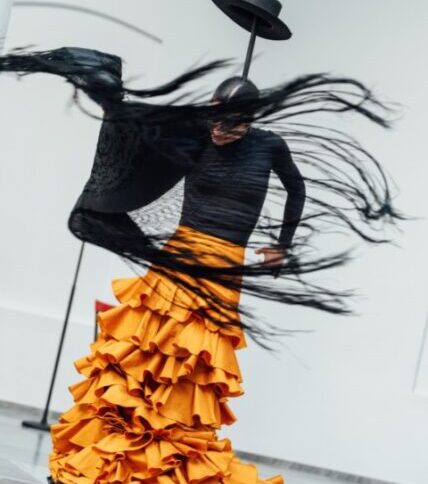
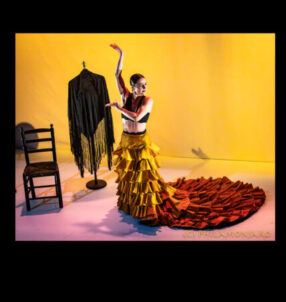
To celebrate 9 d’Octubre, the performance on this day at the Teatro Rialto will be free of charge. Invitations can be collected at the physical box office and online, with a maximum of two invitations per person until capacity is reached. How would you dance if you couldn’t hear? On stage, a dancer traverses three universes: the vibration that travels through the body, memories that blur, and a return to childhood, to play, and to wonder. This dance solo explores new ways of listening, perceiving, and communicating. An accessible proposal for deaf people that transforms flamenco dance into a path to awaken emotions, recover memory, and reimagine.
Irene de la Rosa is a Valencian creator, bailaora, and teacher, graduated in Spanish Dance, Law, Business Administration, Dance Pedagogy, and holds a master’s in Cultural Management. She directs her own company and develops her work from contemporary flamenco, in dialogue with contemporary dance and interdisciplinary creation. Her research explores new scenic languages surrounding the body, memory, and identity, with special attention to accessibility, cultural mediation, and the creation of new audiences.
Antoñita is born from a personal need: to rediscover myself, to accept my circumstances, and to dream again. The process began with *Vibrar* and a question: how would you dance if you couldn’t hear? By researching vibration as a form of presence, communication, and listening, and thanks to working with the FESORD deaf community, I understood that listening does not belong solely to the ear and that there are other paths to reach movement.
From that vibration, memories began to emerge, like distant sounds that hide when I try to reach them. In reality, they were non-memories, black holes in the memory. I remember that I don’t remember. Don’t you have the feeling that certain memories leave? That they abandon us?
From there, *La Múa* is born, a journey to traverse the sadness caused by those memories that our minds believe they have forgotten.
And, from the darkness, the girl reappeared—the one who danced to play, to imagine, and to understand the world. What seemed like an end became a new beginning. For me, Antoñita is a way to remember where I come from, recover my illusions, and look toward the future from a different place. I hope the audience also finds a space to recognize themselves, to dream, and to wonder: what did you use to play at when you were little?
TICKETS: https://ivc.sacatuentrada.es/va/productos/descripcion/anto%C3%B1ita
Report by Will McCarthy
Article copyright ’24/7 Valencia’
Irene de la Rosa
Company: Cía. Irene de la Rosa
Authorship, production, performance, and direction: Irene de la Rosa
Stage direction: Mariana Collado
Choreography and accompaniment: Jacob Gómez, Mariana Collado, and Rosa Sanz
Musical composition: Pantera Acosta, Miguel Jiménez, and Rosa Sanz
Production assistant and mediation activities coordinator: Marta Sofía Gallego
Lighting design: Ximo Rojo
Technical direction and scenography: Marcos Orbegozo
Audiovisual creation: Medusa
Stage manager: María Sorribes and María Martí
Accessibility collaboration: FESORD CV – Federación de Personas Sordas de la Comunitat Valenciana; Asociación de Sordos de la Axarquía (A.S.-AX), Vélez-Málaga
Accessibility advisory and sign language teaching: Aurora López and Alba Mesa
Bata de cola: José Galvañ
Costume making: Mi Niña Lola
Photography: Antonio Portillo
Poster design: Pilar Estrada
Press and communication: Elena Sanz and Eva María Marqués
Artistic Residency
Show developed during the “In Progress” residency, organized by the Fundación Concienciarte, Flamenco Festival, and the Torrox City Council.
This project has received the support and collaboration of:
Ministerio de Cultura · Ajuntament de València · Institut Valencià de Cultura · Dansa València · Espai LaGranja · Festival Bucles · Festival 10 Sentidos · La Rambleta · Museu de Belles Arts de València · CC La Reina 121














Leave a comment