

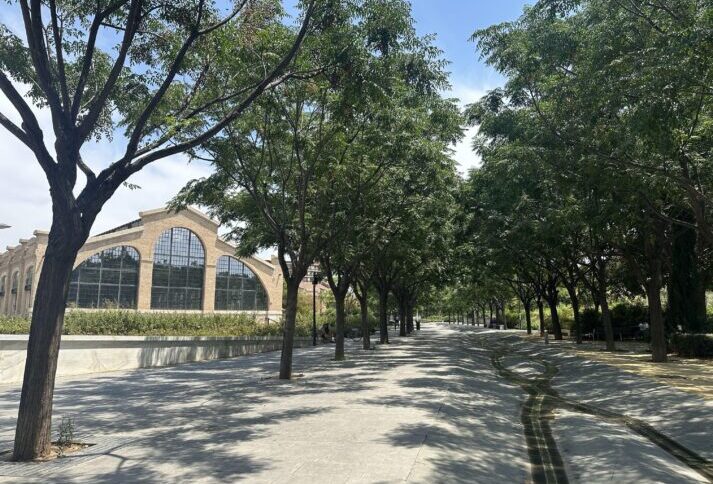

There is a version of urban renewal that announces itself loudly, with press releases and ribbon cuttings and renders that promise more than the finished thing can deliver. And then there is Parque Central, which sits quietly between Ruzafa and Malilla and simply gets on with being one of the most thoughtfully made public spaces in any Spanish city. I went on a weekday morning, and left with the feeling that Valencia has been quietly hiding one of its best kept secrets in plain sight.
Where It Came From
The story behind Parque Central is as interesting as the park itself. For most of the 20th century, the land on which it now sits was occupied by railway lines and industrial infrastructure, a scar running through the middle of the city that physically divided the neighbourhoods on either side of it. Residents on the Ruzafa side and those on the Malilla side were separated by tracks for decades, and the idea of reclaiming that land for public use was discussed for more than thirty years before it actually happened.
The solution was to bury the high-speed train lines underground, freeing up the surface land for transformation. The city launched an international design competition in 2011, won by the landscape architecture firm Gustafson Porter and Bowman, who beat out entries from Zaha Hadid, Rogers Stirk Harbour and Partners, and West 8 among others. Construction took eight years. The first phase, covering 11.5 hectares, finally opened in 2019, and the completed park will eventually cover 23 hectares once the remaining phases are finished, with the total project representing a 73 million euro investment in new public space for the city.
The Design
The first thing you notice walking into Parque Central is the water. The entire design is inspired by a poem by the medieval Valencian writer Ausiàs March, Aigua plena de seny, which translates as water full of wisdom, and that influence is visible at every turn. Water pools, channels, jets, and pathways thread through the whole park, keeping the temperature noticeably lower than the streets outside and giving the space a quality of sound that is genuinely calming.
The park is organized around a series of large bowl- shaped depressions in the landscape, called ullals in Valencian, a word for natural springs. These sculpted landforms reference Valencia’s long tradition of ceramics and earthenware, and they define the different zones within the park: the Children’s Garden, the Romantic Garden, the Flower Garden, the Orchard Garden, and the Demetrio Ribes Arts Plaza, each with its own character and planting palette but all connected by the same materials running throughout, marble, granite, and Calatorao limestone typical of the Valencia region.
The planting itself is one of the park’s greatest achievements. More than a thousand trees, 85,000 shrubs, and 13,000 planters fill the space with native and Mediterranean adapted species that make the park feel genuinely alive rather than decorative. Coming in July, the colour and density of the planting is extraordinary, a wall of green in a city that can feel relentlessly sun baked by midsummer.
The Old Buildings
One of the most unexpected pleasures of the park is what has been kept rather than built. Several of the original railway buildings have been preserved and restored, including the old Alquería farmhouse at the heart of the park, now used as offices for the park management, and a series of industrial era structures that provide a quiet historical counterpoint to all the new landscaping. There is something genuinely moving about standing in a space this green and carefully designed and being reminded by the surviving architecture that this was once a working railway yard.
What It Feels Like
On the morning I visited, the park was doing exactly what good public space is supposed to do. Dog walkers were circling the main water feature near the entrance on Calle Filipinas, where the dogs have a dedicated pool. A group of older men were occupying a set of benches in a way that suggested they had been doing so every morning for months. A few parents were at the children’s playground with small kids. Some people were running. Most were just sitting in the shade.
The park is not trying to be spectacular in the way that Valencia’s other great green space, the Turia Gardens, is spectacular. It is quieter and more intimate than that, designed for daily use rather than tourist photography, which is part of what makes it so good. The Turia feels like a civic achievement you visit; Parque Central feels like somewhere you would come every morning if you lived nearby.
What it has already done for the surrounding neighbourhood is equally visible. Ruzafa, already one of Valencia’s most creative and liveable barrios, has continued to grow in the years since the park opened, with the new green space pulling life and energy into the streets around it. The connection between the two, a well-designed park and a thriving neighbourhood, is not a coincidence.
It is a city getting something right. Worth an afternoon of anyone’s time in Valencia, not because it is famous, but because it is genuinely good.
Report by Faith Callaway
Article copyright ‘24/7 Valencia’
Photos copyright Faith Callaway/ 24/7 Valencia
Parque Central
Main entrance, Calle Filipinas, Ruzafa, 46006 Valencia.
Opening hours, summer, 8.00 to 21.00. Winter, 8.00 to 19.00.
Entry free.
Getting there, metro lines L1, L2, and L7. Bus lines 8, 27, and 64.











Leave a comment